Rabat – Recent research conducted by professors from Rabat Business School (UIR) has explored the grand challenges of the introduction of Artificial intelligence (AI) in higher education.
Experts in the field confirm that AI technology is redefining the whole landscape of higher education. The question that arises today is: how this change will take place in the next 10 years?
It is obvious that AI technology with all its variants, such as Large Language Models, machine learning, and deep learning, is changing higher education in terms of learning, teaching and administrative services.
AI technology has the potential to revolutionize higher education in the African context.
Indeed, several African countries seems to have the willingness to develop AI capabilities to make a better development.
For example, a survey-based study shows that more than 50% of academic institutions in Morocco have experimented AI. The same study also shows also that 67% of educators are using AI in both teaching and research and that more than 40 % of students are familiar with AI tools, in particular Chat-GPT.
Despite the growing number of studies on this topic, it is not yet clear how this technology will impact the world of higher education. Indeed, the use of this technology remains limited at present for several reasons. These include, but are not limited to investment cost, risk of non-return on investment, problems linked to data confidentiality and ethics.
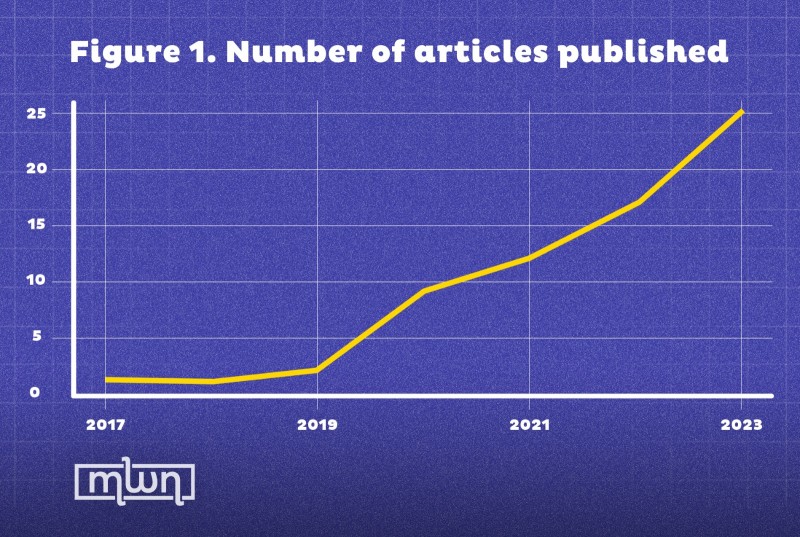
In order to have a best understand of the effect of AI technology on higher education, we performed an exploratory study based on a bibliometric and a content analysis covering 67 academic articles published between 2017 and 2023.
The findings of this study allowed us to identify different applications of AI in higher education, which can be classified according to three perspectives: students, educators and administration. Furthermore, the content analysis of previous research allowed us to identify the opportunities and threats linked to each perspective (see Table 1).
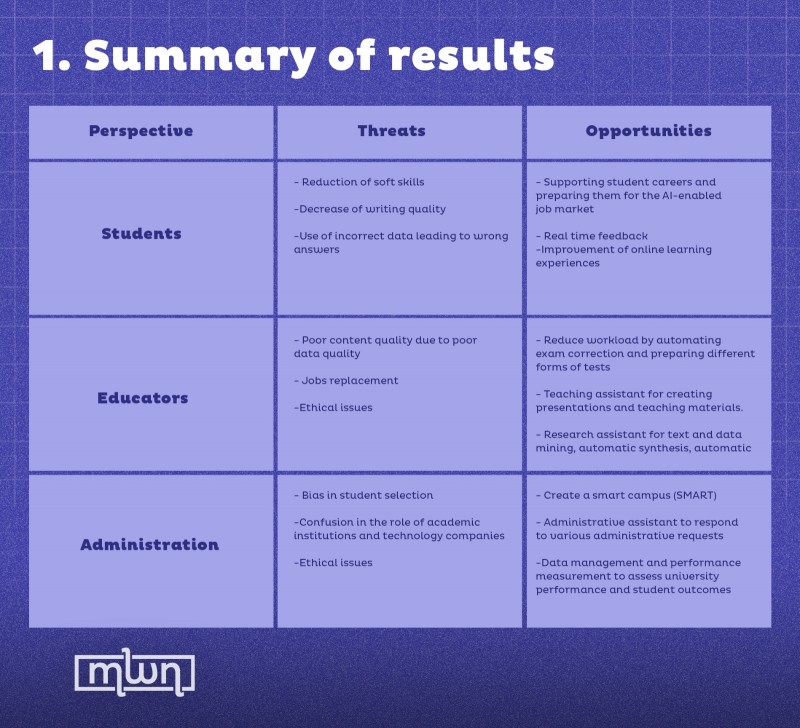
By analysing the opportunities and threats of AI in higher education in this first stage of our research, we look to contribute in the development of AI responsible use framework in higher education in the particular context of Africa.
The study is co-authored by
Kerim Karmeni, Rabat Business School, UIR, Morocco
Tariq Ahmed, Rabat Business School, UIR, Morocco
Abdelkader Hammadi, Skema Business School, France
Gregory Paulin Mvogo, Essec Business School, University of Douala, Cameroun
Nadia Karmani, Research Groups on Intelligent Machines (REGIM),
National Engineering School of Sfax (ENIS), University of Sfax, Tunisia
References
Bearman, M., & Ajjawi, R. (2023). Learning to work with the black box: Pedagogy for a world with artificial intelligence. British Journal of Educational Technology, 54(5), 1160–1173. https://doi.org/10.1111/bjet.13337
Huang, C., Samek, T., & Shiri, A. (2021). AI and Ethics: Ethical and Educational Perspectives for LIS. Journal of Education for Library and Information Science, 62(4), 351–365. https://doi.org/10.3138/jelis-62-4-2020-0106
Martín-Núñez, J. L., Ar, A. Y., Fernández, R. P., Abbas, A., & Radovanović, D. (2023). Does intrinsic motivation mediate perceived artificial intelligence (AI) learning and computational thinking of students during the COVID-19 pandemic? Computers and Education: Artificial Intelligence, 4, 100128. https://doi.org/10.1016/j.caeai.2023.100128
Moukhliss, G., Lahyani, K. & Diab, G. (2024). The impact of artificial intelligence on research and higher education in Morocco. Journal of Education and Learning (EduLearn). DOI: 10.11591/edulearn.v18i4.21511
Rodway, P., & Schepman, A. (2023). The impact of adopting AI educational technologies on projected course satisfaction in university students. Computers and Education: Artificial Intelligence, 5, 100150. https://doi.org/10.1016/j.caeai.2023.100150