


 Join on WhatsApp
  Join on Telegram
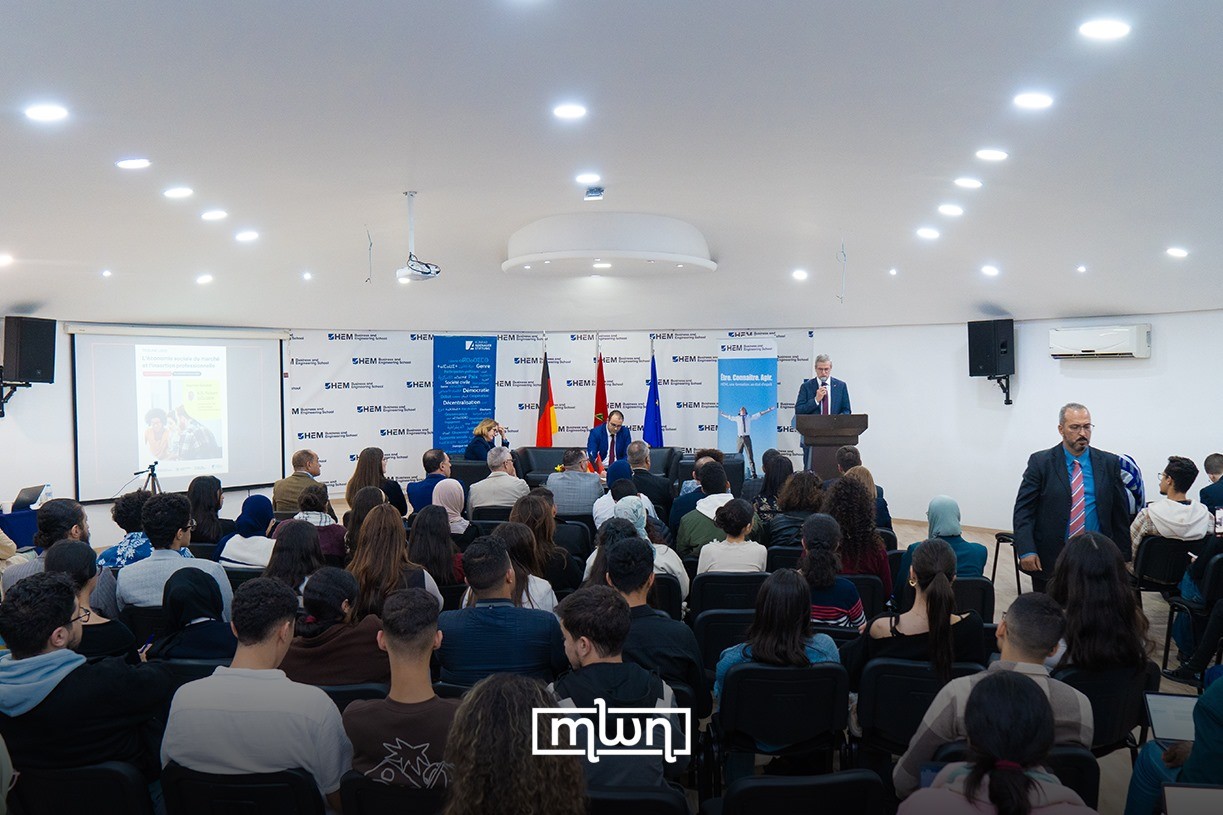
 Rabat – The future of professional integration and sustainable economic development was the focus of a high-level event held today in Rabat, where influential figures gathered to discuss the evolving challenges of employment in the context of global economic change.
The event focused on the theme of “The Social Market Economy and Professional Integration,” with Germany’s Ambassador to Morocco, Robert Dölger, offering a keynote address that explored the principles of the social market economy and its relevance in today’s world.
Dölger’s speech highlighted Germany’s dual vocational training system as a key mechanism for ensuring social mobility and economic success, stressing the importance of adapting the model to address modern-day challenges like the climate crisis.
A German perspective on economic integration
Ambassador Dölger’s speech explored the concept of the social market economy, which has been a cornerstone of Germany’s post-war recovery.A

He outlined how the model combines economic freedom with social policies designed to ensure that all members of society benefit from economic progress.
The state, he explained, plays a crucial role in regulating markets to protect the common good while promoting social stability.
“The social market economy is a system where free market competition is complemented by social policies that aim to ensure prosperity is distributed equitably across society,” Dölger said in his remarks. “This model’s success is not just about economic growth; it’s about creating a fairer, more cohesive society.”
Dölger also traced the historical origins of the concept, noting that it emerged in Germany after World War II as a response to the failures of state-controlled economies and the rise of Nazism.

“Post-war Germany had to decide whether to adopt a planned economy or one based on free market principles,” he explained. “The social market economy helped Germany recover from economic turmoil and political crises, ensuring both growth and social solidarity.”
Addressing modern economic challenges
The ambassador asserted that while the global economy has changed, the core principles of the social market economy remain relevant, especially in the face of modern challenges such as the climate crisis.
“In today’s world, we need more than a free market to address the climate crisis. We need a balance of state regulation and social policies,” Dölger said, expressing the need for systemic changes to protect both the environment and workers.

Welcoming of the ambassador
He pointed out that the success of the social market economy was not just due to economic principles but also the shared values of individual freedom, responsibility, and social solidarity. These values, he argued, are fundamental to building a stable and prosperous society.
The dual training system: A key to integration
A significant portion of Dölger’s speech focused on Germany’s dual training system, which combines hands-on vocational training with formal education.
This system, he argued, plays a pivotal role in professional integration and social mobility by offering young people practical skills and work experience.
“This system helps individuals gain not only technical skills but also the values and experiences needed for professional growth,” Dölger explained. “It is a model of education that values both practical and theoretical knowledge.”

The ambassador noted that the dual training model has helped Germany maintain one of the lowest youth unemployment rates in Europe and has been crucial in creating opportunities for social mobility.
However, Dölger also acknowledged that the system faces challenges, particularly as more parents now encourage their children to pursue university degrees instead of apprenticeships.
Moroccan-German cooperation in vocational training
Dölger also discussed the growing interest among young Moroccans in pursuing vocational training opportunities in Germany. “Around 80% of visa applicants from Morocco to Germany are seeking apprenticeship programs,” he revealed.

He said that for successful integration into German society, it is not enough for migrants to be professionally qualified; they must also understand German language and culture.
“As Germany continues to attract skilled workers, it is essential that young Moroccans are not only equipped with the necessary professional qualifications but also prepared linguistically and socio-culturally,” Dölger said. “The dual training system provides more than just technical knowledge; it teaches the values of German society, contributing to integration and social mobility.”
In closing, Dölger expressed his optimism for the future of Moroccan-German cooperation, particularly in the field of vocational education.
“In 2024, around 3,000 young Moroccans will begin their training in Germany, opening up new avenues for them to achieve their professional goals,” he concluded.
The event was hosted in a collaborative effort between LCI Education’s Moroccan branches, HEM Business & Engineering School and LaSalle College, and the Konrad-Adenauer-Stiftung Foundation.


