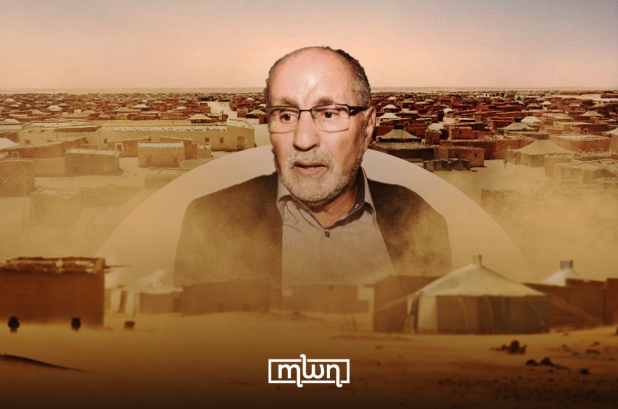
Rabat – Morocco mourns the passing of Captain Ali Najab, who died of natural causes on November 26 at the age of 81. Although his life has come to an end, his legacy will endure in the memories of those who witnessed his struggle for freedom, and his unwavering bravery, which became a symbol of patience, resilience and the pursuit of justice.
Najab’s story was marked by 25 years of imprisonment in the brutal Polisario-run camps in Tindouf, Algeria.
His story serves as a reminder of the long-standing suffering endured by countless individuals detained by the separatist group. The Polisario Front is backed by Algeria – a country that continues to refuse to shoulder its responsibility in the Western Sahara dispute despite its direct involvement and interference in Morocco’s territorial integrity.
Who is Captain Najab?
Najab dedicated his life to defending and campaigning for Morocco’s territorial integrity, exposing Polisario’s crimes and hostilities.
The Moroccan war hero joined the Royal Air Force in 1965, and was captured on September 10, 1978 after his Mirage F5 was hit by a surface-to-air-missile. He subsequently spent 25 years as a prisoner, facing unimaginable brutality.
Najab endured torture, humiliation, and starvation by the Polisario Front, which has been committing war crimes, terrorist attacks, and human rights abuses for decades.
A native of Ait Ourain tribe in the Atlas mountains, Najab has shed light on his story of survival in several interviews, books, and documentaries. His testimony paints the reality of the inhumane conditions as well as the psychological and physical toll he experienced in the Tindouf camps.
In a 2020 interview, Najab spoke about that fateful day in 1978 when his plane was hit and the brutality he survived after his arrest for 25 years until his release date in 2023.
He said once he was captured three Algerian officers entered and immediately transferred him to Tindouf, throwing him into a cell on the ground floor.
“Since 1976, the Algerians had been bringing Moroccan prisoners to northern Algeria,” he said in the interview with Moroccan news agency MAP.
In 1979, Algeria transferred pilots to Tindouf and handed them over to the Polisario.
He also explained how Algeria’s regime had full control of the area and how much control Algerians had over Polisario’s creation.
Najab has also shared what he endured during his imprisonment in Tindouf in his book “25 Years in Jails of Tindouf: My Memoirs as a Prisoner of War.”
In his autobiography, the author calls the Polisario attack a “decisive, even fatal, turning point in my life and in my military career.”
The captain’s career was decorated even before his capture. Najab has had intensive training as a fighter pilot, and served as the chief of a squadron of F5 planes and chief operations officer at the Moroccan air base in Laayoune.
In his book he talks about how Polisario jailers subjected all prisoners to inhumane treatment, with some of them dying due to lack of health care.
Exposing torture used in the Tindouf prisons, he recalled that prisoners were used to broadast anti-Moroccan propaganda on the radio or to the press.
Najab has shared that it is his duty to share his experience so Moroccans have more knowledge about his history, noting that he feels personally disturbed when he meets people who do not know about the Sahara dispute.
Mourning the warrior
Najab’s death is being mourned by a large community, including Moroccans, the press and even former members of the Polisario – the very group that captured him.
Bachir Dkhil, a former member and founder of the Polisario Front mourned his death in an emotional post, describing Najab as a “great friend and an honorable man.”
“A person who gave everything for his country and his friends, of which I am one. Ali Najab, the unwavering fighter,” Dkhil wrote on Facebook.
Describing him as “a warrior with words and a sincere smile,” Dkhil said he met Najab where “ freedom is a sin.”
“He was a military pilot, imprisoned in the gloomy dungeons of the Polisario, and he generously taught English to the children I myself taught at the Duce d’Octobre prison school,” Dkhil added.
Dkhil said he liked Najab since the first day he met him when he was poorly introduced to him by a guard.
“Fate allowed me to meet such extraordinary men. I lost sight of him until 2008…,” Dkhil said, recalling the day when he proposed the idea of traveling to the US to raise American public opinion about the liberation of 400 Moroccan military prisoners held in Rabouni.
“Ali Najab never hesitated to get involved in this task, which eventually led to the liberation of those enslaved in Tindouf,” Dkhil said, extending his condolences to all victims of Polisario’s war crimes and brutality.
In a documentary aired on Morocco’s television channel 2M, Najab’s story and struggle resounded, showcasing how the Algerian backed Polisario acts and torture of individuals.
The documentary, aired in 2017, showcased Najab’s bravery, documented through his words and his life of service dedicated to Morocco.
“It would be a crime to die and disappear without leaving any testimonies of what we lived- what I lived with my comrades- what I did in the south during the war,” he said in the film.
He also shared disturbing events he experienced, including when the Polisario would tie his and his comrades’ feet on their backs and tighten their arms with ropes until they started yelling from pain.
“The cell was a half meter large, a meter and a half long. There was no ceiling but there was a metal door…when they came to unite us, they would beat us up, and they would beat us again hard every time, even when they gave us food,” he added.
Lack of accountability
Despite the documented war crimes and inhumanity in the Tindouf camps, where thousands of Sahrawis are being held in deteriorating humanitarian conditions, members of the Polisario involved in these atrocities remain at large, backed and protected by Algeria’s regime.
The Algerian government has exploited the ongoing dispute to interfere in Morocco’s domestic affairs for years. However, despite numerous UN reports, resolutions, and calls from the international community, Algeria’s regime continues to shirk responsibility, evading accountability for its actions.
Polisario leadership, including its leader Brahim Ghali, has long been the subject of trials for war crimes and arrest warrants, including those related to terrorist acts committed by the separatists.
Moroccans are not the only victims. Spanish individuals victim to similar attacks have also been demanding the immediate arrest of Ghali – who use false identity and forged documents to evade justice, including in Spain.
Ghali has been facing trials for attacks on Spanish workers and for orchestrating the assassinations, kidnappings, and disappearance of several Spanish sailors from 1973 to 1986.
Several NGOs and civil society services have condemned Ghali’s acts, calling on Spanish authorities to arrest the separatist leader.