
 Join on WhatsApp
 Join on Telegram
Rabat – Between December 26 and 31, 2024, the Moroccan dirham experienced a modest decline, depreciating by 0.5% against the US dollar and 0.6% against the euro.
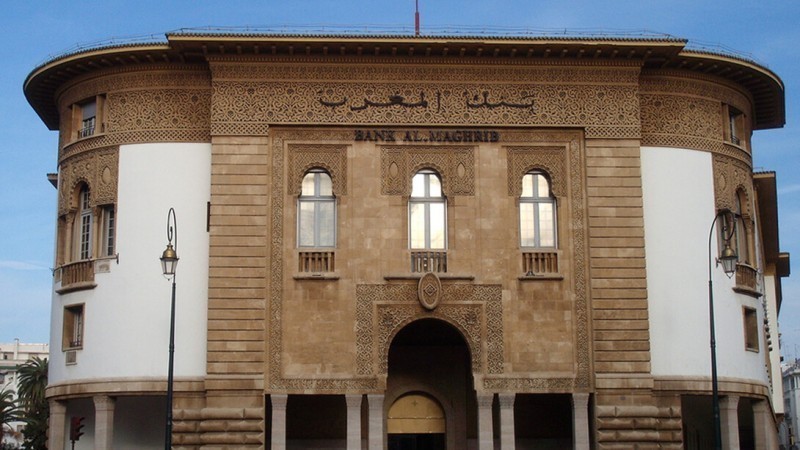
Bank Al-Maghrib (BAM) noted in their report that this adjustment in the exchange rates signals a slight weakening of the local currency in global markets.
During this period, Bank Al-Maghrib (BAM) chose not to conduct any foreign exchange auctions, which are typically used to regulate currency supply and maintain stable exchange rates.
As of December 27, 2024, Morocco’s official reserves stood at MAD 375.2 billion ($37 billion).
This marked a 0.6% uptick from the previous week and a 4.6% rise compared to the same time the previous year. This potentially signals a strengthening of the country’s financial position despite the dirham’s recent depreciation.
In the final week of 2024 and early 2025, BAM injected an average of MAD 156.6 billion ($15.5 billion) daily to support liquidity.
This amount was distributed across various forms of assistance: MAD 72.6 billion ($7.2 billion) in short-term loans, MAD 49.6 billion ($4.9 billion) in longer-term repurchase agreements, and MAD 34.4 billion ($3.4 billion) in secured loans.
Read Also: Floating the Moroccan Dirham: Challenges and Opportunities in 2026
On the interbank market, daily trading averaged MAD 5 billion ($USD 500 million), with the borrowing interest rate between banks standing at 2.51%. This suggests a stable liquidity environment within the banking sector.
Meanwhile, in the stock market, the Moroccan All Shares Index (MASI) saw a 1.1% decline over the same period, reducing its year-to-date performance to 22.2%. Despite this overall drop, certain sectors posted positive results.
The real estate sector surged by 8.4%, while the agro-industrial sector gained 2.9%.
Additionally, the construction and building materials sector rose by 1.3%, and the banking sector saw a modest 0.5% increase. However, the telecommunications sector struggled, falling by 3.2%.
Trading volume on the stock exchange saw a sharp decline, dropping from MAD 11 billion ($1.1 billion) the previous week to MAD 7.3 billion ($730 million).
A major portion of this decrease came from block market transactions, which accounted for MAD 4.4 billion ($440 million), while MAD 2.9 billion ($290 million) was traded on the central market.
In simpler terms, while the Moroccan dirham weakened slightly, the country’s foreign reserves grew, and BAM took action to keep the financial system well-funded. On the stock market, some sectors performed well, but overall, trading slowed down.