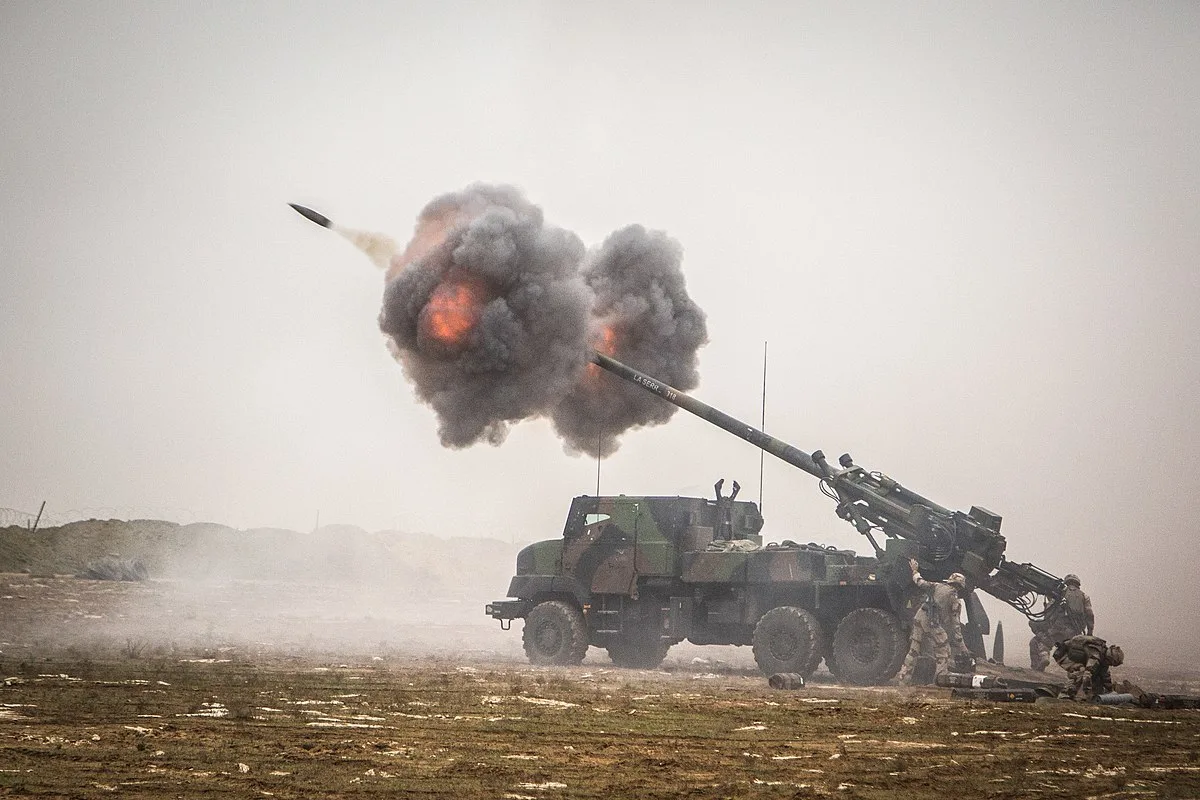
Doha – French defense manufacturer KNDS (formerly known as Nexter) has acknowledged technical problems with Caesar artillery systems delivered to Morocco, leading to its second failed contract with Rabat, which opted to purchase Atmos 2000 howitzers from Israeli Elbit Systems.
During a hearing at the French National Assembly on Wednesday, Alexandre Dupuy, Director of Systems Business Unit at KNDS, detailed the circumstances that led to Morocco’s shift toward sourcing the military equipment from Israel.
The revelation comes after French newspaper La Tribune first reported Morocco’s decision to acquire 36 Atmos 2000 self-propelled howitzers from Israel’s Elbit Systems.
“The Moroccans observed some operational and reliability issues with certain subassemblies, particularly hydraulic components. These subassemblies are not manufactured by us but through the subcontracting chain,” Dupuy explained during his testimony.
The problems emerged after Morocco received its first batch of Caesar systems in 2022, a delivery that coincided with KNDS’s increased production commitments for Ukraine.
The timing of these technical issues proved particularly challenging for KNDS. “We had to produce new equipment at a time when we were already at maximum production capacity for the ramp-up for Ukraine,” Dupuy stated.
He acknowledged that while KNDS mobilized to identify and address the problems, the process was complex, requiring on-site firing tests and technical evaluations.
“These operations took some time,” Dupuy admitted during the hearing, conceding that the Ukraine conflict’s impact on production capacity had also played a role in the delays and complications encountered.
A shift for technical reasons, not political
Morocco had initially ordered 36 Caesar pieces in 2022 in a contract valued at €170 million, which included 30 million in ammunition and training for Royal Armed Forces (FAR) personnel. However, recurring technical problems led to multiple complaints from FAR to the French group.
Dupuy insisted that the technical difficulties have since been resolved, stating, “Today, both regiments are fully operational, and we are proud to equip the Moroccan armed forces. They are members of the Caesar club and will continue to benefit from the improvements we make to Caesar.”
In this context, the KNDS executive insisted that Morocco’s decision to opt for Elbit Systems’ Atmos 2000 was primarily driven by technical capabilities rather than political considerations.
The Israeli manufacturer offered a combined solution featuring both cannon and rocket launcher capabilities, which KNDS could not match. “It’s not that Morocco chose Elbit, but rather that Elbit proposed a different offer, with faster development capability,” Dupuy explained.
According to the Stockholm International Peace Research Institute (SIPRI), Israel has become Morocco’s third-largest military equipment supplier, providing more than 11% of its armament.
The developments interlace with Morocco’s broader military modernization efforts. Recent reports in the country’s official bulletin indicate that Turkish firm Baykar may establish the first Bayraktar drone manufacturing facility in Africa on Moroccan soil.
The North African country has already acquired eighteen Bayraktar TB2 drones and is expected to receive the next-generation Akinci model. Morocco’s defense budget also saw a 7% increase in 2025 compared to the previous year.
This case mirrors a similar situation in Denmark, where Elbit Systems successfully used the same strategy of offering combined artillery and rocket launcher capabilities to secure a contract over KNDS France.
Despite the setback, Dupuy maintained that the initial Caesar systems supplied to Morocco remain operational, and the country will continue to receive technical updates as part of the “Caesar club.”
However, the episode exacerbates the intensifying competition in the global defense market and the necessity of comprehensive weapons systems capabilities in securing military contracts.
Experts describe Morocco’s approach to arms procurement as “pragmatic,” prioritizing efficiency and strategic adaptability over ideological alignment.
Read also: Morocco Acquires Advanced Chinese TB-001K Combat Drone