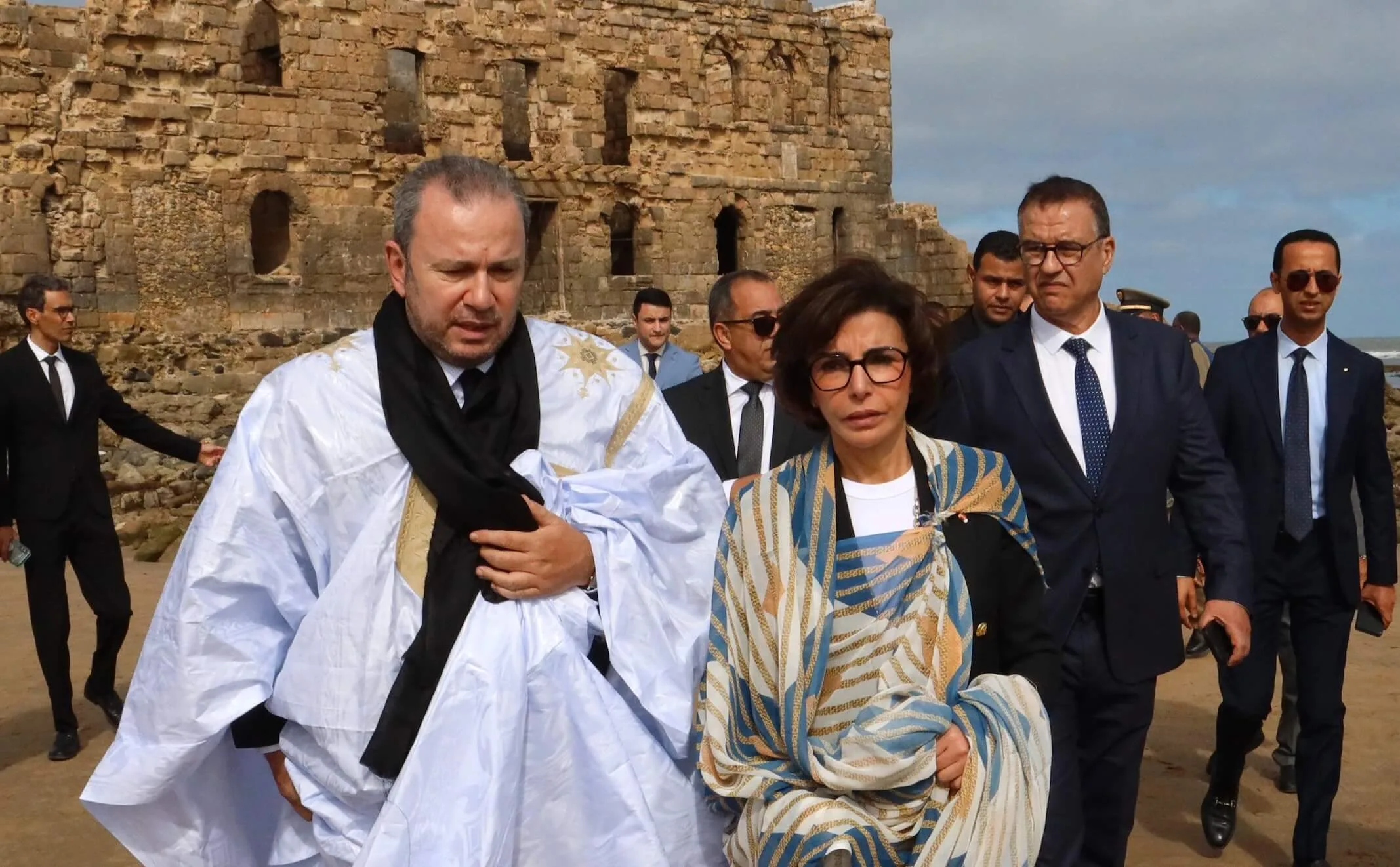
Doha – Algeria’s foreign ministry unleashed a barrage of accusations Tuesday against French Culture Minister Rachida Dati’s historic visit to Laayoune, blasting what it termed a “flagrant disregard for international law” by a permanent Security Council member.
In an inflammatory statement, Algeria’s foreign ministry – which continues to back the Polisario Front separatists’ claims against Morocco’s territorial integrity – condemned the first-ever visit by a French government official to the region.
The ministry alleged that the visit “helps consolidate the Moroccan status quo in Western Sahara” and branded France as “an old colonial power showing solidarity with a new one.”
The statement further denounced the visit as “particularly serious” and “condemnable on multiple levels,” claiming it concerned “a territory where the decolonization process remains unfinished and where the exercise of the right to self-determination remains unfulfilled.”
The ministry also accused the French government of “further disqualifying itself and isolating itself from United Nations action aimed at expediting a settlement of the Western Sahara conflict based on strict respect for international law.”
Although Algeria purports to be a distant observer in the dispute, its ministry keeps betraying its deep involvement by launching into an extended tirade against France’s diplomatic shift, going as far as describing Dati’s visit as “provocative.”
Dati’s arrival in Laayoune on Monday, where she inaugurated a French Alliance center and visited the Mohammed VI library, reaffirmed France’s resolute support for Morocco’s sovereignty over its southern provinces.
The visit sent shockwaves through Algiers, which maintains its destabilizing backing of the Polisario Front’s separatist agenda.
“This is a historic visit because it’s the first time a French minister has come to the southern provinces,” Dati declared. “The present and future of this region fall within the framework of Moroccan sovereignty.”
The visit builds on French President Emmanuel Macron’s watershed declaration in July 2024 supporting Morocco’s autonomy plan under Moroccan sovereignty, followed by his October state visit where he pledged France’s full diplomatic engagement to advance Morocco’s position at the UN and within the European Union.
Dati, who was part of Macron’s delegation during the October visit, has emerged as a key figure in cementing Paris’ backing for Morocco’s territorial integrity.
Adding to what is perceived as a controversy in the neighboring eastern country, Dati faced an Islamophobic attack from Malika Sorel, a National Rally Member of the European Parliament of Algerian origin.
Sorel targeted Dati for displaying a photo of a woman wearing hijab – reportedly Dati’s mother – in her office, attempting to undermine the minister as she reinforced France’s support for Morocco’s territorial integrity.
Culture meets diplomacy
During her two-day official tour, Dati, accompanied by Moroccan Culture Minister Mohamed Mehdi Bensaid, executed a carefully planned itinerary across the southern provinces.
The minister, who frequently expresses her “personal attachment” to Morocco where her father was born, views the cultural cooperation as a bridge between the two countries.
“Today, we are implementing one of the cooperation agreements signed between Morocco and France in the field of cinema,” Bensaid declared at the occasion, recalling King Mohammed VI’s special interest in strengthening human capital in the cultural field.
In Tarfaya, she toured the historic Kasbah constructed in 1938 and the Casa Mar fort, before visiting the Antoine de Saint-Exupery Museum, which commemorates the French writer’s 1927 stay during Aeropostale missions.
The centerpiece of her visit materialized in Dakhla, 500 kilometers south of Laayoune, where she launched a regional branch of the Higher Institute of Cinema Professions (ISMAC).
Bensaid asserted that “our partnership with France represents an important opportunity to learn from French experience and acquire new cinematographic techniques that will strengthen youth training in cinema and audiovisual professions.”
“My visit as French Minister of Culture to Dakhla carries a very strong political meaning,” Dati added, underlining the expanding cultural partnership between France and Morocco.
The diplomatic friction intensifies amid broader regional tensions, as Algeria’s regime recently refused to accept a deported influencer from France.
French Interior Minister Bruno Retailleau responded by accusing Algeria of attempting to “humiliate France,” stating that “we have reached an extremely concerning threshold with Algeria.”
The visit also witnessed the signing of a strategic partnership between the Royal Moroccan Federation of Aerobics Sports, Fitness, Hip Hop and Related Disciplines (FRMSAFH) and the French Embassy in Morocco, aimed at developing Breaking practices throughout the kingdom.
In October 2024, the UN Security Council, with support from 12 of its 15 members, adopted a resolution calling for a “realistic and mutually acceptable” solution to the territorial dispute.
The resolution came as Algeria continues to obstruct the UN-led political process by supporting separatist claims in Morocco’s southern provinces.
“Thanks to the inauguration of this establishment, an important cultural dynamic will be triggered in the city of Dakhla, which is full of enormous natural potential, thus attracting many national and international filmmakers,” Bensaid added, outlining his vision for the region’s cultural development.
Read also: Algeria’s President Still Seething Over France’s Western Sahara Decision