
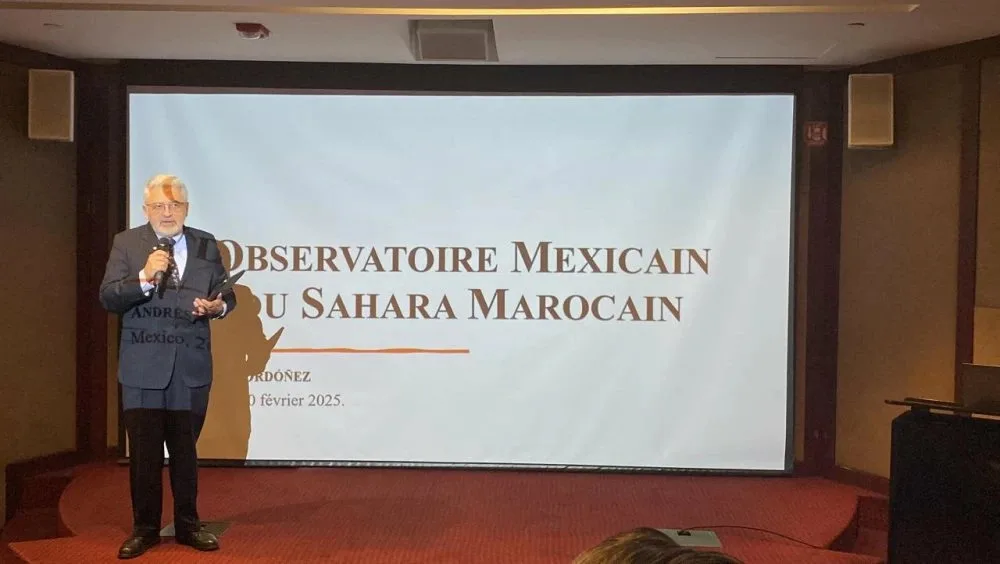
Doha – Mexico City saw on Thursday the launch of a new platform dedicated to advocating for Morocco’s territorial integrity in Latin America.
The Mexican Observatory for Moroccan Sahara brings together prominent academic, political, and intellectual figures to advance understanding of the Sahara issue and promote Morocco’s autonomy plan as a solution to the regional dispute.
Maria Reyna Carretero, president of the Observatory and professor at the National Autonomous University of Mexico, stressed that the launch comes amid growing international support for Morocco’s position on the Sahara issue.
The platform aims to provide the Mexican public with accurate information about the autonomy plan, which Morocco has presented as a solution for the dispute.
Addressing an audience that included Morocco’s Ambassador to Mexico, Abdelfattah Lebbar, Carretero presented the initiative as an essential step towards cementing the already strong and evolving diplomatic relations between Morocco and Mexico.
“The Observatory will serve as a hub for promoting bilateral relations, reflecting the strong commitment to dialogue and understanding between our two countries, which share numerous historical and civilizational commonalities,” she asserted.
Observatory member Andrés Ordóñez also underlined the initiative’s significance in strengthening Morocco-Mexico relations and promoting better understanding of the Sahara issue.
He noted that international support for Morocco’s autonomy plan stems from both the legitimacy of the North African country’s position and the plan’s practicality in guaranteeing local governance under Moroccan sovereignty.
The Observatory will organize dialogue forums and debates showcasing development efforts in Morocco’s southern provinces and exploring opportunities for economic cooperation between Africa and Latin America.
A dedicated website was unveiled during the launch, featuring information about Morocco’s autonomy plan and development opportunities in the Sahara region.
Robert Ly Djerou, Ivory Coast’s ambassador to Mexico and dean of the diplomatic corps in Mexico City, reiterated his country’s support for Morocco’s territorial integrity.
He espoused the view that resolving the Sahara dispute is only conceivable within the framework of the autonomy plan, which he described as the sole credible and realistic solution for ensuring regional stability and development.
An opaque legacy
The relationship between Mexico and Morocco on the Sahara issue has evolved significantly since diplomatic relations were established between the two countries in 1962.
In 1979, then-Mexican Foreign Minister Jorge Castañeda y Álvarez de la Rosa recognized the self-proclaimed Sahrawi Arab Democratic Republic (SADR), a position that has influenced bilateral relations.
This stance was notably visible in 2018, when Polisario Front Secretary-General Brahim Ghali attended Mexican President Andrés Manuel López Obrador’s inauguration, while no Moroccan officials were present at the event.
However, recent years have shown signs of changing dynamics. In September 2020, the Mexico-Morocco Friendship Group was established, comprising personalities from both countries’ political, academic, cultural, social, and economic sectors.
The group has repeatedly expressed support for Morocco’s autonomy initiative, including backing Morocco’s actions to restore civil and commercial traffic in El Guergarat.
In March 2022, the Friendship Group issued a momentous letter to both countries’ foreign ministers, taking a resolute position on the regional situation. “We reiterate our support for the Moroccan proposal for autonomy and we condemn the separatist plans which attempt to compromise the security and stability of the Sahara and Sahel region,” the letter read.
The group’s coordinator and Mexican MP Miguel Vargas Mendosa declared that the letter represented “the solidarity of Mexicans with the Moroccan cause” and called on Mexican authorities to reject foreign-sponsored separatist attempts in the Sahara region.
That same year, Mexican experts added their voices to the growing support for Morocco’s incontestable right. During an online conference organized by the Autonomy for the Sahara Coalition (AUSACO) in Mexico City, international development expert Pedro Diaz de la Vega praised Morocco’s efforts in the region.
“It is the immeasurable efforts made by Morocco that have made it possible to erect the Moroccan Sahara into a region of stability, prosperity, and a future for the development of the entire African continent,” he said.
Meanwhile, international law lecturer Juan de Dios Gutierrez Baylon insisted that “autonomy is the only solution to guarantee the right to self-determination of the population of the Sahara.”
Bilateral relations between the two countries are governed by 17 agreements covering various areas of cooperation, including education, culture, animal health, water resources, intellectual property, and public sector modernization.
While still below potential, trade relations averaged $338.85 million annually between 2010 and 2020, with total trade reaching $353.76 million in 2020.
The launch of the Mexican Observatory materializes amid a paradigmatic shift in Latin American geopolitical alignments regarding the Sahara issue, building upon the transformative US recognition of Morocco’s sovereignty over the territory in December 2020—a stance poised for reinforcement under Trump’s second administration.
This recalibration of diplomatic postures is crystallized in Panama’s November 2024 suspension of ties with the self-proclaimed SADR—a particularly consequential development given Panama’s historic role as the first Latin American nation to recognize the separatist entity in 1980.
Ecuador’s October 2024 withdrawal of SADR recognition further exemplifies this diplomatic realignment, indicating a systematic erosion of the separatist movement’s traditional spheres of influence in a region once instrumental to its recognition strategy.