
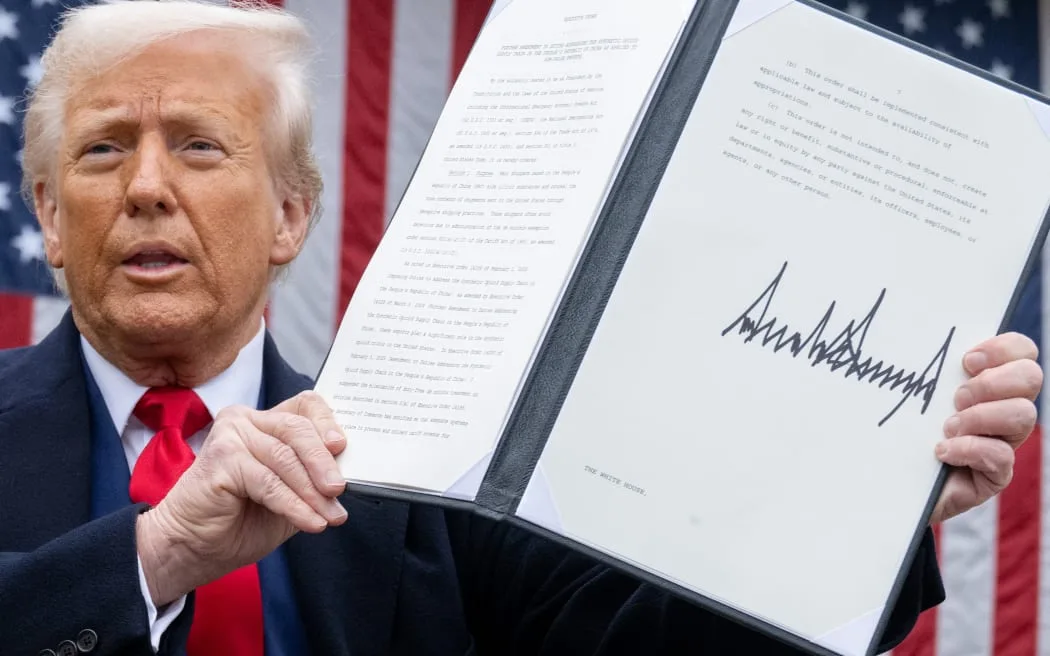
Earlier this week, U.S. President Donald Trump announced a series of tariffs aimed at addressing what he described as trade imbalances and strengthening American industries.
Declaring April 2 as “Liberation Day”—the country’s “declaration of economic independence”—Trump vowed to “Make America Wealthy Again” by implementing “reciprocal tariffs.” These include a universal 10% tariff on all imports, with higher rates for 57 countries based on their trade surpluses with the US.
“American steelworkers, autoworkers, farmers, and skilled craftsmen […] have suffered gravely,” said Trump. “They watched in anguish as foreign leaders stole our jobs, foreign cheaters ransacked our factories, and foreign scavengers tore apart our once-beautiful American dream.”
Trump insisted that the US had been “ripped off for more than 50 years” but vowed that it “won’t happen anymore.” While the administration argues these tariffs will restore trade balance and strengthen the US middle class, economists have warned of a potential US and global recession. Following the announcement, global stock markets tumbled, sparking outrage among world leaders.
International Response
European Commission President Ursula Von Der Leyen, responding to a 20% tariff on EU imports, acknowledged that “others are taking unfair advantage” of current trade rules.
She expressed willingness to negotiate reforms but warned that if talks with the U.S. fail, the EU would impose countermeasures to protect key industries, including Germany’s auto sector, Italy’s luxury goods market, and France’s wine exports.
British Prime Minister Keir Starmer, speaking from Downing Street, acknowledged the tariffs would hurt the economy but pledged to respond calmly in the coming weeks.
“Last night, the president of the United States acted for his country, and that is his mandate. Today, I will act in Britain’s interests with mine,” he stated.
Canada, which Trump has repeatedly referred to as “the U.S.’s 51st state,” has faced a 25% tariff on most goods and a 10% tariff on energy products since February. In response, Canada imposed 25% tariffs on C$155 billion worth of U.S. goods.
The trade dispute escalated further when Trump announced a 25% tariff on auto imports, prompting Canadian Prime Minister Mark Carney to impose retaliatory tariffs specifically targeting U.S. vehicles that fail to comply with the North American trade agreement.
“Every single dollar raised from these counter-tariffs—expected to reach $8 billion—will go directly to our auto workers and the companies affected,” said Carney.
China also delivered on its promise of “resolute countermeasures,” imposing a 34% tariff on all U.S. imports, effective April 10.
“The purpose of these measures is to safeguard national security and fulfill international obligations, including non-proliferation,” stated China’s Ministry of Commerce.
Markets reacted sharply, with major U.S. indexes plummeting nearly 3% and European markets dropping around 4%, some companies seeing double-digit declines.
“CHINA PLAYED IT WRONG, THEY PANICKED—THE ONE THING THEY CANNOT AFFORD TO DO!” Trump wrote on Truth Social.
Other Global Reactions
Morocco received a baseline 10% tariff, mirroring its own tariffs on US imports. Mohammed Benhammou, an international security expert, called Trump’s trade policies “the beginning of the end of globalization and free trade,” arguing they would hinder, rather than help, U.S. industrial growth.
Meanwhile, Morocco’s Justice and Development Party (PJD) requested a parliamentary committee meeting with Industry and Trade Minister Ryad Mezzour to assess the potential disruptions to supply chains and exports.
The only nations spared from the tariffs were Cuba, Belarus, North Korea, and Russia. A White House official told Anadolu Agency that these countries were excluded because they were already subject to heavy US sanctions.
“Our previously imposed measures preclude any meaningful trade with these countries,” the official explained.
Unintended Comical Blunder
Amid waves of global panic and disbelief, many found humour in Trump mistakenly imposing tariffs on deserted Australian Islands –Heard and McDonald Islands– that are only accessible via a seven-day boat Trip from the Australian city of Perth, and haven’t been visited by humans in almost a decade.
“Poor old penguins, I don’t know what they did to Trump, but, look, I think it’s an indication, to be honest with you, that this was a rushed process,” said Australian trade minister Don Farrell.
Memes of the flightless bird quickly flooded social media with one widely shared meme showing a penguin replacing Ukrainian leader Volodymyr Zelensky in his latest meeting with Trump and US Vice President JD Vance, where he was berated for “gambling with World War III.”
“The penguins have been ripping us off for years,” joked Anthony Scaramucci, who briefly served as the White House Director of Communication during Trump’s first term in office.
Jokes aside, the concerns weighing on Americans and the global community are serious. As major trading partners move to place retaliatory measures, the coming months will reveal whether the brazen tariffs would truly revive the “American dream” or drag the entire world into a trade war.