
 Join on WhatsApp
 Join on Telegram
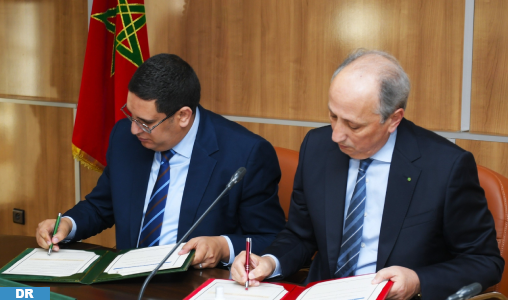
Rabat – The Ministry of National Education, in collaboration with the National Observatory for Human Development (ONDH), signed a partnership agreement in Rabat to support the “Pioneering Institutions” initiative.
This agreement aims to facilitate the process of awarding the “Pioneering Institutions” label for the 2024-2025 school year and will be applied to eligible educational institutions.
Minister Mohamed Saad Berrada and ONDH President Otmane Gair attended the signing ceremony. The event marked a significant step in the ministry’s commitment to ensuring inclusive, equitable, and quality education. Both institutions stressed in a press release that this commitment aligns with the Constitution, Law 51.17, and the 2015-2030 Strategic Vision.
Under the terms of the agreement, the ONDH will assist the ministry by collecting and analyzing relevant data, which will be provided to the committee responsible for classifying the participating institutions.
The initiative will involve 2,000 primary schools, 512 annexes, and 232 middle schools, all of which are engaged in the “Pioneering Institutions” project.
Awarding this label to institutions that meet the necessary criteria aims to ensure quality in teaching, learning, management, and administration, Minister Barrada argued. The initiative also seeks to enhance the school environment, improve students’ mastery of their studies, promote student engagement, and reduce school dropout rates.
This effort is part of the implementation of the 2022-2026 roadmap, which aims to establish a new model for educational institutions based on quality, excellence, and innovation.
The government has reiterated its commitment to expanding pioneer schools by 2028, a key initiative in the country’s educational reforms aimed at improving the quality of national education, according to government spokesperson Mustapha Baitas.
Launched in 2024, the program has already made notable progress, integrating around 626 public schools and benefiting nearly 323,000 students.
As the initiative grows, it is expected to expand to 2,000 institutions by 2025, reaching approximately 30% of primary school students, or about 1.3 million children.