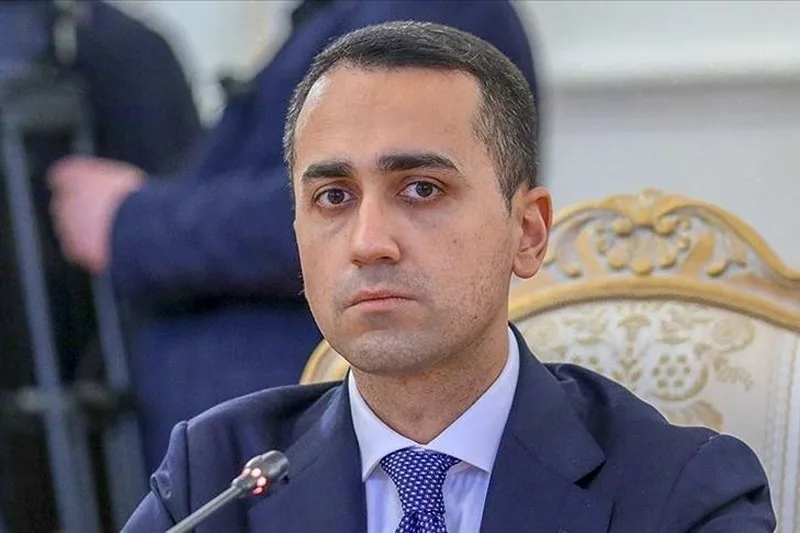
Doha – The European Union’s special envoy for the Gulf, Luigi Di Maio, praised Morocco’s pivotal role in advancing the two-state solution during the fifth Global Alliance meeting in Rabat on Tuesday. The former Italian foreign minister expressed gratitude for Morocco’s “generous hospitality” in co-organizing the gathering with the Netherlands.
Di Maio described the Rabat meeting as the “first joint initiative outside the initial group of co-organizers” of the alliance working toward lasting regional peace. He called for “concrete actions” supporting Palestinian state sovereignty.
The alliance aims to prepare for the high-level conference on the two-state solution scheduled at UN headquarters in New York next month, which will be co-organized by Saudi Arabia and France.
“We are fully committed to collaborating with the Kingdom of Morocco and the Kingdom of the Netherlands, as well as with all partners gathered here,” Di Maio stated.
He warned that the humanitarian crisis in Gaza and the alarming situation in the West Bank risk seriously compromising the viability of the two-state solution.
More than 50 countries and international organizations participated in the Rabat discussions.
Palestinian Minister of State for Foreign Affairs Farsin Aghabekian Shaheen also thanked King Mohammed VI for his efforts in supporting the Palestinian cause. She said Morocco’s hosting of the meeting reflects the country’s sustained efforts to make Palestinian statehood a concrete reality.
“We rely enormously on this kind of meetings,” she noted, particularly during Palestine’s current delicate situation, plagued by genocide. The meeting contributes to efforts to implement the two-state solution and enrich preparations for the New York conference.
On his turn, Arab League Deputy Secretary-General Hossam Zaki affirmed that the two-state solution forms the foundation of the Arab Peace Initiative. “We still believe in this solution and continue to support it as the basis for peace in the Middle East,” he said.
Zaki reminded attendees of Gaza’s catastrophic situation due to continued Israeli aggression and attempts to forcibly displace the population. He called this out as a violation of international law and humanitarian principles.
‘The only option where there are no losers’
For Foreign Minister Nasser Bourita, the two-state solution is positioned as the cornerstone for Middle East stability. He described it as “the only option where there are no losers” because Palestinians gain freedom and dignity, Israelis gain security and stability, and the entire region benefits from development opportunities.
Bourita insisted the solution requires a concrete roadmap with precise timelines and clear, responsible steps.
The minister rejected treating the two-state solution as an empty slogan or diplomatic maneuvering. He noted that extremists from all sides lose with implementation because they feed off conflict.
Morocco maintains this vision under King Mohammed VI’s leadership as head of the Al-Quds Committee. The North African country’s diplomacy works determinedly to bring viewpoints closer and increase chances for just peace.
Morocco’s approach to Palestinian support combines diplomatic initiatives with practical ground projects. The Bayt Mal Al-Quds Agency strengthens Jerusalem residents’ resilience through projects covering daily life aspects, including food, medical care, and education.
Bourita stressed that economic support cannot substitute for political solutions. The country seeks fundamental conflict treatment rather than temporary pain relief.
The Global Alliance operates on three main axes. First, it draws from past successes to converge toward a promising future. Second, it strengthens institutional support for the Palestinian National Authority under President Mahmoud Abbas. Third, it anchors economic dimensions in the peace process.
Bourita called economic foundations essential for sustainable peace, while maintaining that sovereignty cannot be conditioned.
The meeting produced concrete political recommendations supporting diplomatic efforts and strengthening conditions for two-state solution implementation. The Global Alliance launched during the UN General Assembly’s high-level week in September 2024.
This fifth meeting follows previous gatherings in Riyadh, Brussels, Oslo, and Cairo. The initiative positions itself as a diplomatic platform dedicated to effectively relaunching the Israeli-Palestinian peace process.