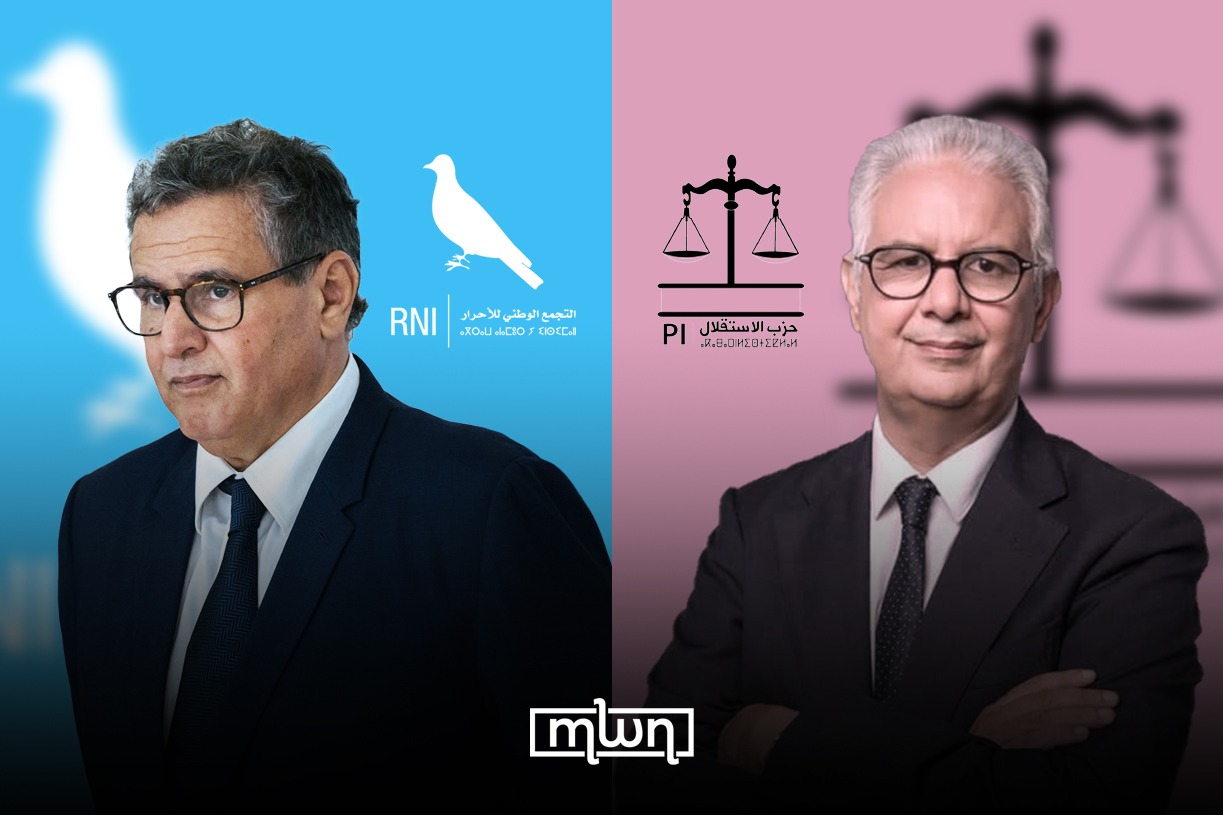
Rabat — Morocco’s government majority coalition confronts growing internal divisions as the Istiqlal Party is challenging the 2026 budget proposal.
The party’s economists have reportedly issued a paper that criticizes the proposal, creating friction with the head of government Aziz Akhannouch’s National Rally of Independents (RNI).
The tension stems from a recent motorcycle seizure crisis where the RNI claimed victory after Akhannouch personally intervened to resolve the issue.
Critics targeted the Istiqlal Party, viewing it as indirectly responsible for decisions made by the National Road Safety Agency due to its role as a government partner.
The RNI’s handling of the crisis violated the coalition’s majority charter principles, according to political observers, promoting its success outside the agreed framework that governs coalition decision-making.
Istiqlal’s strategic response
The Istiqlal Party responded with a comprehensive policy document from its economists’ association. The paper scrutinizes the 2026 budget law and transforms financial discussions into a fundamental disagreement within the ruling majority.
According to political analysts, the party’s response is in line with its traditional approach of measured and rational political engagement; rather than engaging in public disputes, Istiqlal chose to present a detailed policy alternative.
Eight-point economic framework
The Istiqlal position paper outlines eight strategic priorities that challenge the government’s current approach.
The party calls for strengthening the social state to address international economic changes while stimulating private investment to boost sustainable growth. The document points to the need of protecting families’ purchasing power, particularly for those affected by local and imported inflation.
The paper also demands enhanced sovereignty in vital sectors, including health, food, water, energy, and industry. It advocates for focused rural and semi-urban development through programs that consider local characteristics within effective regionalization frameworks.
On fiscal management, the Istiqlal economists call for rationalizing public spending across management, investments, and exemptions through precise economic and social impact assessments. They propose establishing a comprehensive approach to sustainable development that balances economic, social, and environmental dimensions.
The document also addresses volatile international conditions, including geopolitical pressures, trade tensions, and climate challenges, examining their effects on growth and external demand.
Political implications
The Istiqlal document placed Akhannouch and his economy and finance ministers in a bind, as a key coalition partner now demands fundamental changes that essentially restart budget discussions from the beginning.
The paper contains an indirect rejection of the government’s current budget approach, suggesting the Istiqlal Party distances itself from responsibility for the administration’s final financial legislation.
However, political observers may raise questions over the Istiqlal’s move, asking why the party didn’t criticize the 2026 budget proposal, especially as they are part of the coalition.
Others may view this move as Istiqlal’s response to Akhannouch’s pressure tactics during the motorcycle crisis.
Although the party chose a sophisticated political approach, critics suggest this is a partisan campaign ahead of its time, adopting a strategy that would affect the public opinion.