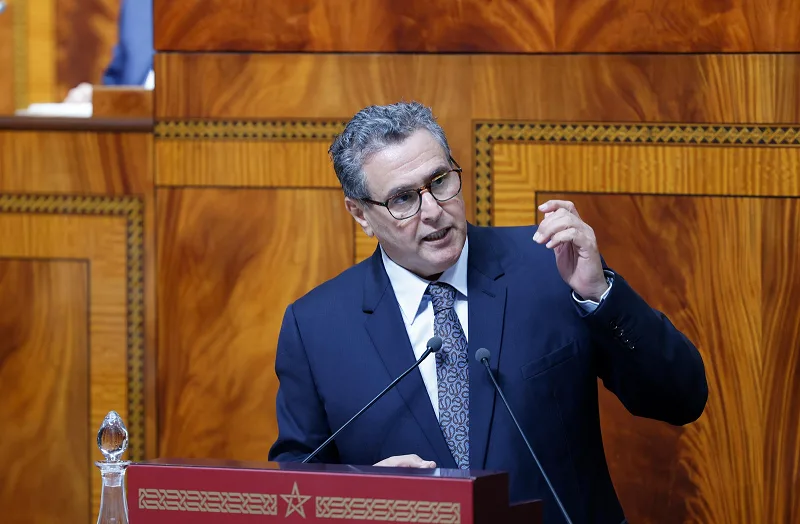
Doha – In a comprehensive address to the House of Representatives on Monday, Head of Government Aziz Akhannouch outlined Morocco’s ambitious education reform strategy and its major achievements to date.
Speaking during a plenary session on general policy focused on “The reform of the educational system: from pioneer schools to excellence universities for rising generations,” Akhannouch presented a detailed progress report on what has become one of the government’s most strategic priorities.
The reform aims to restructure Morocco’s education system—from primary to university—through financial investments and updated teaching methods to address equity and opportunity gaps, the Prime Minister argued.
$8.5 billion earmarked for education
“Throughout the 25 years of His Majesty King Mohammed VI’s reign, the Moroccan school has been a national priority,” he stated, referencing the King’s 2015 Throne Speech.
The King had emphasized that “education reform must primarily aim to enable learners to acquire knowledge and skills, and to master national and foreign languages, especially in scientific and technical fields that open doors to social integration.”
The government has demonstrated its commitment through unprecedented financial backing. Akhannouch revealed that the 2025 finance law allocated over MAD 85 billion (approximately $8.5 billion) to education, compared to MAD 68 billion ($6.8 billion) in 2019.
Additionally, the government plans to mobilize MAD 9.5 billion ($950 million) in supplementary funding annually until 2027.
“The common concern that unites us, government and parliament, is to restore the confidence of Moroccan families in public schools,” Akhannouch vowed.
He noted that the government’s interventions are based on the need to break with previous reform implementation methods that prevented students from acquiring basic learning skills during their school life and addressing the high dropout rates, particularly at middle and high school levels.
‘Pioneer Schools’: Transforming education quality
A centerpiece of the reform is the “Pioneer Schools” (Écoles de Riyadah) initiative launched in 2022. Akhannouch presented impressive statistics about the program’s implementation and results.
“The past academic year marked the effective launch of the Pioneer Schools project, encompassing more than 620 primary educational institutions and benefiting over 330,000 students in both urban and rural areas,” he reported.
The current academic year has seen important expansion, with the program now reaching 2,626 primary institutions serving more than 1.3 million students—approximately 30% of all enrolled students.
These schools implement a targeted program to address learning difficulties through the TARL (Teaching at the Right Level) approach, providing individualized instruction based on each student’s needs with regular, precise assessment of basic learning skills.
Results have been encouraging. “This system has recorded tangible improvement in students’ basic learning: four times better in mathematics, twice better in Arabic, and three times better in French,” Akhannouch noted, adding that this represents learning recovery equivalent to between one and two academic years.
Students attending “Pioneer Schools” achieved better results in evaluations compared to more than 82% of students not benefiting from this program, he asserted, describing these as “very advanced results” that compelled the government to accelerate the completion of this program’s implementation.
The top executive also mentioned that the initiative has expanded to include “Pioneer Middle Schools” this year, with approximately 230 middle schools (representing 10% of all middle schools) now participating, benefiting more than 200,000 students and involving 600 inspectors and over 6,000 teachers.
Higher education and research: Preparing for Morocco’s future
The government’s educational vision extends to higher education, with Akhannouch pushing for the transition to “maximum speed” in implementing the national strategic plan to accelerate the transformation of higher education, scientific research, and innovation by 2030.
University enrollment has reached approximately 1.3 million students, including more than 344,000 new students, with 91% registered in public universities. The current academic year continues to offer diverse training programs with nearly 4,000 new tracks approved.
“During this academic year, we’ve established 82 new ‘tamayouz centers’ for academic excellence in open-enrollment institutions, comprising 186 pathways serving over 15,000 students,” Akhannouch said. “These centers are directed toward future professions and align with socioeconomic requirements and national priorities.”
The government’s vision for higher education aims to achieve five major objectives: reaching 100,000 graduates by 2027 in engineering, technical fields, and middle management positions; increasing health sector professionals by 2030; training 10,000 social assistants by 2030; preparing 50,000 teachers for primary and secondary education by the end of 2025; and strengthening digital specializations to reach 22,500 graduates by 2027.
Akhannouch also detailed advances in doctoral research, with 245 doctoral tracks enrolling over 11,700 students in the 2024-2025 academic year in fields related to national development priorities.
Additionally, the government is implementing a national program to train 1,000 new-generation doctoral students on distinguished research projects, offering them a net monthly grant of MAD 7,000 ($700).
“We will continue building the school of quality and success for tomorrow’s generations,” Akhannouch concluded, “and building an innovative university system to achieve social advancement for the youth of the future… We will continue building the social state that invests in people.”
Read also: Morocco’s School Dropout Crisis: 280,000 Students Abandon Education Annually