
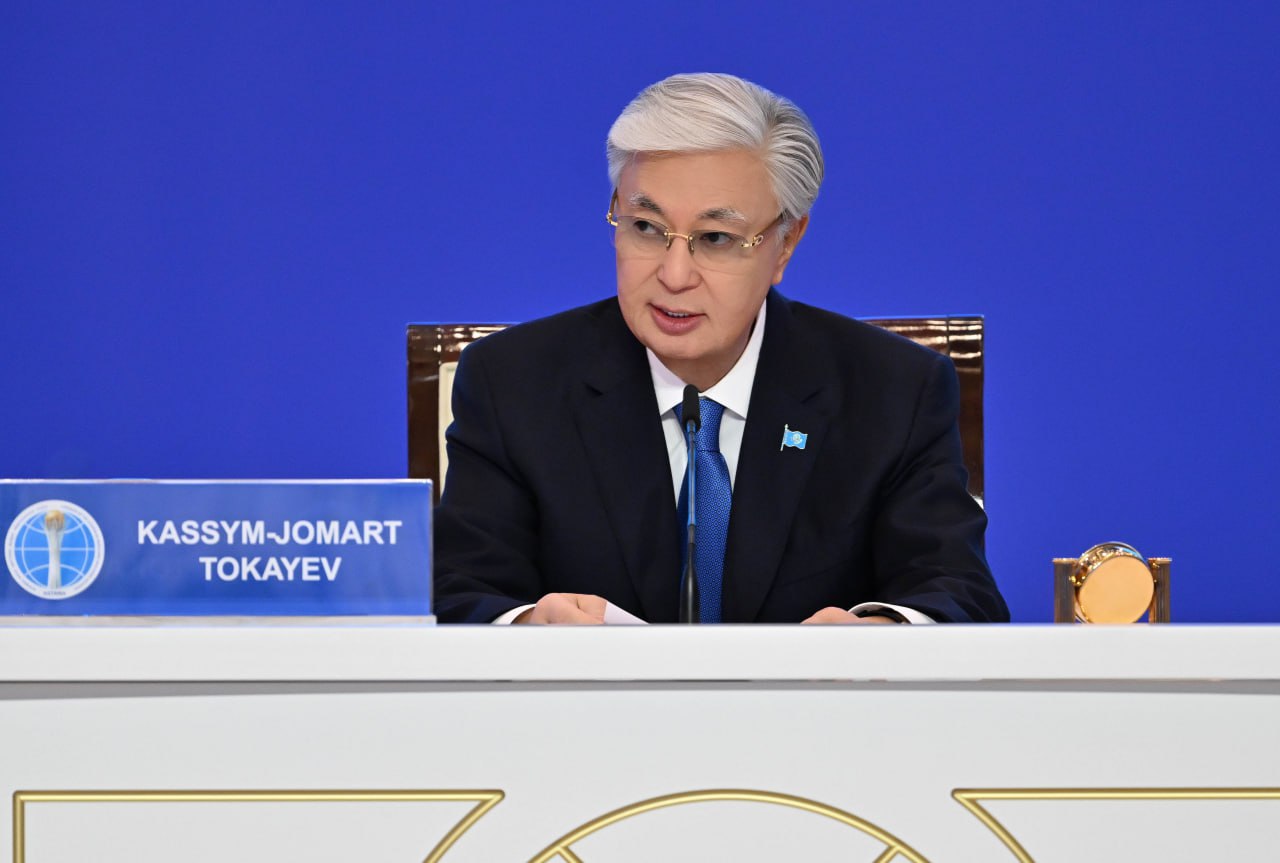
Rabat – President Kassym-Jomart Tokayev used the opening of the eighth Congress of Leaders of World and Traditional Religions on September 17 to press for dialogue, tolerance, and shared responsibility in facing global crises.
His address positioned Kazakhstan not only as host but as an architect of a broader vision of “spiritual diplomacy” at a time of mounting geopolitical tensions.
Tokayev’s vision for dialogue
Tokayev warned that the world is entering an era of heightened conflict, inequality, and mistrust. He argued that interreligious dialogue is not a luxury but a necessity.
“The congress represents a unique tool for strengthening peace and constructive coexistence,” Tokayev said, noting that its framework would be extended through 2033. He called on participants to learn from history and to uphold “unity in diversity,” which he described as the cornerstone of Kazakhstan’s model of coexistence.
Tokayev pointed to his country’s tradition of protecting sacred spaces such as the Mausoleum of Khoja Ahmed Yasawi and the Beket-Ata Mosque, presenting them as living symbols of peace and diversity. He warned against nationalism and ideological conflict, promising that Kazakhstan would suppress any attempt to undermine tolerance and respect.
Proposals for global challenges
Tokayev’s proposals sought to link the congress to urgent global debates. Among them were:
- Establishing a “Movement for Peace” under the congress framework
- Drafting a joint interfaith document on combating climate change
- Creating an interreligious commission on the ethics of AI
These initiatives, he argued, would enable religious leaders to contribute to issues ranging from environmental protection to technological responsibility. He also called on youth to carry forward values of tolerance and mutual respect.
Gaza genocide
The president’s remarks came as the humanitarian catastrophe in Gaza loomed over the gathering, while Israel commits genocide on Palestinians.
Several speakers condemned Israel’s organized starvation and mass killings. Sheikh Mohammad Abdulkarim Al-Issa, Secretary-General of the Muslim World League, called the situation for what it is: genocide and organized criminal starvation, urging the international community to break its silence.
“Mass genocide and systematic famine, controlled famine, in human understanding, that is a huge disgrace for the world community, and this is what our world has not faced since the UN Charter was declared,” he said.
The Israeli Occupation Forces continue their relentless genocidal campaign, killing thousands of innocents and unarmed citizens.
Tokayev framed such war crimes as moral tests, stressing that interfaith dialogue should provide the ethical framework for global responses to crises.
Voices of global faith leaders
The opening day featured powerful interventions by major religious leaders.
Sheikh Al-Issa called for leaders to move beyond symbolism. “Our values do not fade, even as our doctrines differ. What unites us is a shared human morality,” he said.
Pope Leo XIV, in a message, described solidarity as “synergy in action,” urging cooperation without erasing differences.
Patriarch Theophilos III of Jerusalem expanded on synergy as a principle of hope and collaboration: “Together, synergy and dialogue may nourish each other in a fruitful relationship.”
Patriarch Kirill of Moscow recalled attending the 2012 congress, calling the process “authoritative and significant.” He insisted that peace is possible “in a society of truly religious people.”
Li Guangfu, chair of the World Taoist Federation, said global crises require dialogue and cooperation: “Differences are not a reason for conflict, but rather the foundation for mutual support.”
UN backing for Kazakhstan’s platform
UN Secretary-General António Guterres, in a written message, thanked Kazakhstan for hosting and reiterated the UN’s belief that dialogue leads to peace. “Your voices can counter intolerance and inspire hope,” he said.
Miguel Ángel Moratinos, UN High Representative for the Alliance of Civilizations, praised Kazakhstan’s vision of interfaith cooperation. He described “spiritual diplomacy” as a form of conscience-driven mediation, rooted in compassion and reconciliation, that can complement political negotiations. “Dialogue is not a one-time event,” he said. “It is a way of life.”
Kazakhstan as convening power
Beyond the plenary sessions, bilateral meetings on the sidelines further pointed to Kazakhstan’s convening power.
Sheikhulislam Allahshukur Pashazade, Chairman of the Caucasus Muslims’ Board, met with senior religious figures including Vatican representatives and the Muslim Council of Elders, reinforcing Kazakhstan’s role as a hub for interfaith networking.
A platform of growing influence
First launched in 2003 at the initiative of former president Nursultan Nazarbayev, the congress has become a fixture of international diplomacy. By proposing concrete initiatives on climate change, artificial intelligence, and peacebuilding, Tokayev sought to elevate it from a symbolic gathering to an actionable global forum.
As Patriarch Theophilos reminded participants, synergy and dialogue together can sustain hope. For Tokayev, that synergy represents Kazakhstan’s future role: a bridge between cultures and faiths, committed to transforming dialogue into practical solutions for humanity’s shared challenges.
Since gaining independence in 1991, Kazakhstan has been following its peaceful and balanced foreign policy. The country is committed to multilateral cooperation in line with the UN Charter, playing an active role in international security and stability.