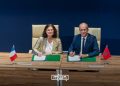
Rabat – At a high-level meeting on Thursday, Morocco and Russia discussed regional issues, including the dispute over Western Sahara.
Russian Minister of Foreign Affairs Sergey Lavrov received today his Moroccan counterpart, Nasser Bourita, during which the two officials discussed the Sahara dispute.
“We exchanged assessments on current international issues, paying priority attention to the situation in the Middle East, North Africa, and the Sahara-Sahel region, and also discussed the situation regarding Western Sahara in the context of ongoing UN Security Council discussions,” Lavrov said in a press conference with Bourita.
He reiterated his country’s principled position in favor of resolving all ongoing conflicts on the African continent, exclusively through political diplomatic means.
These unusual Moroccan-Russian talks on Western Sahara come amid reports suggesting that Russia is leaning towards a shift in its position, considering the Autonomy Plan as a form of “self-determination.”
Lavrov, earlier this week, emphasized that Russia will accept the autonomy initiative as a successful political solution to the dispute, contending that all agree on Morocco’s plan as the best framework forward.
Morocco’s Autonomy Plan has achieved overwhelming support from the international community in recent years, with over 120 nations now considering it as the most viable political path to a lasting settlement of the Sahara dispute.
Among them are global powerhouses like the US, UK, France, and Spain that see the Moroccan proposal as the most realistic and only genuine attempt at a political solution that could end the lingering conflict. Taking it further, beyond their support for the autonomy initiative, Paris and Washington also fully recognize Morocco’s sovereignty over its southern provinces in Western Sahara.
A new recognition for Morocco’s autonomy initiative, especially from another UN Security Council member state, could be crucial for Rabat’s position.
For years, Russia has either rejected or abstained from voting on the UN Security Council resolutions on Western Sahara, describing them as unbalanced.
This noncommittal Russian attitude on the Sahara dossier is mainly due to Moscow’s decades-long strategic relations with Algeria, the main sponsor and advocate of the separatist Polisario Front’s statehood ambitions in the Western Sahara region.
Algeria’s regime obstructs the UN-led political process by rejecting its role as a main party to the dispute, describing itself as merely an observer and “a concerned neighbor.”. This comes despite Algeria’s regime’s direct role in feeding Polisario’s independence claims and supporting the separatist group logistically, financially, and militarily.
During today’s press conference, Lavrov emphasized the importance of Morocco as a strategic ally, stating that both countries share a strategic partnership.
Morocco’s principled position
Bourita also welcomed the importance of bilateral ties between the two countries, saying that Rabat considers Moscow a reliable and constructive partner for Morocco.
“Next year will mark ten years since the signing of the deep strategic partnership memorandum between the two countries,” Bourita said.
“We discussed regional and international issues at length, foremost the Moroccan Sahara,” he said. He recalled that Russia will chair the United Nations Security Council in April, noting that the two countries’ agreed solutions must comply with international law and principles, which cannot be misused to block the process.
“This dispute has lasted 50 years; now is the time to consider the dynamics driven by His Majesty King Mohammed VI and changes in some countries’ positions,” Bourita said.
Bourita stated that Russia is a key actor as a permanent Security Council member, stating that both countries will continue discussing the Sahara dispute.
In September, Morocco renewed its principled position that a solution to the dispute should be based on the country’s autonomy proposal.
The statement came as Morocco’s delegation met with UN envoy Staffan de Mistura.
In the meeting, Morocco reaffirmed its support for the UN-led political process, recalling the country’s unwavering principles as defined by King Mohammed VI to reach a political, realistic, pragmatic, and sustainable solution based exclusively on the Moroccan Autonomy Plan, within the framework of Rabat’s sovereignty and territorial integrity.