 Join on WhatsApp
 Join on Telegram
Morocco’s dominance in the CAF Awards hosted in Rabat on November 19 came as no surprise. The country walked away with a total of six awards out of 11, including Best Male and Best Female Player of the Year. 2025 has been marked by outstanding performances by Moroccan male and female footballers, both in their teams or with the Atlas Lions.
These distinctions confirm that Morocco’s hard work over the past several years is bearing fruit.
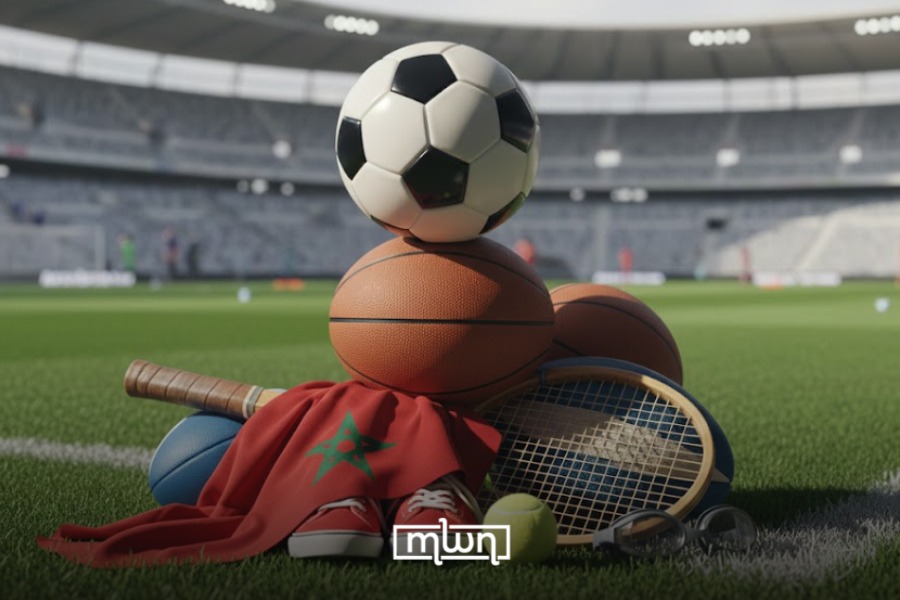
Moroccan football officials, sports journalists, and fans have every right to be proud of all that has been achieved in recent years, especially given the collective memory of all the failures and disappointments of the past. However, Morocco’s impressive football success is overshadowed by its inability to do the same in other sports.
The Olympics and the ultimate test
Morocco’s poor performance in other sports is evident in the last two summer Olympics in 2020 (held in 2021 due to COVID) in Tokyo, and the in Paris Olympics in 2024.
The summer games are the ultimate test of athletic competence across a variety of sports. It is an opportunity for nations such as Morocco to claim a name for themselves in a competition mainly dominated by giants such as the United States, China, Russia, and the United Kingdom.
However, as many predicted, the results of the Moroccan athletes were for the most part disappointing. With only one medal in 2021 and two in 2024 – including a bronze by the Moroccan U-23 football team – the Olympics were a reminder that when it comes to sports beyond football, Morocco does not have what it takes to shine globally.
What was even more striking was Morocco’s defeat at the hands of countries – both on the global or continental level – with similar economies and demographics to Morocco.
For example, a country such as Kenya snatched 11 medals, all in one specialty: Athletics, or track events. The sport has always carried Morocco to the podium, with many Moroccan legends such as Said Aouita, Khalid Skah, and Hicham El Guerrouj.
While Morocco continues to churn out top athletes, it is increasingly rare. And while Kenya boasts many internationally-renowned athletes, Morocco has become dependent on only one.
Run Bakkali, run
Morocco owes its only two gold medals in the last two Olympic games to the 3000m steeplechase champion Soufiane El Bakkali.
El Bakkali rose to become one of Morocco’s finest in Athletics through these Olympic achievements and other accolades in international championships and tournaments.
During the 2024 Olympics, Moroccan fans commented on the poor results of participating Moroccan sportsmen and sportswomen with sarcasm that bordered on blatant cyberbullying. With every new failure, all the hopes to save the face of Moroccan sports were thrust upon El Bakkali’s shoulders.
His story is is a scene reminiscent of “Forrest Gump.’’ As the champion was taking over other runners in the 3000m steeplechase final, one could imagine millions of Moroccans glued to their seats, watching on their TV screens, laptops and smart phones, all screaming the same phrase as the race was heading to the end: “Run Bakkali, run!”
While El Bakkali did not disappoint, many sports fans and journalists pointed an angry finger at the Royal Moroccan Athletics Federation for the continuous failure to produce more athletes who could seriously compete to earn more medals for the country.
“Cloning” Lekjaa
The success of Moroccan football is owed to several factors, primarily King Mohammed VI’s bet to make football an industry to serve Morocco’s greater economy and image abroad.
Additionally, top-of-the-line infrastructure produces players worthy of playing internationally, and allows for Morocco to host major football events. A further addition, of course, is the large pool of talent both locally and in Europe that makes up Morocco’s teams.
This success is also owed in part to a person who has become a household name across Morocco and the MENA region: Fouzi Lekjaa, the President of the Royal Moroccan Football Federation.
Since his election as head of FRMF in 2013, Lekjaa spearheaded a revolution in Moroccan football and Futsal that turned the failures of the past into impressive successes in all categories.
During his 12-year tenure, Morocco won the men’s Futsal AFCON three times as well as the first women’s FUTSAL AFCON, the U-17 and U-23 AFCONs, the U-20 World Cup, and the Bronze Medal at the 2024 Paris Olympics. Additionally, the Atlas Lions A team became the first African nation to reach a World Cup semi-final.
Lekjaa’ success coined the phrase many Moroccans say: ‘’We need to clone him,’’ so that every other federation can follow suit and embark on its own journey towards success.
As much as this may be flattering to the FRMF president, this kind of talk is problematic. It gives the impression that there is a serious shortage of hard-working and competent managers to run other sports.
Several heads of Moroccan sports federations boast impressive management positions in companies or institutions in different fields. Likely, they were brought in to achieve results similar to that of FRMF president. So far, this has not been the case.
While Lekjaa should not be idolized as some football enthusiasts tend to do, he has a clear passion for the game – something that others lack.
Passion may not be the answer to all Moroccan sports failures, but it can be a good start for choosing the right person to chair any sports profession – not just football.