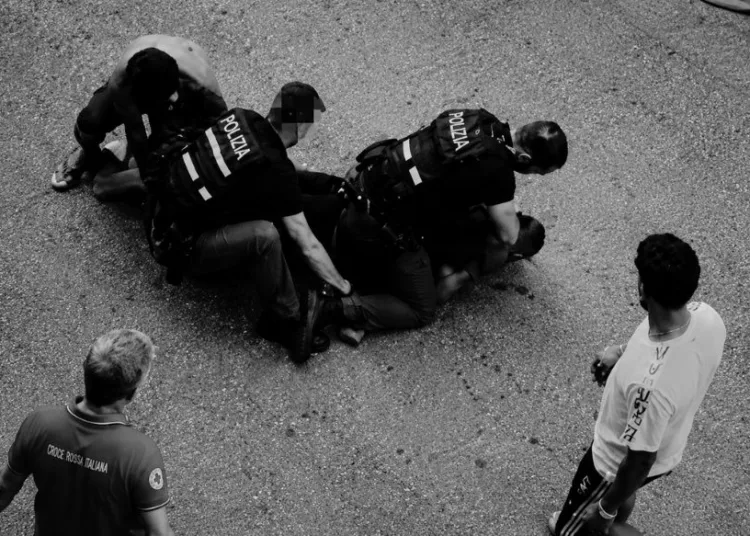
The Ceuta migration crisis has become a central theme in Italy’s far-right political discourse, in an apparent move to overshadow the ongoing investigation into the killing of Moroccan national Abderrahim Fakir, who was brutally tackled by two police officers in Bologna on July 19.
Far-right politicians have been intensifying anti-migration rhetoric following the Ceuta mass crossings last week, involving at least 40,000 people who headed to the enclave.
More than 1,000, meanwhile, headed to the enclave of Melilla, overwhelming security forces deployed at the borders. The situation made headlines across the world, with Italy among the first EU countries to criticize Spain and call for the suspension of the Schengen visa-free zone with Madrid.
“The temporary suspension of Schengen with Spain is a necessary choice to safeguard the security of our citizens and defend the European borders. A measure provided for by the treaties and made unavoidable today,” Deputy Prime Minister Matteo Salvini wrote on X last week.
The Ceuta crisis has drawn attention away from the case of Fakir, a 42-year-old Moroccan man who was brutally handled by two police officers during his arrest after a resident reported that the Moroccan man was acting “violently.”
Some reports said Fakir was struck by an Italian police vehicle before officers handcuffed him and pinned him face down on the ground while pressing his chest against the ground.
Fakir pleaded for help during the arrest, but the two police officers ignored his appeals, while four paramedics were on the scene watching as he suffocated to death.
Police said they opened an investigation involving six people, including the two police officers and four paramedics.
An autopsy has been conducted, and initial reports indicated Fakir had blood in his lungs. A pool of blood was also observed beneath his body at the scene, raising questions and challenging claims that the two police officers carried out the arrest professionally.
Bologna Mayor Matteo Lepore has been following developments in the case and has reiterated his commitment to helping bring justice to light.
On July 31, Lepore recalled the hateful and threatening messages he continues to receive for his support of Fakir’s case.
“I have instructed my lawyer to prepare a criminal complaint, which we will submit to the Public Prosecutor’s Office. Personal threats and insults do not intimidate me,” he said.
Lepore added that he is concerned about the possibility that hundreds or even thousands of “fake profiles” could be part of a systematically organized effort designed to destabilize public debate.
“The real danger is something else: That these methods will increasingly be used to manipulate public opinion through artificial campaigns and intimidate those who participate in democratic life. This is an issue that should concern everyone, regardless of political affiliation,” he added.