Rabat – 23-year-old “Brahim” is at Morocco’s average peak for opportunity. As a master’s student who teaches English speakers the Arabic language, he is relatively well-employed, well-paid, and well-educated—more stable than many fellow citizens. He has the money to dress nicely and own a motorcycle. He even lives in the well-connected, well-serviced municipalities outside of Rabat, meaning his family has access to private schools, functional hospitals, communications infrastructure, and basic goods and services.
Many Moroccans lack those things, so Brahim is fortunate. But even he plans to leave Morocco for better opportunities.
“I won’t find any opportunity in Morocco,” he says. “My country is not giving me any opportunity to stay here. If I stay in Morocco, I’m going to work as a teacher, teaching Arabic to Moroccans, in public school with the government, and I’m going to get MAD 7000 [roughly $700] a month. Do you think it’s enough?”
Today, like always, he drove his motorcycle to the school where he teaches Arabic learners. At this point in the conversation, his fingers drum on his bike helmet. He says, “If [young Moroccan students] stay here, they waste their time.”
His feelings are becoming increasingly common across Morocco. Each year thousands of the country’s most qualified young professionals—studying engineering, medicine, education, and other highly skilled fields—depart Morocco for hypothetically greener shores in Europe, the Gulf, and America.
This phenomenon is known as brain drain: The emigration of talents and qualifications from one country into the rest of the world.
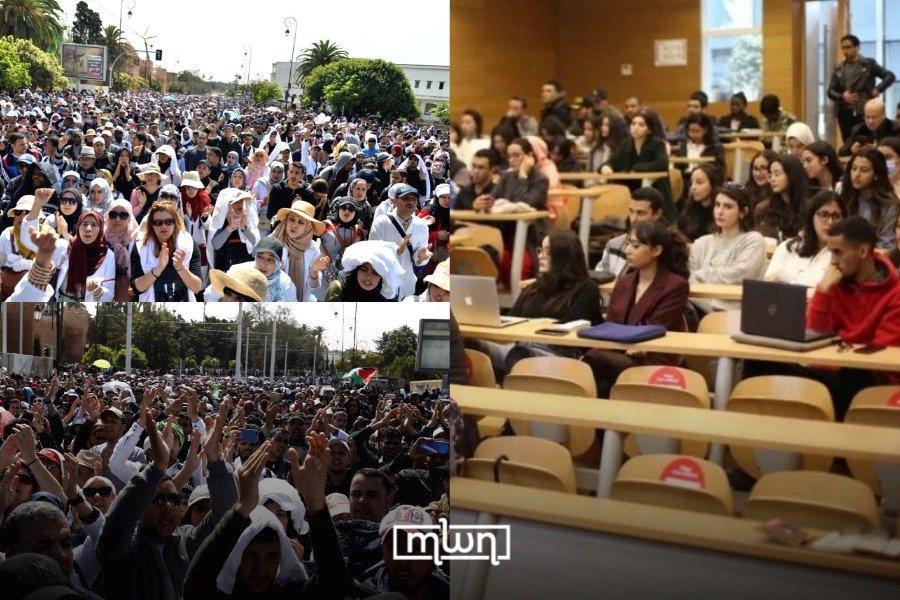
The Moroccan government has looked on with concern as brain drain has accelerated over the past decade. They have also watched as the young Moroccans who have stayed in the country have begun to protest its policies. The healthcare and education systems, which many citizens argue are choked and blocked by government corruption, are under immense pressure from overcrowding, meaning many are unable to access the kinds of services that are taken for granted in other nations. Such problems drew thousands of Moroccans into the Generation Z 212 protests that have rocked the country since early September.
In response to the protests, Head of Government Aziz Akhannouch’s administration has allocated 16% more funding than in years before to FY 2026’s health, education, and business budgets. But some demonstrators consider this reaction insufficient, and as many of the young adults who have catalyzed the protests leave, problems with healthcare and education only worsen.
This results in a ping-pong effect. Poor healthcare, poor education, and poor employment prospects create poor opportunities, so the people with sufficient opportunity—meaning college students or young professionals—want to leave. Their exodus leaves a talent vacuum. Industry issues worsen, and so do opportunities for progress.
But who started the ping-pong effect? Where do nationwide issues in healthcare and education come from?
Overwhelmingly, frustrations point back to job availability and wage quality.
What’s the problem?
According to the Ministry of Higher Education, an estimated 3,700 Moroccan doctors and engineers emigrate annually. Sometimes as much as a third of the graduating medical and pharmacy class from Morocco’s flagship university, University Mohamed V in Rabat, immediately go abroad after graduation. In previous years, thousands of professionals in other fields—including in computer science, mechanical engineering, economics, and more—have emigrated alongside them, often amounting to tens of thousands of annual emigres. Historically, they tend to go to Germany, Spain, Canada, Saudi Arabia, and, in particular, France—so much so that France has begun to recruit specifically from North Africa.
One of the most relevant statistics is this: in 2024, Arab Barometer found that about one in three of surveyed Moroccans wish to leave Morocco for economic reasons alone, leaving out political and social causes. In 2023, over 70% of young surveyed Moroccans wished to leave.
And outside of statistical data, anecdotal evidence—per the college students and graduates interviewed for this article—suggests that “everyone” wants to leave.
“While the government has increased the number of engineering and medical graduates, Morocco struggles to retain its talent. Many skilled workers are drawn to Europe, where wages and opportunities are significantly higher,” writes journalist Dakir Madiha, who reports on brain drain for Walaw.
Though the Moroccan government has poured funding into education and business, much of their attention is turned outwards. The government has invested in events like the African Cup of Nations (AFCON), to be held in December 2025, and the World Cup, to be held in 2030. Then, with the United Nations’ recent resolution placing the Western Sahara under Moroccan authority, Morocco has turned towards foreign investors. Labor laws have even been rewritten to attract and accommodate an influx of international corporations. Much income is expected to flow into Morocco via foreign companies and tourists.
But many jobs associated with such work are transient, far-away, or unrelated to the fields most on Moroccans’ minds—health, education, and small businesses.
Furthermore, foreign investments do not provide sufficiently timely or direct assistance to people like Brahim and his friends. According to Trading Economics, the Moroccan youth unemployment rate hovers around 36%. Last year it reached an all-time high at 40%.
“[It’s] very concerning… many young people can’t find jobs that match their education or skills [or there is a] lack of opportunities, especially in small towns and remote villages. [I’m] both worried and sad,” says Brahim.
Though no official survey data exists, informal interviews and anecdotal evidence seem to suggest that Brahim’s words are accurate.
Take the example of Fahd and his partner, a couple in their 30s living in Rabat. Though both received college educations in engineering and teaching, they ultimately only found employment as a driver and a vape shop attendant, respectively. There is also Mohamed, a man in his 40s who studied law in college but now works as a taxi driver; Soufiane, 34, who studied business, but now works at a call center; and many others whose education now goes untouched in the course of an entirely unrelated and sometimes poorly-paying profession.
The ultimate issue stems back to a lack of opportunities. As Brahim says, his master’s program employs only two people every year. Even in fields with high demand like engineering, teaching, and healthcare, openings are few and salaries are low. There are not enough firms, schools, or hospitals to satisfy workers and consumers, and even in the ones that exist, good wages are not guaranteed.
In other words, it does not matter whether or not Moroccan young adults want to go. If they want to use their degrees, many of them must.
The emotional toll of leaving the homeland
A concept central not just to Moroccan culture, but to Arab culture, is ghorba (غربة). This little word means something that the English language cannot concisely capture. It conveys a deep, intrinsic, and inescapable longing for home, along with a feeling of estrangement from that very place.
Though this sentiment sources back more particularly to refugee conflicts like in Palestine, Syria, and other places, it comes up many times in interviews with the young adults who love their country, but believe they must leave it to achieve their own dreams of fulfilled lives.
“Amir,” a 23-year-old finance student at University Mohammed V in Rabat, says that the thought of leaving tugs deeply on his heartstrings. When pressed about his point of decision—when he realized he would have to leave Morocco to get a chance at the future he wants, which lies in the intersection of businessmaking and policy-making—he says he cannot even remember the decision.
“I think, like, the whole Moroccan society had this… realization… We all [woke] up to [think], like, yeah, this is bad,” says Amir. “It’s like a win or lose situation. And winning is leaving.”
Though Amir says he feels great pain over his decision to leave, it is because he cares deeply about his family and his fellow citizens, not about the government.
“The problem here… is the trust, especially with the last events [the Generation Z 212 protests and detainments],” adds Amir.
Nevertheless, Amir says that if things improved, he would not leave Morocco. He also would like to come back to Morocco after securing his own future. “The bigger, the older [I get], the more resources I have, I can help Morocco.”
Amir is not alone in his sentiments. Interviewed college students and professionals say that they would not leave Morocco if they could find an opportunity to work here, or that they hope to return to Morocco to reinvest in their homeland after studying and working elsewhere.
But many feel alienated by current Moroccan events, meaning the relationship between the government and the Generation Z 212 protests that have swarmed every major Moroccan city. Thousands of young adults have been arrested while protesting. Authorities have accused them of engaging in righteous and unruly behavior during the demonstrations. But eyewitnesses, lawyers, and human rights advocates testify that many of them were protesting legally and peacefully.
People like Brahim, Amir, and others also believe that they cannot make a difference in politics outside of protesting. Brahim alleges that, even if he were to try to enter politics, the electoral process is stifled by candidate dishonesty. This would bar him from advancing to a national level.
“Corrupt politicians buy votes from unaware citizens… This makes the political arena dirty and repulsive,” says Brahim. “In the last election, I was offered 500 MAD to vote for a candidate, but I refused. I also know many people who were offered money to vote.”
The wealth gap therefore prevents Moroccans from making a political difference, especially at levels above that of their local community. Upward social mobility averages around 35% in Morocco and is particularly low in rural communities, meaning people tend to stay in the same sphere of influence as the one in which they were born.
Furthermore, many in the governing class, meaning Parliamentary officials or wealthy business leaders, entered their roles via what the Washington Institute calls “parachutage”—meaning leaders are usually the children of previous leaders. Outsiders cannot access such circles.
This altogether creates a feeling of helplessness. If Moroccans are detained while peacefully protesting, if the government does not recognize their demands, if they cannot enter the government themselves, and if they cannot find adequate employment or education within Morocco, then they have no choice but to leave.
At the conclusion of the interview, Brahim zips his motorcycle jacket back up. It is chilly outside, and it is a long drive home to his family’s farm in the suburbs of Rabat. He may be happy to see them, but he will still be glad to move away—one day. He dreams of going to the US eventually, or to Europe. But growing anti-immigrant sentiment in the West works against him.
Even with increasingly long odds, he goes to school and work and networks with American and European professors and students in addition to his Moroccan friends and teachers. The whole time, emigration stays on his mind.