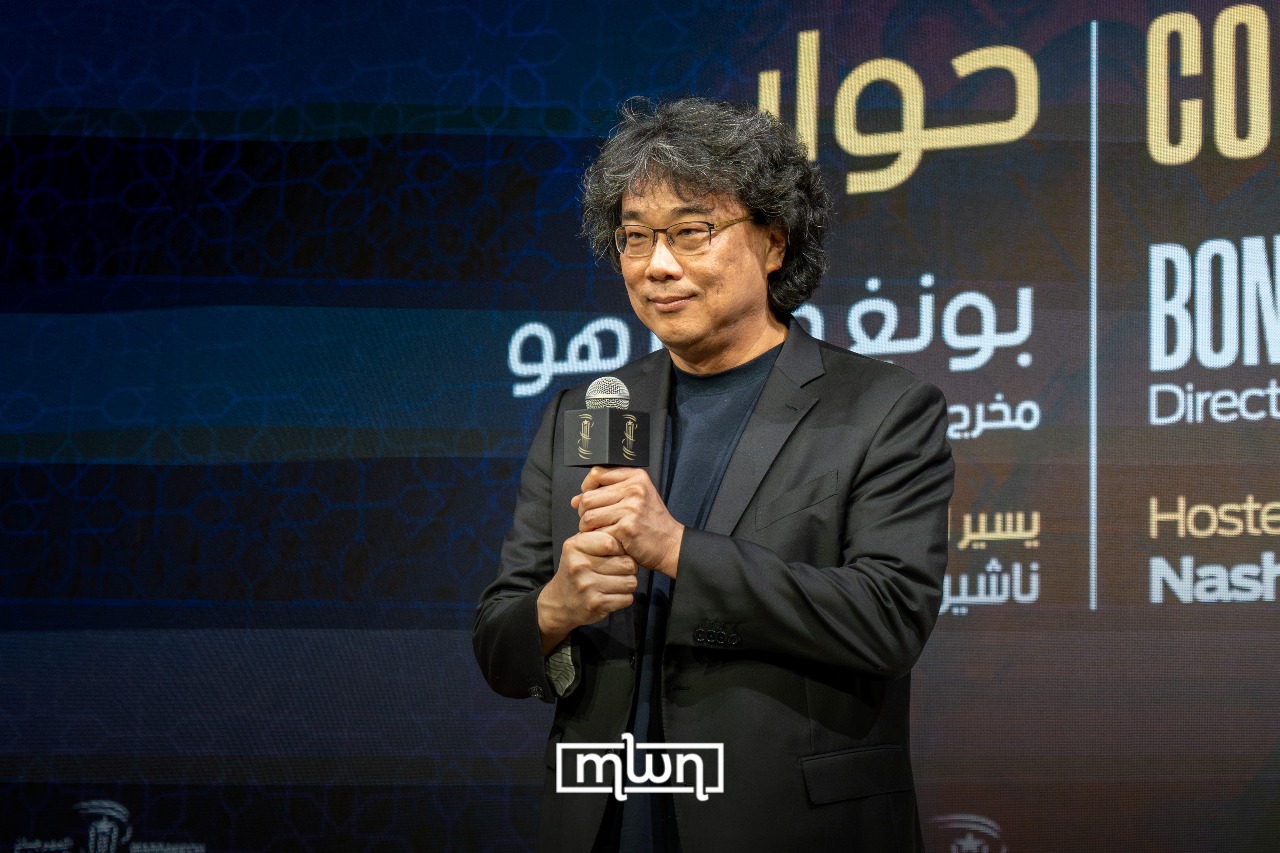
Marrakech – Acclaimed South Korean filmmaker Bong Joon Ho, serving as jury president at the 22nd Marrakech International Film Festival, dismissed concerns that Netflix’s acquisition of Warner Bros. will eliminate theatrical cinema experiences during the festival’s final day.
“I don’t think the cinematic experience will disappear so easily,” Bong told festival audiences when questioned about the $82.7 billion deal announced Friday. The Oscar-winning director of “Parasite” acknowledged streaming as “a good way to watch and enjoy movies” while stressing the irreplaceable value of theatrical screenings.
Speaking in conversation with Nashen Moodley, director of the Sydney Film Festival since 2012, Bong appeared unfazed by Hollywood industry anxieties. “To be honest, I don’t know what’s going on there in LA. I’m just a South Korean guy staying at home,” he said with characteristic humility during Saturday’s extensive hour-and-a-half interview.
The 56-year-old filmmaker praised the Marrakech festival’s commitment to theatrical presentation. Over ten days, he and jury members “really enjoyed” watching two films daily “in the big theater, with the big screen,” he noted. The festival represents a unique platform where “visions, aesthetics, and sensibilities from around the world meet,” Bong stated.
Bong, who has worked with both companies – Netflix distributed his 2017 film “Okja” while Warner Bros. released this year’s “Mickey 17” – reasserted cinema’s fundamental mission during the conversation.
Born in 1969 in Taegu, Bong studied sociology at Yonsei University while drawing cartoons supporting the pro-democracy movement for the campus newspaper. He later attended the Korean Academy of Film Arts, experiencing all aspects of filmmaking before directing his 2000 debut “Barking Dogs Never Bite.”
Absurdity meets tragedy in equal measure
His breakthrough came with 2003’s “Memories of Murder,” based on real unsolved serial killings in 1980s South Korea under military dictatorship. The director revealed the film’s iconic opening scene – where a detective flies through the air after being kicked – was completely unplanned. “It was the very first day of shooting,” Bong explained to Moodley. “We never planned it. It just suddenly happened. There was no stunt coordinator.”
The actor had trained extensively for wrestling roles in a previous film, making the spontaneous stunt possible. “He very naturally flew,” Bong recalled. “And his reaction is always amazing. They never measured it, but they perfectly followed all the focus.” This improvisational energy defined the production’s mood, creating “unexpected energy, something wild and crazy” that permeated the entire film.
During the year-long screenwriting process, Bong spent six months attempting to solve the real case. “I really tried my best to find out the reason why they couldn’t catch the murderer,” he said. “Is the serial killer so smart or are the detectives so stupid?” The film’s unconventional decision to end without resolution reflected this investigative futility.
Years later, in 2019, the real killer was finally identified. “It was amazing,” Bong reflected on the revelation, having interviewed journalists, detectives, and others connected to the case during his research, though the murderer himself remained impossible to meet.
Regarding the film’s distinctive humor amid deadly serious subject matter, Bong noted his approach to black comedy. The detective character’s reliance on shamanic fortune-telling contrasts sharply with later scientific DNA analysis, bringing into sharp relief investigative incompetence.
“We can see they depend on some DNA inspection, something scientific, but before that, they would ask a shaman,” he observed.
Bong consistently weaves social critique into commercially successful entertainment. His 2006 monster film “The Host” addressed environmental destruction and government incompetence while becoming Korea’s most successful film at the time.
Bong unites genre spectacle with piercing social critique
It follows a Seoul family confronting a mutated creature born from toxic waste dumped into the Han River. Around the 10-12 minute mark, the monster emerges from the river in broad daylight. It begins by hanging under the bridge, then drops into the water, swims toward the riverbank, and starts attacking people in the park.
“I will show the whole body of the monster within 15 minutes of the opening,” Bong declared, deliberately breaking genre conventions that typically reveal creatures gradually.
The film’s political subtext emerged from historical precedent. “Very classical sci-fi or monster movies from the 1940s and 1950s already carried political messages,” he observed. The monster symbolizes environmental pollution caused by American military chemical dumping in the Han River, while depicting government manipulation during the crisis to diminish civil rights.
His 2009 film “Mother” originated from inspiration by actress Kim Hye-ja. “Everything came from the actress,” Bong explained. The story of maternal protection taken to extremes showcased what he called the “Korean version” of intense motherhood, with the actress contributing additional emotional depth during production – a performance he even compared to the work of Moroccan actress Raouya.
The English-language “Snowpiercer” marked Bong’s first major international production. “It was actually 2007, between ‘The Host’ and ‘Mother,’ when I worked with Japanese actors and crew members,” he clarified regarding his international experience. The post-apocalyptic survival story naturally required international casting. “If I cast only Korean actors for post-survival, it’s going to be very odd,” he explained.
“Parasite,” Bong’s 2019 masterpiece about class inequality, earned him Academy Awards for Best Picture, Best Director, and Best Original Screenplay – making history as the first foreign-language film to win Best Picture. The film’s detailed family characterizations drew from extensive research into contemporary Korean society, with the contrasting houses representing stark economic divisions.
Bong maintains a long-standing partnership with actor Song Kang-ho, who has appeared in multiple films since their 1997 meeting. Initially a stage actor, Song impressed Bong despite rumors of method acting involving actual gangsters.
“He’s just very professional, sophisticated,” Bong clarified. “There was a rumor that Song Kang-ho, to prepare for his role as a Korean local gangster, actually hung out with real Yakuza. But he doesn’t. He’s just very professional.”
An upcoming animated project expected around 2027
Discussing his upcoming animated project expected around 2027, Bong acknowledged the medium’s challenges. “It’s very difficult. But it was my dream to make an animation movie,” he admitted, confessing his impatience with extended production timelines. The project requires coordination across three different time zones, testing his self-described impatient nature.
Korean filmmakers increasingly follow the Marrakech festival closely, expressing a desire to present their works there, Bong said last week. The festival’s selection of “very good competition films makes our job very, very difficult,” he noted regarding jury deliberations, though he maintained that the jury still relished the viewing process.
“A great film is born when aesthetics, beauty, and pure art coexist with a critical look at society,” he explained at the time. He views cinema as a singular space where visual poetry, confrontation of ideas, and collective memory converge.
When questioned about artificial intelligence’s impact on cinema, jury members unanimously agreed that AI-generated characters cannot replace human actors. “No technology can reproduce the sensibility, emotional complexity, and soul of an actor,” they concluded, viewing AI as a potential production tool rather than a creative substitute.
Addressing class representation in his films during today’s conversation, Bong underscored complexity over moral simplification. “Each character has their own humanity,” he stated, avoiding clear heroes or villains regardless of economic status. This approach reflects his belief in cinema’s responsibility to examine social structures while maintaining character nuance.
Looking ahead, Bong confirmed plans for future Korean productions, including “some bloody horror movie” set in South Korea, signaling his continued commitment to domestic filmmaking alongside international projects.
The festival, drawing to a close tonight, honored cinema luminaries, including Jodie Foster, Guillermo del Toro, Moroccan actress Raouya, and Egyptian actor Hussein Fahmi.
The international jury includes actresses Jenna Ortega and Anya Taylor-Joy, directors Julia Ducournau and Celine Song, along with other industry figures, reflecting the event’s multicultural scope that attracts filmmakers like Bong to its annual celebration of global cinema.