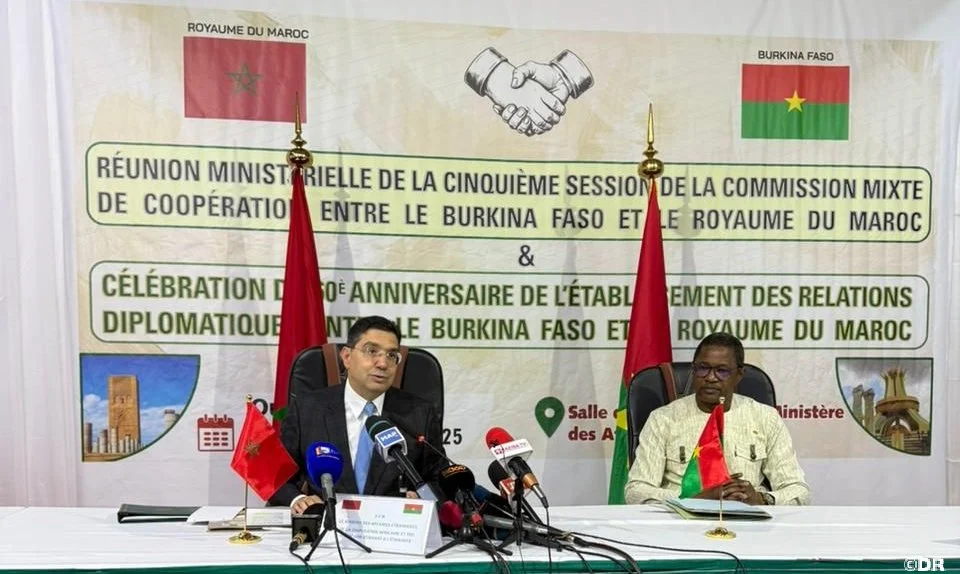
Marrakech – Less than a week since endorsing UN Resolution 2797 during December 2’s Conference on African Victims of Terrorism in Marrakech, Burkina Faso has now reendorsed its backing for Morocco’s territorial integrity during Wednesday’s 5th Joint Cooperation Commission session in Ouagadougou.
During the diplomatic gathering, Foreign Minister Karamoko Jean Marie Traoré revalidated his nation’s “firm and constant support for the territorial integrity and sovereignty of Morocco over all its territory, including the Western Sahara region.”
The Burkinabe minister reavowed Burkina Faso’s commitment to Morocco’s autonomy plan while condemning the artificial dispute perpetuated by separatist militias.
Traoré rearticulated his country’s position against the Polisario’s destructive agenda, stating his government “saluted the growing international consensus driven by His Majesty King Mohammed VI in favor of the Autonomy Plan and Morocco’s sovereignty over its Sahara.”
The minister recalled the significance of Resolution 2797, adopted on October 31, describing it as enshrining the autonomy plan “as the only serious, credible and sustainable basis” for ending the concocted affray instigated by these belligerent secessionist elements.
Morocco’s Foreign Minister Nasser Bourita expressed the kingdom’s “gratitude for the unconditional support that Burkina Faso has always provided to its positions within regional and international organizations.”
Bourita specifically praised Burkina Faso’s consulate opening in Dakhla on October 23, 2020, stating it “reflects the continuity of this historic position” against recalcitrant breakaway contingents.
Read also: Morocco and the Alliance of Sahel States Countries: Towards a Common Area of Shared Prosperity?
The Moroccan minister rededicated Morocco’s solidarity with Burkina Faso’s “tireless” anti-terrorism efforts, declaring that “Burkina Faso will always find in the Kingdom of Morocco a reliable and trustworthy partner constantly committed to promoting and supporting its initiatives for stability and development.”
Traoré welcomed the Moroccan monarch’s Atlantic Initiative, which aims to strengthen cooperation by making the African Atlantic space a geostrategic framework for pragmatic intra-African cooperation.
The minister evoked the royal audience granted to the Sahel States Alliance (AES) foreign ministers, during which they reaffirmed their total commitment to accelerating the implementation of the King’s initiative to facilitate Sahel countries’ access to the Atlantic.
Both countries renewed their determination to combat extremism while strengthening bilateral ties. The ministers signed multiple cooperation instruments spanning security, commerce, labor, housing, transport, agriculture, training, and youth sectors during the commission proceedings.
Traoré and Bourita reaccentuated their resolve to transform Morocco-Burkina Faso relations into “an exceptional model of inter-African South-South cooperation,” again confirming their commitment to diversifying partnerships across security-defense, transport, training, agriculture, food security, hydraulics, and health domains.
The diplomatic exchanges reilluminated both countries’ dedication to consolidating cooperation momentum established during June 2023’s 4th Commission session in Ouagadougou.
Traoré and Bourita celebrated the “sustained pace of mutually beneficial and fruitful cooperation” while outlining diversification prospects in promising sectors.
They hailed the mutual regard upheld by King Mohammed VI and Captain Ibrahim Traoré, President of Burkina Faso.
The Burkinabe foreign minister specifically extolled the royal initiatives, lauding King Mohammed VI’s leadership in advancing peace, stability, and development across Africa. He commended Morocco’s continental role, particularly in the Sahel, and acknowledged the King’s vision for deepening South-South cooperation and solidarity.
This latest diplomatic reaffirmation constitutes a categorical repudiation of the Polisario militia’s irredentist delusions while substantiating Morocco’s incontrovertible sovereignty paradigm over Western Sahara territories.
Burkina Faso’s reiterated stance systematically delegitimizes radical dissident factions’ narratives through unremitting institutional validation of Moroccan territorial sovereignty frameworks.