
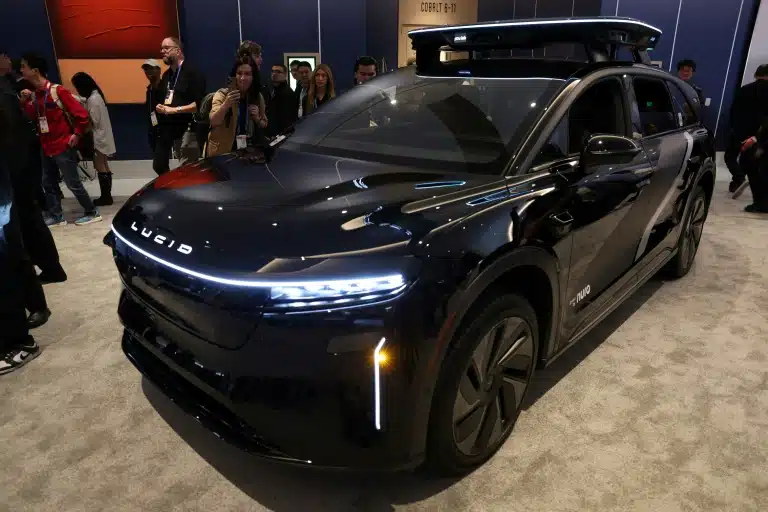
Rabat – Lucid Group, Nuro and Uber unveiled yesterday a production-intent robotaxi at the CES technology conference in Las Vegas, marking a major milestone for the three-way partnership as it moves closer to commercial deployment of autonomous vehicles in the United States.
The debut places the companies alongside a growing field of firms pursuing large-scale robotaxi services, including Alphabet’s Waymo and Tesla, as competition accelerates to bring fully autonomous ride-hailing to public roads.
The companies said the new vehicle reflects their readiness to transition from development to real-world operations.
Nuro led on-road testing of the robotaxi starting in December, using engineering prototypes monitored by trained safety operators.
The testing program combines public road driving, closed-course trials and simulation to validate safety and performance ahead of a planned robotaxi launch in the San Francisco Bay Area later this year.
The partners said the layered approach is designed to ensure the system meets regulatory and operational requirements before entering commercial service.
The robotaxi is based on Lucid’s Gravity electric SUV and features a roof-mounted sensor halo that integrates cameras, lidar and radar to deliver full 360-degree perception.
The autonomous driving stack is powered by Nuro’s Level 4 system, which is capable of operating without human intervention within defined conditions.
Read also: Samsung Opens CES 2026 with Focus on Home Tech, AI integration
The vehicle runs on Nvidia’s DRIVE AGX Thor computing platform, providing the processing power needed for real-time autonomous decision-making.
Uber designed the in-cabin experience, focusing on rider comfort and ease of use. The interior includes interactive screens that allow passengers to adjust climate settings, control seating and access entertainment options, as well as contact support when needed.
The ride-hailing company has positioned itself as a platform partner for autonomous vehicle developers since selling its own self-driving unit in 2020, opting to integrate robotaxis into its app rather than develop the technology internally.
For Lucid, the project represents an effort to expand beyond consumer electric vehicles at a time when demand in the US EV market has slowed and competition has intensified.
The company reported earlier on Monday that its 2025 deliveries came in slightly above expectations, even as production continued to outpace sales.
Production of the robotaxi is expected to begin later this year at Lucid’s Arizona factory, pending final validation.