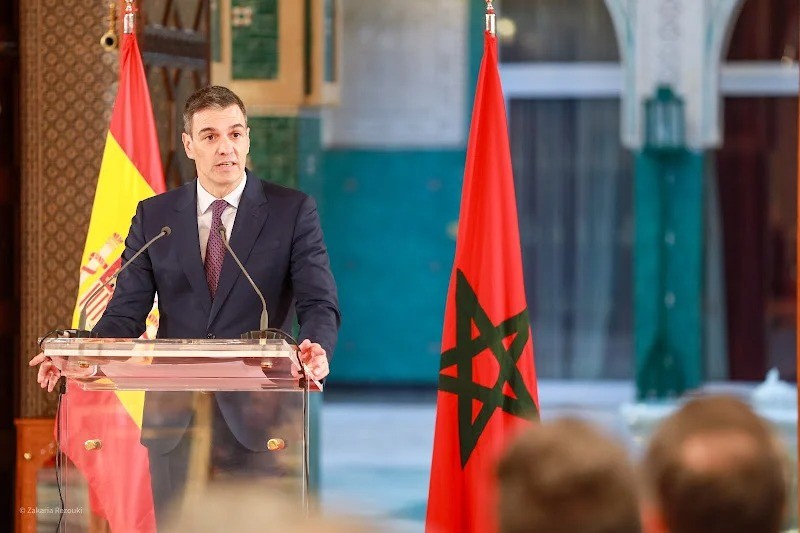
Rabat – Spain has reaffirmed its commitment to maintaining good ties and close migratory cooperation with Rabat amid anti-Moroccan rhetoric following the Ceuta mass crossings.
Far-right politicians and some Spanish officials targeted Morocco, pointing fingers and blaming the North African kingdom for the mass crossings that took place on July 30, involving tens of thousands of migrants – including minors.
Spanish reports alleged the number of those who entered the enclave is estimated at between 70,000 and 80,000 – most of whom returned through a Moroccan-Spanish agreement to mitigate the crisis.
Despite Morocco’s efforts and contribution to tackling the crisis, some far-right politicians claimed Morocco facilitated the mass entry to pressure Spain.
El País quoted Spanish government sources who emphasized that Pedro Sánchez’s cabinet is not considering “a change in strategy or tone.”
“The strategy with Morocco is what allowed more than 70,000 people to leave within a few hours,” El País quoted government sources as saying.
The sources emphasized that it is continuing to investigate what happened at the end of July, but stressed that there is “no evidence Rabat did anything wrong other than allowing migrants to pass for a few hours to prevent further deaths; once control was restored, they prevented thousands of entries … and cooperated in the rapid return of tens of thousands of people.”
Spanish government sources believe that Morocco’s cooperation makes it difficult to believe Rabat facilitated deliberate mass crossings as a “hybrid attack.”
For NATO, a hybrid attack is a combination of military and non-military actions to “destabilize a country.”
This comes amid accusations and conspiracy theories promoted by far-right politicians and some European figures recently.
Morocco remains key Spanish partner
Last week, former EU Commissioner for Internal Market Thierry Breton urged the European Union to investigate what he described as a “hybrid attack” behind the mass crossings into the Spanish enclave of Ceuta in July.
Breton made his remarks in an interview with Le Soir, where he described the mass crossing as an “operation,” pointing to the role of social media and possible “state or non-state actors” behind the incident, without specifically naming a particular party.
He did not directly accuse Morocco of orchestrating the incident, nor did he identify any specific country as being behind it.
While he did not accuse Morocco directly, Breton alleged Rabat did not help prevent the mass migration from happening – contradicting remarks by the Spanish government itself, which lauded Morocco’s cooperation.
The government sources also emphasized the importance of Morocco as an essential partner in different fields.
El País also quoted Jorge Dezcallar, a former ambassador to Morocco, who described Morocco as an essential partner in the fight against terrorism, drug trafficking and migration.
He emphasized that Spain is also an essential partner to Morocco.
Other officials, quoted by the Spanish news outlet, however, seek a “firm response” to Morocco, especially after Abdellatif Ouahbi, Morocco’s Justice Minister, emphasized that Morocco continues to see Ceuta and Melilla as occupied, but stressed that the issue is pending and remains on the table.