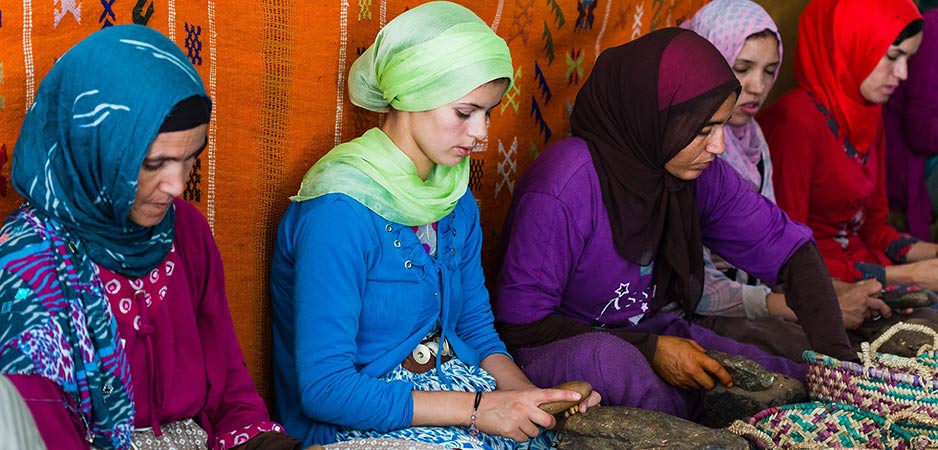
Agadir – Marrakech held on Wednesday a ceremony marked by the distribution of financial support to 436 cooperatives benefiting from the Women’s Qualification and Economic Empowerment Program in the Marrakech-Safi region.
Minister of Solidarity, Social Integration and Family, Naima Ben Yahia, the Wali of the Marrakech-Safi region, Khatib El Hebil, the President of the Regional Council, Samir Goudar, and the Regional Coordinator of the Social Development Agency (ADS), Awatif Chafik all attended the ceremony. In addition to institutional partners and stakeholders in major social and economic initiatives.
The gathering provided an opportunity to review the program’s results across the region’s prefecture and provinces, as well as to assess its impact on the targeted beneficiaries.
The program is the implementation of a partnership between the Ministry of Solidarity, Social Integration and Family, the Wilaya of Marrakech-Safi, the Regional Council, and the Social Development Agency.
It supports 436 cooperatives operating across the prefecture and six provinces of the region. In total, the initiative benefits approximately 7,970 people, including 6,587 women, with an overall budget of nearly MAD 16 million.
Speaking at the event, Minister Naima Ben Yahia emphasized the strong commitment demonstrated by all partners, underscoring the program’s role in supporting women-led initiatives, promoting women’s access to entrepreneurship, and stimulating the local economy through income-generating projects with high added value.
She stressed that the program is aligned with the directives of King Mohammed VI, which “aimed at building the foundations of the social state through a participatory and inclusive approach, based on coordination and complementarity between governmental and territorial programs, thus guaranteeing efficiency and coherence in the implementation of public policies,” she said.
An example of effective cooperation between government departments and regional institutions
Ben Yahia highlighted the importance of such integrated programs tailored to regional specificities, with a focus on improving women’s employability, fostering entrepreneurship, and encouraging initiative at the local level.
She also noted that the program has delivered encouraging results thanks to the sustained mobilization of all partners, enabling many women to improve their economic and social conditions, reinforce their autonomy, and actively contribute to local development.
For his part, Wali Khatib El Hebil recalled that the program forms part of broader efforts to enhance women’s status and promote their economic and social empowerment, in line with the high royal directives.
He described the initiative as a successful example of effective cooperation between government departments and regional institutions, and a practical mechanism for ensuring the convergence of public policies and territorial development programs.
El Hebil added that the program goes beyond financial assistance by providing training, skills development, and technical support, thereby strengthening the sustainability and long-term viability of supported projects.
He also highlighted the role of the National Initiative for Human Development (INDH), which places particular emphasis on supporting cooperatives through capacity building, quality improvement, organizational strengthening, and market integration.
Regional Council President Samir Goudar emphasized that the project reflects a strong partnership between government departments and public institutions.
According to Goudar, the program is built to take local realities into account and leverage the region’s diverse economic potential in both rural and urban areas, with a focus on innovative initiatives, entrepreneurship, and the creation of tangible opportunities for economic inclusion.