 Join on WhatsApp
 Join on Telegram
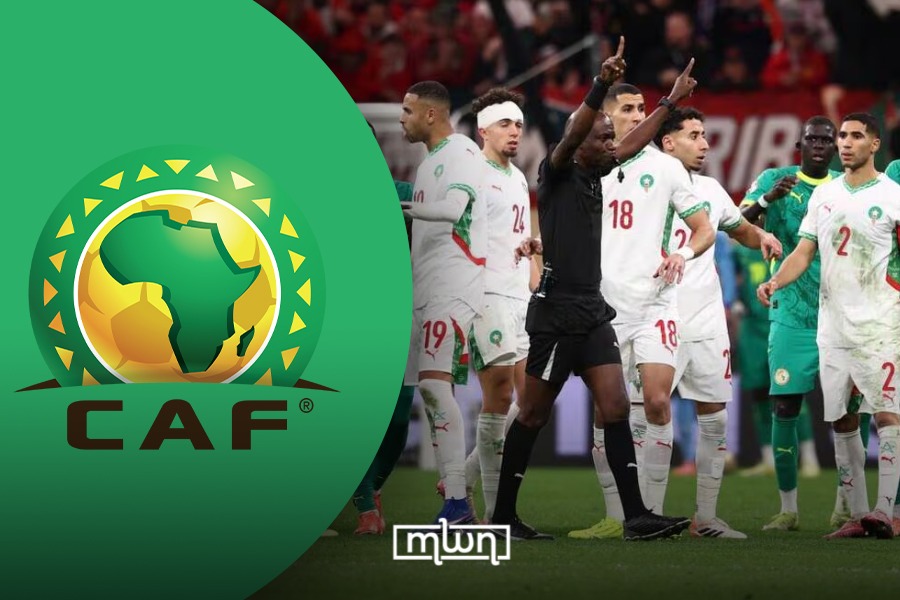
Rabat – CAF’s disciplinary ruling on the Africa Cup of Nations (AFCON) 2025 final has triggered a wave of anger in Morocco, not only because of the sanctions themselves, but because of what many believe the decision will encourage in future tournaments.
Across Moroccan media, the same argument keeps coming up: the punishment did not match the crime, and that imbalance risks normalizing chaos as a tool in African football.
CAF’s sanctions and why Morocco is furious
CAF announced sanctions against Senegal and Morocco after the chaotic final in Rabat. Senegal coach Pape Bouna Thiaw received a five-match suspension and a $100,000 fine.
Two Senegal players, Iliman Ndiaye and Ismaïla Sarr, were each banned for two matches. CAF also fined Senegal’s federation $615,000 and Morocco’s federation $315,000 for multiple violations linked to supporter behavior and actions by team officials and players.
CAF rejected Morocco’s protest citing Articles 82 and 84 of the AFCON regulations.
For many Moroccans, the last part of CAF’s ruling is the heart of the controversy. Articles 82 and 84 are widely seen as covering cases where a team refuses to play, withdraws, or leaves the pitch without permission.
Morocco’s federation argued that Senegal broke those rules in the final. CAF rejected the protest but gave no detailed public explanation as to why.
The fear of a precedent: walk-offs as pressure tactics
The reaction in Morocco was swift. Commentators are not on the fines first, but the message. The main fear is that CAF has now shown that walking off the pitch in a final can be punished, but not treated as something that changes the result. In a competition shaped by pressure, crowds, and fine margins, many believe that sets a dangerous precedent.
The debate has moved beyond one match to the future of discipline in African football. From Morocco’s perspective, the walk-off was not a small protest. It was the moment the game stopped being normal.
Leaving the pitch, even briefly, in a final is not the same as a heated argument or a technical foul. It challenges the referee’s authority and the principle that the match must be played to the end under the rules of the sport.
What Moroccan analysts are saying
African football analyst Jalal Bounouar, speaking to Morocco World News (MWN), said the reaction in Morocco comes from what people saw live. “We all saw what happened during the final,” he said, but argued the sanctions against Senegal’s coach and players were “very lenient.”
He warned that the penalties fall short of African fans’ expectations and risk sending the wrong message. Bounouar stressed that teams cannot stop a final watched by millions, then return and pressure the referee. If that behavior is not punished firmly, he said, it could lead to “more serious problems” in future matches.
Bounouar also offered a more positive view, commenting that Moroccans can still be proud of AFCON 2025 as a tournament, pointing to strong organization, facilities, and security. He added that Moroccan supporters helped show a welcoming and respectful image of African football to the world.
Moroccan sports analyst Abderrahim Ouchrif also gave his thoughts on this morning’s events to MWN, saying that the rulings left many stunned because they expected tougher punishment.
He explained that public anger comes from the feeling that “the trophy was taken” and Morocco was wronged, which is why many waited for sanctions that matched the scale of the chaos.
Instead, he argued, CAF focused mainly on what happened inside the match, the 120 minutes, referee and delegate reports, and video evidence, rather than the wider context Moroccans believe mattered.
Ouchrif called the decision a harsh lesson for Morocco: hosting successfully and offering hospitality does not win trophies in Africa. He added AFCON is decided not only by technical skill or tactics, but also by psychological battles and the ability to handle disruptions.
The journalist further argued that Senegal used those methods at a decisive moment, breaking Morocco’s focus and momentum.
Sports analyst Toufik Senhaji also raised the same concern about future consequences, calling CAF’s ruling a precedent risk. In a discussion with MWN, Senhaji said the decision sends a dangerous message to the other team in the future – walking off the pitch can be treated as a manageable protest rather than a red line.
Why Past Cases Fuel Morocco’s Anger
Another point fueling Moroccan anger is that the most destabilizing moments of the final were not just about the two teams on the pitch, but also the chaos in the stands which added pressure that shaped the match.
Reports and widely shared footage showed Senegal supporters trying to invade the pitch and clashing with security when the penalty was awarded, turning the stadium into a tense zone at the very moment the game needed calm.
Moroccan commentators say CAF treated these incidents mainly as “fineable” problems instead of threats to match integrity. They point to club‑level precedents that make CAF’s position harder to defend.
In late 2025, CAF sanctioned AS FAR with two home matches behind closed doors and a $100,000 fine after lasers and water bottles were thrown in a Champions League game.
To many fans, the contrast is sharp: a club can lose its crowd for two matches over stadium misconduct, yet a national team can walk off in a final and still avoid a sporting consequence that changes the result. That gap, more than the fines, fuels talk of inconsistency and accusations of bias.
The debate is even more sensitive because Senegal has faced tougher CAF measures before. In 2012, CAF took a hard line after Senegal’s AFCON qualifier against Côte d’Ivoire was abandoned due to crowd violence.
That incident was not treated as something that could be “managed” later. CAF awarded Côte d’Ivoire a 2-0 win and disqualified Senegal from the 2013 Africa Cup of Nations. At the time, the ruling was seen as deterrence in action, a punishment strong enough to stop repetition.
Outside Africa, Moroccan observers point to how governing bodies usually handle walk‑offs.
Over in Europe, UEFA has often treated refusal to continue as a forfeit, separate from other misconduct. In the Kosovo vs Romania case last November, Romania was awarded a 3-0 win after Kosovo’s players walked off in the Nations League.
The common thread in these precedents is clear: fines and suspensions can address many forms of misconduct, but when a team leaves the pitch and the match cannot continue normally, the sporting outcome itself is usually the first tool used to protect the competition.
What happens next for Morocco and CAF
The majority of critics against CAF’s ruling do not point merely to the legal reasoning, but moreover the wider concern for African football’s future. When finals turn into stoppages, walk‑offs and chaos, the sport itself suffers.
For Morocco, the anger is also tied to pride. The country hosted a major tournament and delivered strong organization, yet the final ended with people debating rules instead of focusing on the team’s performance. Many see CAF’s ruling as a missed chance to set a firm standard and protect the image of the competition.
What happens next will shape how this controversy is remembered. If Morocco appeals, the focus will likely be on how the regulations were interpreted and whether rules were applied consistently.
Analysts like Ouchrif argue that the Court of Arbitration for Sport (CAS) is the right path if Morocco wants a serious legal review – and there is genuine precedent for this.
In 2015, Morocco pulled out of hosting the AFCON because of Ebola-related concerns and asked CAF to postpone the tournament. CAF rejected the request and punished Morocco severely: a ban for the next two AFCON editions and a $1 million fine.
Morocco appealed to CAS and overturned the ban. The case became a major example of how CAS can reserve CAF discipline outcomes when legal reasoning does not hold up under review.
Even if the decision stands, CAF still faces a challenge. To stop walk‑offs from becoming a tactic, it must draw a clear line.
That means more than fines. It requires clear standards, consistent enforcement, and public reasoning that explains how the rules were applied in a final that everyone watched.
Read Also: AFCON Final: Could Morocco Turn to CAS After CAF’s Light Sanctions on Senegal?