


 Join on WhatsApp
 Join on Telegram
Marrakech – Spain’s Moroccan community – now one of the country’s most structurally important migrant workforces – sits at the center of a deep contradiction and occupies an uneasy position. While it is indispensable in fields and food supply chains, the community disproportionately remains the most vulnerable group in the Spanish labor market.
That is the core message of a new analysis by Spain’s Elcano Royal Institute, published January 27 by researchers Carmen González Enríquez and José Pablo Martínez, the third in a series on immigrant labor integration.
Using Spain’s latest consolidated population statistics and Labor Force Survey microdata (EPA, Q4 2024), the report estimates that 1,524,788 African-born immigrants lived in Spain on January 1, 2024 – about 3% of Spain’s total residents and 17% of the foreign-born population.
But the decisive story is Morocco: Elcano notes that Moroccan migration has been Spain’s main African-origin flow since the 1980s, and Moroccan nationals account for nearly three-quarters (72%) of African immigration, putting the Moroccan community at roughly 1.1 million people.
Elcano’s “key messages” set the tone with blunt metrics. It says African-origin migration represents 17% of all immigration in Spain and 20% of non-EU immigration, with Moroccans forming “almost three quarters” of the African total.
That demographic weight is increasingly visible in specific geographies: in Melilla, 21% of residents are born in Morocco, and in Ceuta it is 11% – while the broader population “of Moroccan origin” in the two cities is estimated at 40%-55%.
Yet the labor-market figures are even more striking. Elcano finds that African-origin immigrants have “clearly lower” employment integration than both natives and other immigrant groups – and that the weakest outcomes are concentrated among Moroccans.
The report attributes a major share of this gap to gendered labor participation: while 73% of sub-Saharan women are employed or actively seeking work, only 42% of Moroccan women do so. Elcano phrases it plainly: “only 42% of [Moroccan immigrant women] work or look for work.”
That labor participation pattern does not translate into lower unemployment. On the contrary, Elcano places the African-origin unemployment rate at an “extremely high” 25%, and highlights that Moroccan unemployment reaches 27%, compared with 8% among natives and 16% among sub-Saharans.
In other words, Moroccans face a jobless rate more than three times the native benchmark – an outcome that, in the report’s framing, reflects structural segmentation and weaker positioning in the labor market, not just cyclical conditions.
Moroccans trail across education levels
Education is presented as a key driver of that segmentation. Among African immigrants aged 25-59, Elcano finds that one in five did not finish primary schooling; within that, 21% of Moroccans and 19% of sub-Saharans did not complete primary education, while 9% of Moroccans and 6% of sub-Saharans are illiterate.
At the top end, only 10% of African-origin immigrants have a university degree – “no other group of immigrants shows results this low in education,” the report argues.
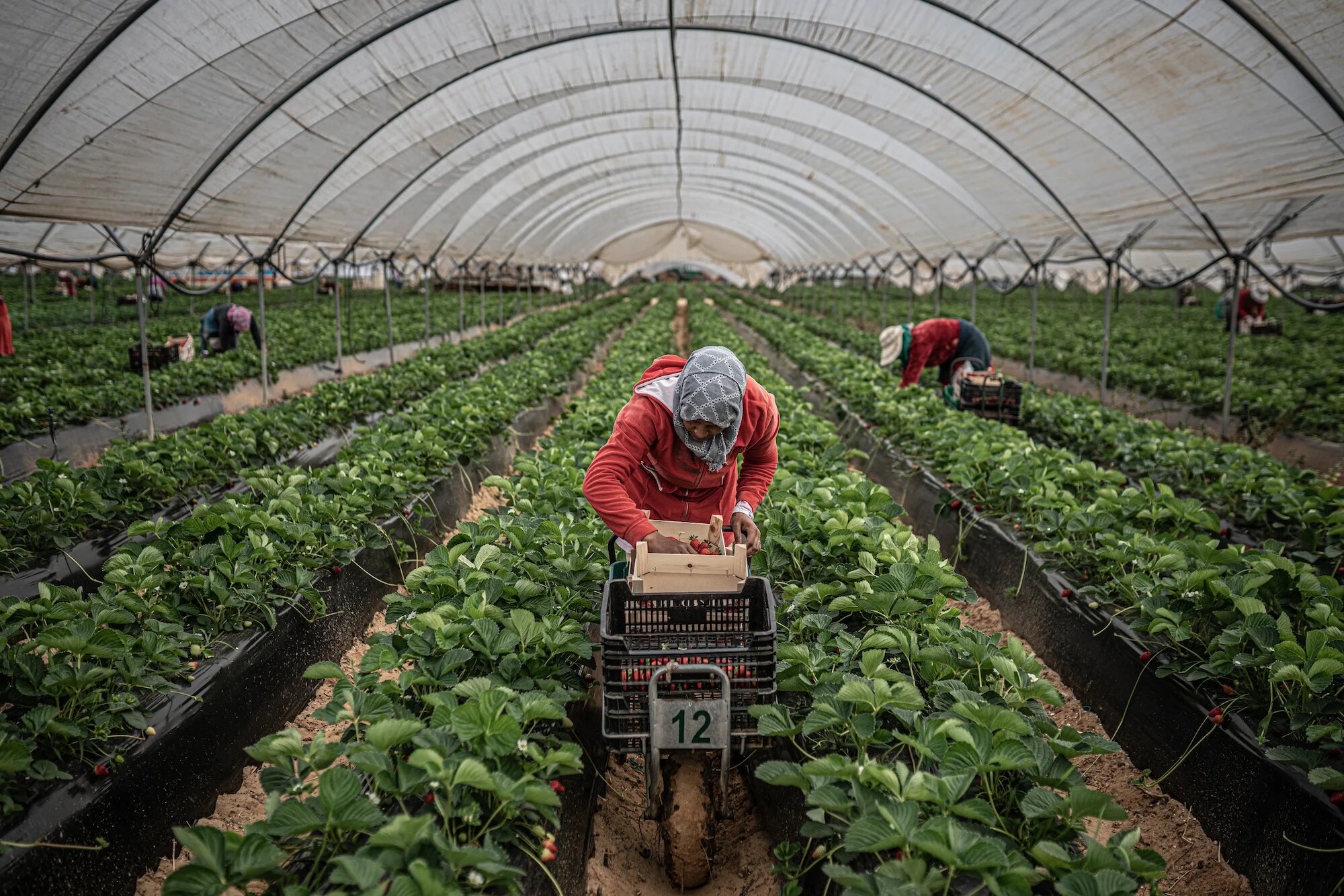
The labor-market consequences appear in sectoral concentration. Africans make up only 3% of total employment in Spain, but 15% of agricultural employment, Elcano reports – describing their role as “basic” in intensive-farming zones.
In the southern agricultural provinces most dependent on that workforce, the report identifies extreme reliance: in Murcia, 36% of agricultural workers are African-origin immigrants; 34% in Almería; and 24% in Huelva.
Among Moroccans specifically, 15% are employed in agriculture (versus 3% of natives), alongside elevated presence in construction and parts of industry tied to food processing.
Income data in the analysis is especially revealing because Spain’s Social Security statistics provide separate detail for Moroccan nationals. Elcano cites the Social Security Treasury’s December 2024 figures showing Moroccan contributors’ average contribution base at €1,554 per month – 32% below Spaniards.
For women, the gap widens: Moroccan women’s average base is €1,288, compared with €2,082 for Spanish women (a 38% difference). The report underlines a superlative: among all nationalities listed in the dataset, “the lowest female contribution base is that of Moroccan women.”
Highest birth rates among migrants
Finally, Elcano flags second-generation stakes – especially for Moroccans – through schooling and fertility indicators. Among 16-20-year-olds of Moroccan origin born abroad (the so-called “generation 1.5”), 26% are not studying, with a wide gender split: 37% of males versus 16% of females.
Meanwhile, the report notes that Moroccan immigration represents 11% of total immigration but accounts for 20% of births to immigrant mothers, and that 31% of Spain’s second-generation immigrants (born in Spain to two foreign-born parents) have Moroccan-born parents. Elcano links this scale to higher fertility and long-term demographic weight.
In other words, because Moroccan immigrant women have the highest fertility rates of any migrant group, people of Moroccan origin now account for a larger share of Spain’s second-generation population than of the first.
Put simply, Elcano’s numbers depict a community that helps keep Spain’s farms, packing houses, and construction sites running – while remaining locked into low-wage, high-risk segments of the economy.
For policymakers, the report’s logic is hard to ignore: Spain’s “Moroccan question” is no longer just about borders or integration rhetoric – it is about the labor market’s ability to convert demographic permanence into upward mobility.
That urgency has gained traction as Prime Minister Pedro Sánchez’s government is preparing an extraordinary regularization of around 500,000 undocumented migrants, granting them legal residency and work rights in an effort to integrate long-standing residents into the formal labor market and relieve bottlenecks in agriculture, construction, and services.




