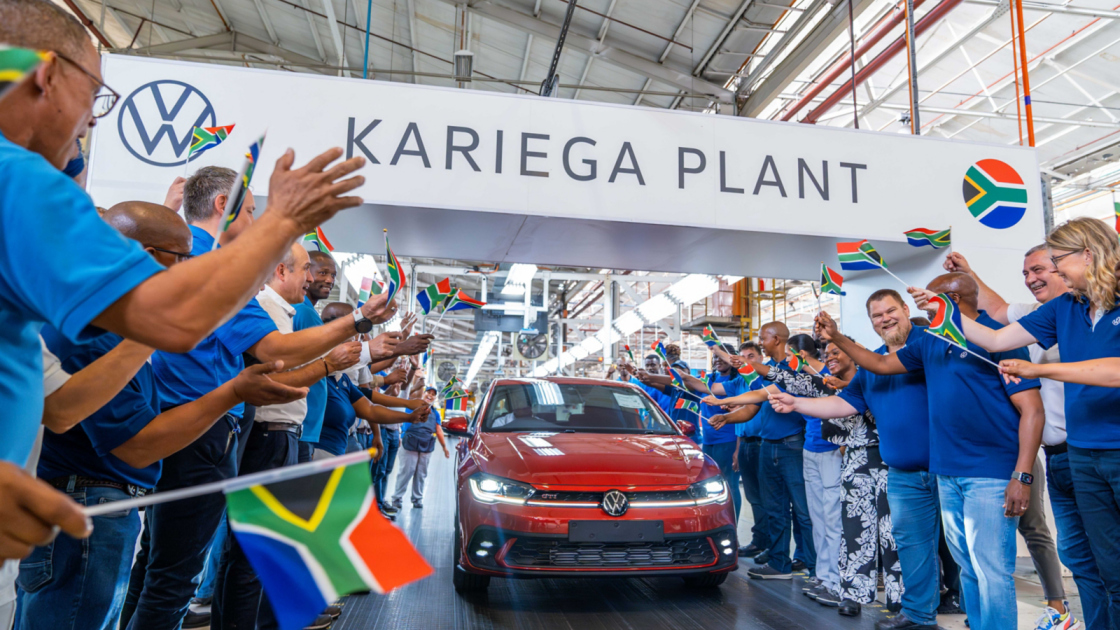
Beni Mellal – South Africa’s automotive industry is entering what industry leaders describe as a make-or-break moment, as Volkswagen Group Africa warns that continued policy inertia could place thousands of jobs – and future manufacturing investment – at risk.
In parallel, Morocco has quietly but decisively overtaken South Africa as the continent’s largest vehicle producer, reshaping Africa’s automotive hierarchy.
Volkswagen has raised the alarm over the future of its Kariega manufacturing plant in the Eastern Cape, which employs more than 4,000 workers directly and supports tens of thousands across the automotive value chain.
Despite investing over $538 million since 2011, including a $210 million upgrade in 2024 for a new SUV planned for 2027, the German carmaker says South Africa’s policy framework is no longer fit for purpose.
“2026 will be a make-or-break year for Volkswagen in South Africa,” said Martina Biene, Chairwoman of Volkswagen Group Africa, at the company’s third annual Volkswagen Indaba, held earlier this month, warning that investment decisions beyond 2030 are now being weighed globally. “Words without action are not leadership – they are negligence.”
Volkswagen’s concerns mirror a broader trend. Other major manufacturers have already signaled shifts or exits from South Africa’s production landscape. Earlier this year, Nissan ended local manufacturing and sold its Rosslyn plant to Chery, halting production of its Navara pickup.
While Chery pledged to retain most of Nissan’s workforce, the uncertainty around full absorption indicates the sector’s instability. These developments have heightened fears that South Africa may be losing its once-robust manufacturing base to rivals offering clearer strategic incentives and stronger growth prospects.
This reality has been openly acknowledged in South African media itself, with leading outlets warning that the country’s automotive model is structurally eroding rather than merely under cyclical pressure.
At the core of Volkswagen’s concern lies South Africa’s stalled transition toward new energy vehicles (NEVs). While global markets – particularly Europe – are rapidly shifting toward electric and hybrid mobility, South Africa’s policy response has lagged.
The country’s NEV framework remains narrowly focused on battery electric vehicles, which Biene says are largely unaffordable locally and unsuitable for most African markets.
“We need a broader definition of new energy vehicles,” she stated. “That includes hybrids and transitional technologies. Without this, South Africa will lose competitiveness.”
South Africa’s automotive industrial complex is ‘cooked’
The consequences are already visible. South Africa produced just under 600,000 vehicles in 2025, far below the one-million-unit threshold widely considered necessary to sustain a competitive automotive ecosystem.
Imports now account for around two-thirds of new vehicle sales, eroding incentives designed to support local production. Rising EU carbon penalties are also beginning to cut into export orders, with Volkswagen reporting 20,000 fewer European vehicles in its order book this year alone.
“In 2006, about 56% of vehicles sold in South Africa were locally manufactured,” she declared. “Today, that figure has dropped to around 33%, with 67% being fully built imports.”
Industry analysts warn that even basic assembly increasingly depends on imported components, hollowing out local value chains and making it difficult for manufacturers to scale, localize supply, or justify long-term investment in high-value production capacity.
In this context, Morocco’s ascent has become impossible to ignore. Daily Maverick recently brought to light the North African country’s overtaking of South Africa in total vehicle production in 2025, bluntly characterizing the situation as evidence that South Africa’s automotive industrial complex is effectively “cooked,” adding that “actually, that’s the only way to react.”
A northern shift
In 2025, Morocco surpassed South Africa in vehicle production, reaching one million units annually – nearly double South Africa’s output. The shift has been driven by aggressive industrial policy: five-year corporate tax exemptions, extended to 25 years for export-oriented production, competitive labor costs, modern port infrastructure, and clear alignment with European electrification timelines.
“Headquarters are not comparing whether South Africa is slightly better than last year,” Biene acknowledged. “They are comparing South Africa to Morocco, to India, to other markets competing for the same capital.”
Morocco’s appeal has already attracted major global players, including Chinese EV giant BYD, and positioned the kingdom as Europe’s preferred near-shore automotive hub. While South Africa debates policy revisions, Morocco has delivered scale, certainty, and speed – three factors multinational manufacturers increasingly prioritize.
Labor unions in South Africa are now calling for urgent state intervention, warning that the country risks hollowing out its industrial base. “We are openly being raided, and there is no sense of urgency,” said Irvin Jim, General Secretary of the National Union of Metalworkers of South Africa.
As investment windows narrow and global automakers reposition for a post-combustion era, the contrast is stark: South Africa hesitates, Morocco accelerates. For Africa’s automotive future, the center of gravity is already shifting north.