 Join on WhatsApp
 Join on Telegram
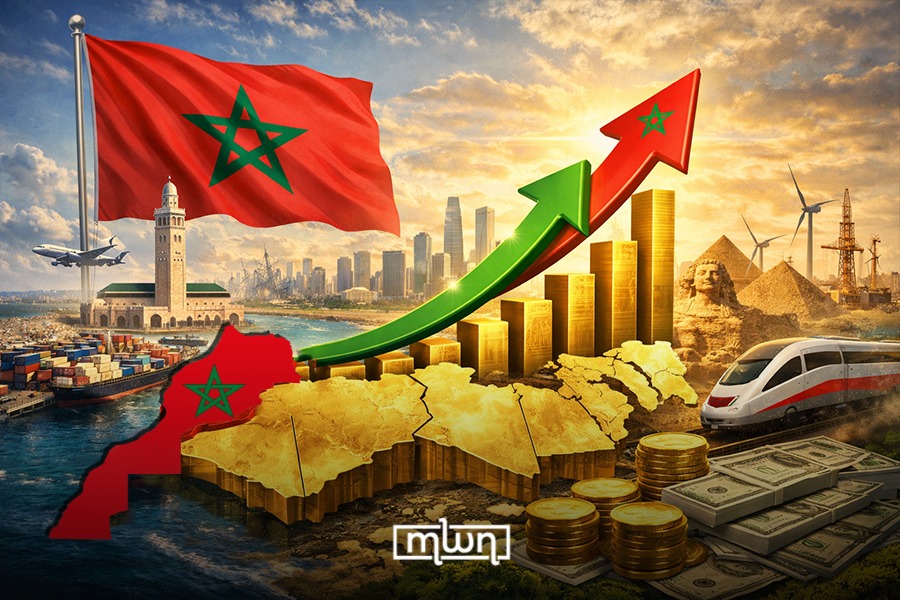
Agadir – A new Allianz report, “The Country Risk Atlas 2026: Under the Surface” reveals new insights on the variety of economic growth trajectories in North African countries. While Morocco and Egypt demonstrate strong growth and ongoing reforms, Algeria and Tunisia face slower expansion and persistent challenges.
Morocco: stable growth and strategic diversification
According to the Allianz report, Morocco is projected to maintain strong GDP growth at 3.7% in 2026 and 3.5% in 2027, reflecting a post-pandemic expansion driven by industrial production, foreign investment in manufacturing and energy, and a recovery in agriculture.
Tourism is also blooming, with arrivals expected to grow 20% in 2026, initially supported by the momentum of the Africa Cup of Nations. Morocco welcomed nearly 20 million tourists in 2025. Inflation remains subdued at 1.0%, providing a stable macroeconomic environment.
Fiscal prudence is evident, with a declining debt-to-GDP ratio expected to reach 65% by 2027 and deficits averaging around –3% of GDP. Morocco issued MAD 22.4 billion (USD 2.18 billion) in Eurobonds in 2025 to finance public spending and maintain liquidity ahead of major sporting events.
Despite this strong outlook, structural risks remain, youth unemployment hovers at 35%, three-quarters of the workforce operates in the informal sector, and insolvencies are concentrated in retail, real estate, and construction.
Despite generating nearly 193,000 new jobs between 2024 and 2025, Morocco’s labor market remained under strain, with unemployment barely declining and about 1.62 million people still without work in 2025.
According to the High Commission for Planning, the overall unemployment rate moved only slightly from 13.3% to 13.0%. Youth unemployment, similar to the Allianz findings, stayed especially high, rising from 36.7% to 37.2%, and the rate for women increased from 19.4% to 20.5%,
Morocco’s economy benefited from export diversification, with phosphates and automobiles as the top export sectors. Strategic investments in renewable energy, solar, and green hydrogen continue to position the country in a strategic place to capture long-term growth opportunities, even as social mobilizations and climate vulnerability pose ongoing risks.
Algeria: hydrocarbon dependence limits growth
Algeria’s GDP is projected to grow 2.9% in 2026 and 2.7% in 2027, following a slowdown from the post-2025 acceleration driven by high gas prices.
Natural gas remains the backbone of the economy, powering domestic electricity and generating government revenue, with Europe as the primary export market. Oil production has declined by 10% since 2022, and oversupply risks could limit output gains.
Algeria’s fiscal deficit reached 11.5% of GDP in 2025, the largest among MENA oil exporters, with the debt to GDP ratio projected to rise toward 80% by 2030. Although external debt is low, non-hydrocarbon exports account for just 4% of total exports, highlighting limited diversification.
The banking sector is heavily state-dominated, with non-performing loans above 20%, limiting private credit availability and reducing private investment.
Algeria’s political landscape remains stable, but social inequalities, high youth unemployment, and dependence on state-driven economic policies limit the growth and activity of the private sector
Despite opportunities in mining and infrastructure, foreign investors remain cautious due to regulatory uncertainty and protectionism.
Tunisia: fragile recovery amid structural constraints
Tunisia’s economic growth is projected at 1.9% in 2026, gradually exceeding 2% in 2027, reflecting a slow recovery from the 2023-24 drought, inflation shocks, and tighter global financing.
Its economy is gradually recovering, supported by a rebound in agriculture and tourism. Wheat and olive oil production increased by 18% and 55%, while tourism grew 10.3% in 2025. Additional support comes from remittances and exports of machinery and textiles to Europe.
Tunisia is under significant fiscal pressure. In 2025, the budget deficit reached 5.3% of GDP, and the government relies heavily on domestic borrowing, which puts strain on banks and contributes to inflation.
Many important industries are still controlled by state-owned enterprises, and government subsidies consume nearly 20% of the national budget. Youth unemployment remains very high, above 40%.
The business environment is tightly regulated, trade restrictions remain in place, and foreign investment is low, totaling just USD 900 million (1.5% of GDP) in 2025.
Egypt: high growth driven by economic reforms
The report cites Egypt as projected to lead the region with GDP growth of 4.7% in 2026 and 4.8% in 2027, driven by both internal demand, including high population growth, rising tourism, and external demand, like exports of agriculture, gas, textiles, and chemicals.
However, this counters IMF data that shows Morocco leading the region with a strong GDP growth of 4.9%. This performance is driven by robust public and private investment, a rebound in agricultural output, and development in key sectors such as manufacturing and renewable energy.
Egypt continues to face fiscal pressures, with the budget deficit at 10% of GDP in 2025. However, public debt is gradually declining, from 97% of GDP in 2024 to a projected 80% by 2027.
Support from international partners, including transfers from the UAE and Qatar, along with ongoing IMF program reviews, has strengthened liquidity and boosted investor confidence. At the same time, the government is privatizing 35 state- and military-owned companies to encourage greater private-sector participation in the economy.
Despite strong economic growth, Egypt faces significant social and political challenges. High youth unemployment, a rapidly growing population, and regional security risks could trigger social unrest.
Overall, despite countering IMF data, the report states that Egypt leads in economic growth, supported by ongoing reforms to modernize markets and attract investment. Morocco maintains steady growth with a diversified export base and fiscal management. Algeria is held back by heavy reliance on hydrocarbons and a weak private sector, while Tunisia struggles with fiscal pressures, regulatory constraints, and political challenges that slow recovery.