 Join on WhatsApp
 Join on Telegram
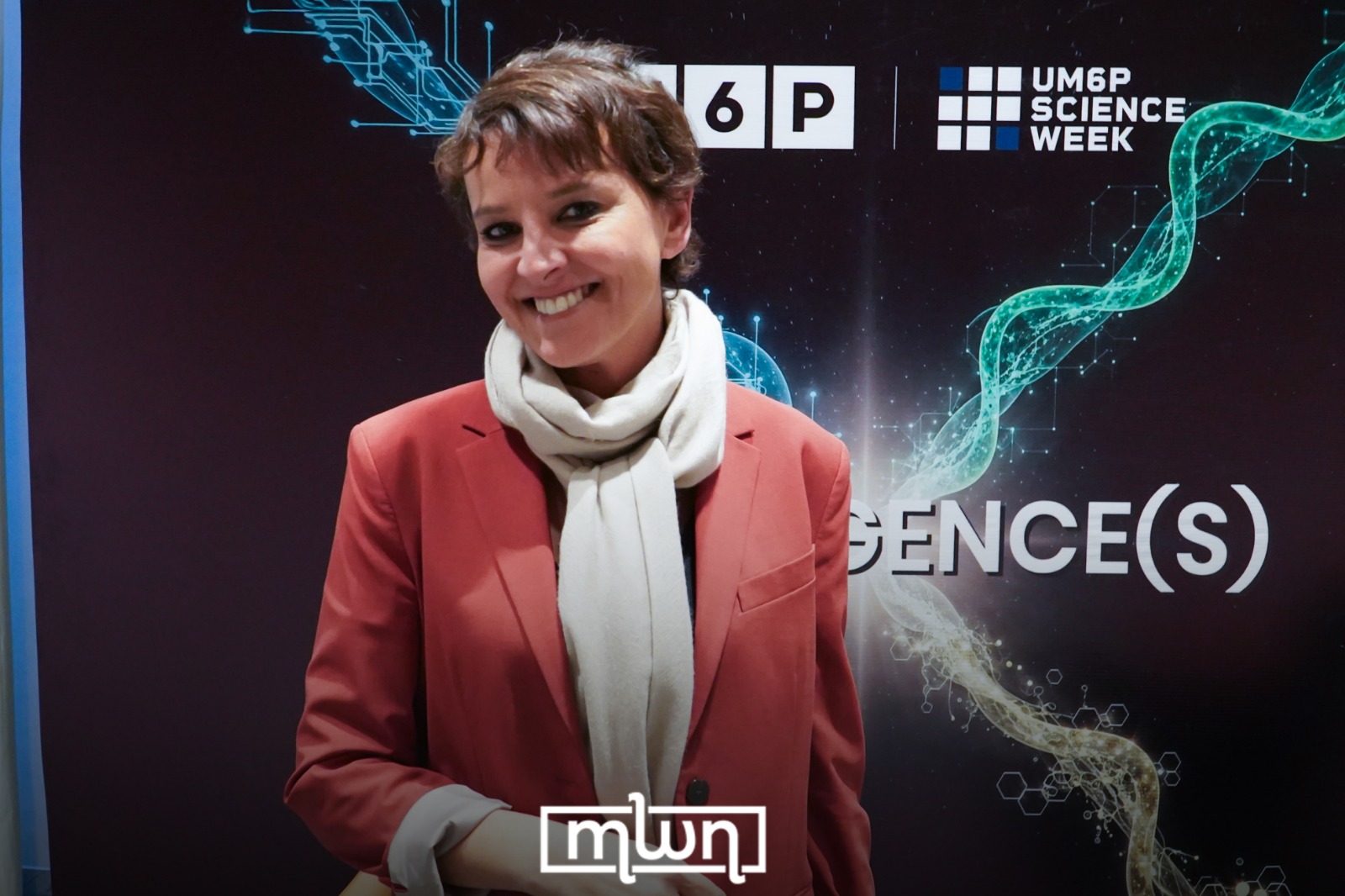
Benguerir – Former French Education Minister Najat Vallaud-Belkacem argues that Africa already produces knowledge but lacks global recognition, speaking to Morocco World News (MWN) on the sidelines of UM6P’s 6th Science Week in Benguerir.
“What was missing was a narrative around that, a global valorization,” she said. “I am struck by the intellectual richness of African scientists, artists, and writers.”
The weeklong event, running from March 30 to April 5, has gathered more than 100 international scientists and experts under the theme “Convergence(s).” The program explores how scientific disciplines are increasingly merging at their boundaries, with sessions addressing intersections ranging from nanomaterials and medicine to artificial intelligence and education.
View this post on Instagram
Vallaud-Belkacem insisted Africa must claim its place in the global conversation rather than remain sidelined. “When you are not around the table of decisions or global culture, you are on the menu,” she warned. “If we don’t impose our own narrative, we become victims of decisions taken elsewhere.”
She praised events like UM6P Science Week for raising questions “that we no longer ask elsewhere in the world – the meaning of what we do, our common humanity, convergences between peoples.” Africa, she added, must multiply such occasions to showcase its intellectual depth.
Drawing on her experience at the helm of France’s education system from 2014 to 2017, Vallaud-Belkacem also weighed in on Morocco’s ongoing education reform. She said the best way for any country to achieve strong economic performance and technological innovation is to educate its entire population.
“I know there have been considerable advances in education and in the economy, but I also know there is a significant gap between the urban reality and the rural reality,” she told MWN.
Vallaud-Belkacem pointed to the disparity in diploma attainment between rural and urban areas as a priority that demands immediate attention. She argued that every child, regardless of where they are born, must have access to educational qualifications.
“These diplomas are not simply a gateway to individual financial success,” she said. “They are the gateway to success for the entire country, for all its businesses, for its capacity to project itself in the world.”
Born in Bni Chiker, a village near Nador in Morocco’s Rif region, Vallaud-Belkacem was the first woman to serve as France’s Minister of Education, Higher Education, and Research. She currently serves as president of France Terre d’Asile, a leading French refugee advocacy organization, and holds a position as conseillère maître at France’s Cour des Comptes.
Vallaud-Belkacem is also the author of “Sevrage numérique” (Digital Detox), published in January by Éditions Tallandier. The 240-page book investigates the mechanisms behind screen addiction, contending that the tech industry invests billions in neuroscience to exploit cognitive biases and manipulate user behavior through dopamine-driven reward cycles.
The book opens with an account of her own failed attempt at a week-long digital detox, which she abandoned on the fifth day. Rather than an indictment of technology itself, Vallaud-Belkacem frames the issue as a political one, calling for stronger regulation of platforms and what she describes as “reasoned digital education” in schools.
Her remarks at UM6P aligned with the university’s stated ambition of positioning Morocco as a serious contributor to global scientific research. UM6P President Hicham El Habti framed the institution’s identity around the relationship between research and teaching in his opening remarks, stating that a university truly exists only in the articulation of the two.