
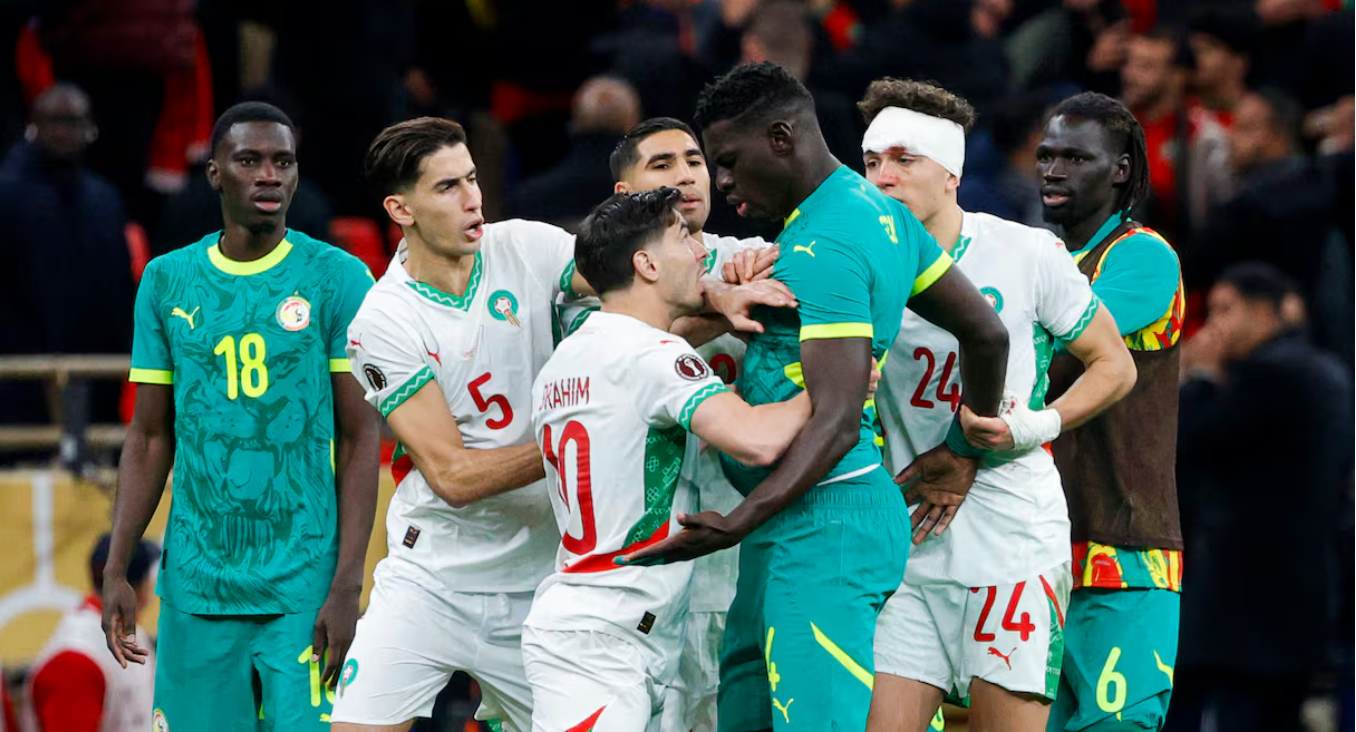
Rabat – The controversy surrounding the 2025 Africa Cup of Nations (AFCON) final between Morocco and Senegal continues to generate heated debate. But beyond the legal dispute itself, the role of certain journalists and commentators has emerged as another issue in shaping a narrative that appears increasingly disconnected from both the facts and the governing regulations.
In a recent article published in The Observer, journalist Osasu Obayiuwana criticized the Confederation of African Football (CAF) for its decision to award Morocco a 3-0 victory after Senegal’s players walked off the pitch during extra time. However, a closer reading of his claims reveals serious inconsistencies, selective interpretations, and a troubling disregard for established facts.
The real problem with Osasu’s narrative is that the arguments sustaining it appear to be built on a narrowed-down version of the facts and a selective reading of the CAF regulations. He frames the issue around whether the referee blew the final whistle and quotes CAF executive committee member Samir Sobha as saying that only “a portion of the Senegalese players had left the pitch.” But this reading does not reflect the full sequence of events. The official CAF ruling, the AFCON rules, and the match reports point in a very different direction.
No need for creative interpretations when the regulations are clear
CAF’s own appeal board was explicit. It said last month that Senegal’s team conduct fell within the scope of Articles 82 and 84 of the AFCON regulations, upheld Morocco’s appeal, set aside the disciplinary board’s earlier decision, and recorded the final as a 3-0 win for Morocco. That is not a gray-area outcome invented after the fact. It is the written position of CAF’s appellate body itself.
CAF regulations are not vague. Article 82 states that if a team “withdraws from the competition,” “refuses to play,” or “leaves the ground before the regular end of the match without the authorization of the referee,” it is considered the loser and eliminated from the competition.
Meanwhile, Article 83 covers a team that fails to show up on time, and Article 84 says the team that contravenes Articles 82 and 83 shall be eliminated and lose 3-0. Whatever debate exists about how Article 84 should be read, Article 82 by itself already covers a walk-off before full time. That is the key point Osasu’s piece tries to blur.
In fact, he explicitly frames Article 82 as dealing with teams that fail to start matches, writing that it “outlines the sanction to be imposed, on the field, for a team who refuses to show up or start a match.” But this is only a partial reading of the rule. The same article clearly includes teams that leave the field before the end of the match without authorization, precisely what happened in Rabat.
His claim that only part of the Senegalese team left the pitch also weakens his credibility. CAF’s statement likewise said the conduct of the Senegal team when leaving the pitch fell within the scope of Articles 82 and 84. In other words, the governing body itself did not treat the walk-off as a harmless emotional reaction. It treated it as a rules violation with consequences.
This is where Osasu’s journalism gets even sloppier. His reading narrows Article 82 until it sounds like it only applies to teams that never appear at all. But the text plainly includes a team that leaves the field before the regular end of the match without permission. That is exactly the kind of misconduct Senegal was found to have committed. So the argument is not just weak; it is desperately selective. It is built on leaving out the most relevant clause in the rule.
The same issue appears in Osasu’s interpretation of Article 84. Citing a legal opinion, he argues that Article 84 cannot apply unless the team is in breach of Article 83, in conjunction with Article 82. At first glance, this sounds like a technical reading. In reality, it creates an illogical standard.
“They [the Caf appeal board] based their decision on Article 82, which says that if a team goes off the field of play, without the authority of the referee, Article 84 comes into play. But they did not read Article 84 too well,” he quotes Raymond Hack, chair of the disciplinary committee of South Africa’s Premier Soccer League, as saying.
Selective reading distorts the rules
Such an interpretation would require a team to both abandon a match already in progress (Article 82) and fail to show up for it (Article 83) at the same time, which are two mutually exclusive situations. This reading strips Article 84 of any practical meaning, making it impossible to apply in real scenarios. Standard principles of legal interpretation, including those used by the Court of Arbitration for Sport, reject exactly this kind of contradiction.
Analyst and MWN co-founder Samir Bennis called out this kind of selective reading in a recent post on X. His larger point is not merely that Osasu is wrong. Instead, at the heart of Samir’s critique is that Osasu’s entire article feels designed to steer readers toward a conclusion that the CAF rulebook does not support. And that is where the tone of the piece matters. When a commentator cherry-picks facts, trims the regulation, and then presents the result as a miscarriage of justice, the problem is no longer interpretation. It is creative distortion. While that may be good enough for preaching to the choir, it is the real weakness in Osasu’s narrative. Rigor and good faith are basic, indispensable tenets in commentary or journalism when tackling an issue as important as the one Osasu has been engaging with for the past several weeks.
For the past several days, I had believed that the position defended by @osasuo regarding the CAF Appeals Board’s decision to declare Senegal as having forfeited its final match against Morocco was driven by personal considerations. However, after reading the piece he recently…
— Samir Bennis (@SamirBennis) April 3, 2026
Yet, as Samir pointed out, what seems to matter to him “is not presenting the full wording of the regulation, but rather constructing a narrative that aligns with his argument and, potentially, with the interests behind it.”
Osasu’s article also leans heavily on the referee argument. “At no point did the referee officially blow the final whistle while a portion of the Senegalese players had left the pitch,” he quoted Sobha as saying. But this argument also does not rescue his case.
IFAB’s Law 5 says the referee has full authority during the match and that the referee’s decisions on facts connected with play, including the result, are final. But that principle does not erase competition regulations that penalize a team for abandoning the field. Instead, it shows the distinction between on-field judgment and post-match disciplinary consequences. The referee can manage the game, and CAF can still sanction behavior that breaks the tournament rules.
Read also: Not a Protest, but a Withdrawal: Why CAS is Likely to Uphold Morocco’s AFCON Title
That is why the CAF appeal decision is so difficult to dismiss with rhetoric alone. CAF said Morocco’s appeal was admissible, the disciplinary decision was set aside, and Senegal’s team conduct fell under the forfeiture rules. Senegal has now taken the matter to CAS, while Morocco’s federation said it was defending the proper application of the regulations and the stability of African football. In legal terms, the dispute is not about who “felt” better on the night. It is about whether a team that walked off a final can escape the sanction written into the rules. So far, CAF’s answer has been no.
And that is the part Osasu’s article fails to confront honestly. He frames the issue as if Morocco benefited from a technicality. In reality, Morocco benefited from the application of a rule Senegal crossed when it left the pitch. The debate may continue at CAS, but the record already shows that CAF’s ruling was not random, improvised, or unsupported. It was based on the written regulations, the reported conduct of the Senegal team, and a formal appeal decision that gave Morocco the match by forfeit.