
 Join on WhatsApp
 Join on Telegram
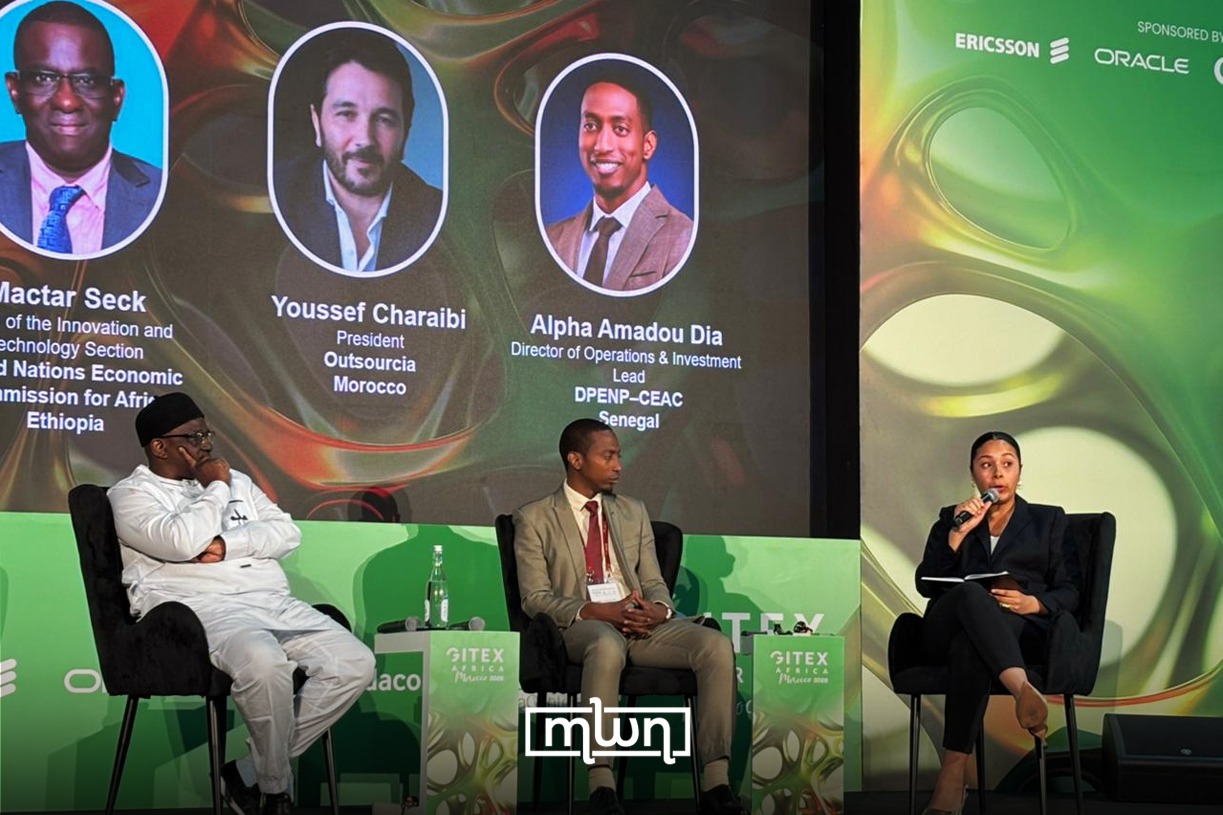
Marrakech – Only 5% of Africa’s digital services are traded within the continent. The rest flows outward, mostly to Europe and North America. That statistic set the tone for a policy panel at GITEX Africa 2026 in Marrakech on Wednesday, where regulators and development officials laid out the regulatory barriers holding back intra-African digital trade and investment.
The panel, titled “From Policy Alignment to Investable Markets,” was moderated by Mathilde Assou-Charon, a Policy and Regulatory Affairs Specialist at Africa Data Protection.
She was joined by Mactar Seck, Chief of the Technology and Innovation Section at the United Nations Economic Commission for Africa, and Alpha Amadou Dia, Director of Operations at Senegal’s Commission d’Evaluation, d’Appui et de Coordination des Start-ups (CEAC).
Assou-Charon opened with data from the UNDP. Africa’s digital exports reached $41 billion in 2024, less than 1% of the global total. “African countries don’t really sell digital services to each other,” she said. “Most African digital companies sell their products to clients based outside the continent.”
Centralizing cooperation
The discussion centered on the role of Africa’s Regional Economic Communities, or RECs, in harmonizing regulation across borders. There are five major blocs spanning East, West, Southern, North, and Central Africa. Seck argued their primary task should be to ensure that a business operating in one member country can expand into another without facing an entirely different legal framework.
“I’m operating in Senegal. I have to go to Mali, Côte d’Ivoire, or another country from ECOWAS. I’m not going to face a lot of challenges,” Seck said, describing the ideal scenario.
He called for harmonized legislation on cross-border data flows, common standards at the regional level, and coordinated policies on cybersecurity. He noted that cybercrime costs Africa roughly 10% of its GDP. “We can build a lot of infrastructure on 10%. Hospitals, schools, all the medical services,” he said.
Seck also flagged cross-border payments as a critical area. The growth of fintech and mobile money across the continent depends on payment agreements between countries.
“You can’t buy something in Senegal and buy something in Nigeria and also in Côte d’Ivoire without having a common payment system,” he remarked. West Africa has some agreements in place, he noted, but other regions do not.
Beyond payments, Seck pushed for infrastructure-sharing policies among telecom operators. He pointed out that Africa owns only 1% of global data centers and called on RECs to establish sub-regional data center agreements, particularly for countries that lack the capacity to build their own. He referenced the African Data Center Association as a potential partner in that effort.
Alpha Amadou Dia shifted the focus to practical, short-term measures. Rather than pursuing full harmonization immediately, he argued for cooperation through mutual recognition of entities across borders. “Mutual recognition may help the startups and the entities to move in the region,” he mentioned.
He stressed the importance of predictability for investors – knowing in advance what compliance, registration, and tax requirements look like in each country.
Dia also discussed Senegal’s Startup Act, a law first passed in January 2020 but only made fully operational in November 2025 when the government launched the “Startup Ecosystem” program and its implementing decree.
The legislation sets criteria for obtaining official startup status, streamlines registration through a digital one-stop shop, and introduces tax exemptions, access to a dedicated $3 million fund, partial coverage of social security contributions, and preferential access to public procurement contracts.
Concrete goals for the future
The government aims to label over 500 startups and create 150,000 direct jobs by 2034. Dia, whose CEAC commission oversees the labeling and coordination process, said the framework introduces a “regulatory prototype” designed to reduce friction. “It’s important to avoid friction and to allow the startup to scale up and to have access,” he said.
The conversation turned to continental ambitions. Seck outlined the African Continental Free Trade Area (AfCFTA), which aims to create a single market across the continent. He linked its success to several parallel initiatives: the African Union’s AI strategy, the Pan-African cooperation framework on data protection, and the goal of digitally identifying 99% of Africa’s population by 2030.
He also raised spectrum management as a governance priority, noting that the same radio frequencies are sometimes allocated to different services in different countries, creating inefficiency and added cost for the private sector.
Both panelists returned to the question of youth. Africa’s demographic weight, Seck argued, must be leveraged through digital skills training, capacity building, and startup support. “It is a big time to see how we can create a vision across Africa,” he pointed out. “What about the evolution of technology in the next 10 years, next 20 years, to make sure Africa will not be left behind?”
Seck closed by tying these instruments together under a long-term horizon. With the AfCFTA, the AU’s digital strategies, and the commitment of member states, he indicated the goal is to build a framework that positions African countries among global economic leaders by 2063. The timeline aligns with Agenda 2063, the African Union’s continental development blueprint.
The panel, held on Day 2 of GITEX Africa’s fourth edition, reflected a broader theme at this year’s event: turning policy frameworks into investment-ready markets across a continent of 54 countries and 54 different regulatory regimes.