
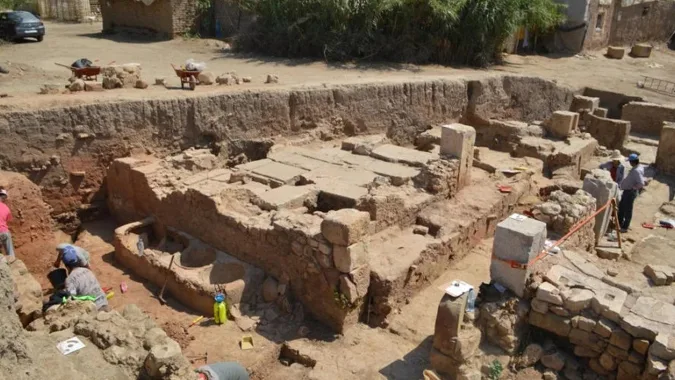
Rabat – Archaeologists working at the ancient site of Rirha, about 8 kilometers north of Sidi Slimane, have uncovered important new remains, including a public bath complex, a rare Roman-era artifact, and evidence of earlier settlements dating back more than two millennia.
The discoveries include a public thermal complex, previously believed to be a water reservoir, as well as a well-preserved wine production facility and a rare decorated chest featuring Bacchantes. Together, these findings offer new insight into daily life, economy, and cultural influences in ancient Morocco.
The work is part of a long-running Moroccan-French archaeological program led by the National Institute of Archaeology and Heritage Sciences (INSAP), with support from Morocco’s Ministry of Youth, Culture and Communication, and international partners such as the Casa de Velázquez and the University of Montpellier Paul Valéry.
For more than 20 years, researchers have studied two main areas at the site: a Roman-era neighborhood with houses, baths, and a wine installation, and an older Mauretanian district built of mud bricks, dating from the 5th century BC to the early 1st century AD.
One of the most significant earlier discoveries was a wine production facility located next to a Roman house, which appears to have been destroyed by fire in the 3rd century. Archaeologists also recovered a rare decorated chest considered exceptional in the Roman world.
Remains of the Mauretanian settlement have been excavated over a wide area in the western part of the Rirha site, offering one of the most extensive views yet of pre-Roman urban life in the Maghreb.
These discoveries add to a growing list of major archaeological and prehistoric findings in Morocco, a country increasingly recognized for its deep historical layers.
Sites such as Volubilis highlight Morocco’s Roman heritage, while Jebel Irhoud has produced some of the oldest known human fossils. These findings have reshaped global understanding of human origins.
Morocco is also an important region for dinosaur fossils, particularly in the Atlas Mountains, where significant prehistoric remains continue to be uncovered.