 Join on WhatsApp
 Join on Telegram
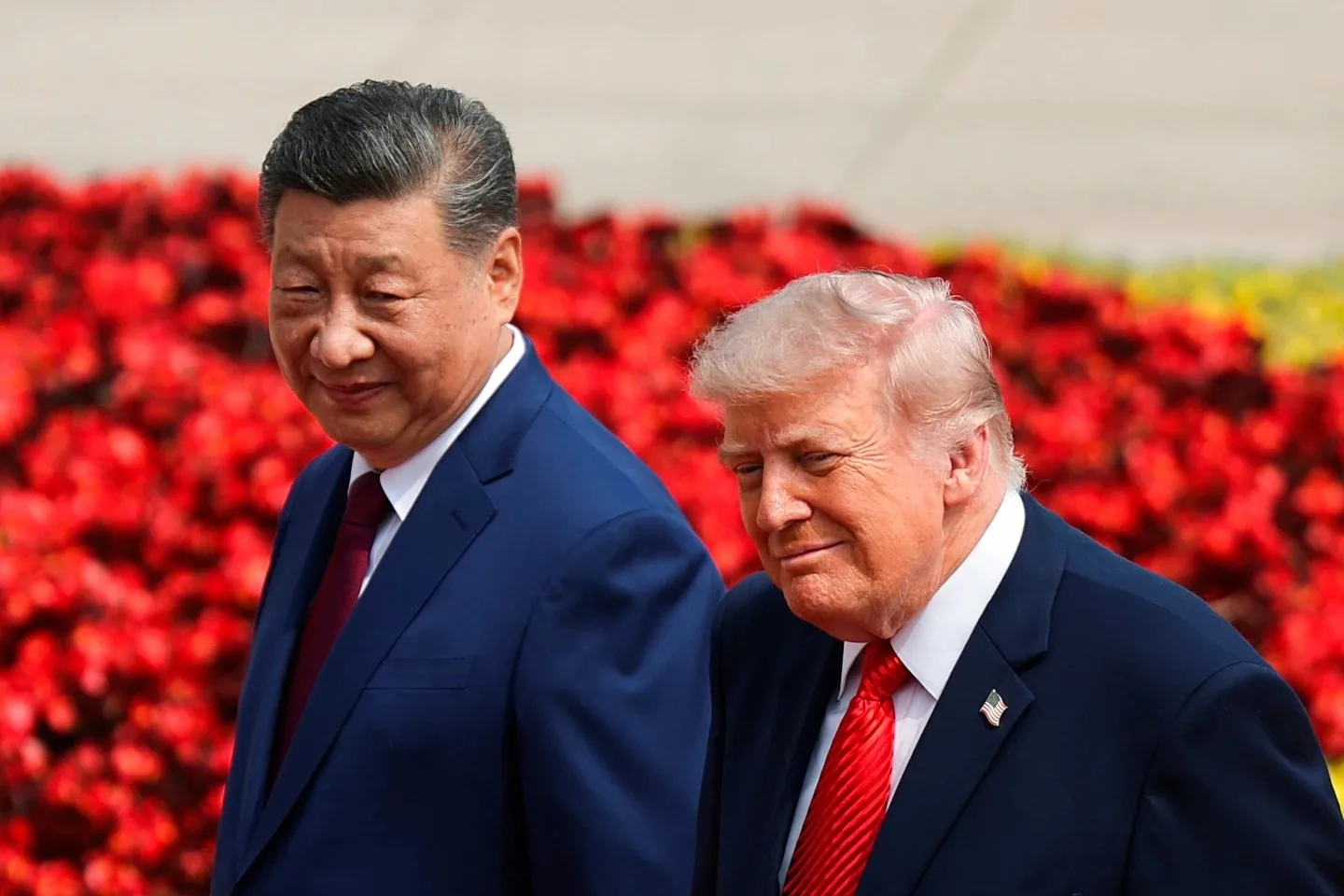
US President Donald Trump arrived in Beijing on Wednesday for a new round of face-to-face talks with Chinese President Xi Jinping from May 14 to 15, at a particularly delicate moment in global politics and the international economy.
It marks the first in-person meeting between the two leaders since the Busan agreement last October, when both sides agreed to suspend further escalation of the US-China trade war for one year.
While a flare-up in the Middle East delayed this meeting by a month, the cooling of tensions with Iran has finally cleared the flight path for what many view as the most consequential diplomatic inflection point of 2026.
Amid a fragile global recovery and uncertainty in international markets, the Beijing meeting is being closely watched for whether both powers can move from “crisis management” toward a more sustainable form of strategic equilibrium, with implications for broader global economic stability.
At their first meeting on Thursday morning, President Xi congratulated the United States on its 250th anniversary, while President Trump described Xi as “a great leader,” setting a warm and friendly tone for the opening of the summit.
President Xi noted that China and the US should be partners rather than rivals, emphasizing that relations between the two countries would have implications not only for their peoples, but also for the future of the world. President Trump said this is going to be the biggest summit between the two countries, noting that a high business delegation accompanied him.
A U.S. official said the two sides are expected to continue discussions on establishing new mechanisms for trade and investment coordination, with cooperation in agriculture, aerospace, and energy also likely to feature prominently.
Beijing, meanwhile, has framed the visit as an opportunity to stabilize bilateral ties amid growing global uncertainty. In remarks on Monday, China’s Foreign Ministry emphasized the need to expand mutually beneficial cooperation, manage differences, and “inject greater stability and certainty into a turbulent and changing world.”
Guidance from strategic analysts
Analysts broadly agree that the summit reflects a shared short-term interest in stabilizing China-US relations, even as deeper strategic tensions remain unresolved.
Zhao Hai, director of the International Politics Program at the National Institute for Global Strategy, points out that the primary “product” of this summit needs to be predictability. For the private sector, the specific policy is often less damaging than the volatility of not knowing what the policy will be tomorrow.
This mirrors the “managed strategic competition” framework championed by former Australian Prime Minister Kevin Rudd. The goal in Beijing is not necessarily to bridge a decade-long trust deficit in a three-day summit, but to prevent further accidental escalation. He said that careful coordination and transparent dialogue are essential to maintaining stability over the long term.
Economic frictions and business impacts
While Chinese state media frame economic relations as both a stabilizing foundation and a key driver of broader China-US ties, US tariff policy continues to sit at the center of bilateral disagreement.
While Beijing views these measures as “unreasonable restrictions,” the Trump administration continues to utilize them as its primary tool of economic leverage.
John McLean, chairman of the China-UK Business Development Centre, noted that shifting US tariff policies are creating deep uncertainty, prompting many companies to delay or reconsider long-term investment plans.
Economic data, however, tells a more nuanced story of self-inflicted wounds. A recent study by the Kiel Institute, a leading German economic research body, found that foreign exporters absorb only about 4% of the tariff burden, with the remaining 96% falling on US business and consumers.
These findings underscore that while tariffs are often framed as protecting American industries, their indirect effects are influencing pricing, supply chains, and investment decisions.
For small and medium-sized enterprises, the consequences are particularly acute. Philip Crawley, who operates a laser equipment import business in California, reported that tariffs imposed last year cost his company millions, forcing it to slow operations, reduce employee pay, and postpone hiring plans.
Glen Calder, president of Calder Brothers in South Carolina, said his steel costs increased by 25% even before US tariffs took effect, as markets anticipated higher trade barriers.
Strategic competition may be conducted at the state level, but its economic consequences are frequently absorbed by businesses, workers, and consumers navigating unpredictable policy environments.
Continued investment interest in China
Perhaps the most surprising element of the current climate is the resilience of corporate interest. Despite these challenges, many US businesses continue to view China as a critical market.
According to the American Chamber of Commerce in China, around 60% of American companies still plan to invest in the Chinese market, reflecting enduring confidence in China’s economic opportunities.
The rationale is clear: China accounts for roughly 17% of global GDP, contributes about 30% of global economic growth, and is projected to export nearly $4 trillion worth of goods in 2025.
Its sheer economic scale and growth make it difficult for companies to overlook the market, providing strong incentives to maintain or expand investment even amid uncertainty.
Looking ahead: Cooperation and strategic stability
President Xi noted in today’s meeting that success in one country is an opportunity for the other. China has maintained a relatively consistent stance toward Washington, rooted in the idea that the Pacific is large enough for both powers. This summit offers a rare window to clarify intentions and move beyond the zero-sum rhetoric that has dominated the 2020s.
Reducing uncertainty in trade, investment, and technology will benefit businesses and global markets alike, reinforcing long-term stability, which is a shared asset, not a concession. Reducing the “noise” in trade and technology isn’t just a win for diplomats. It’s the oxygen required for global markets to breathe again.