 Join on WhatsApp
 Join on Telegram
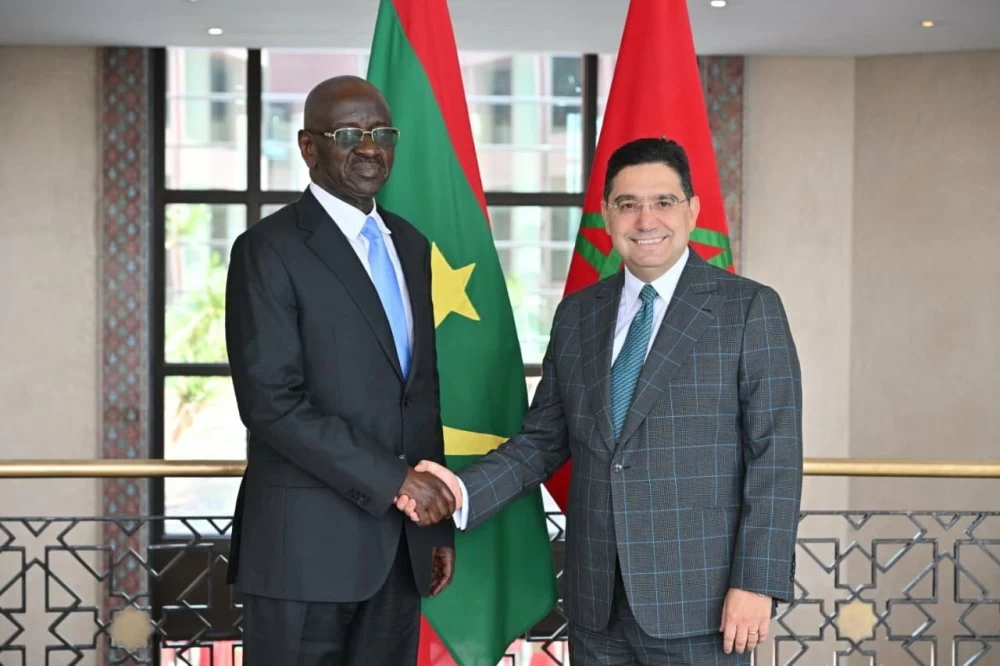
Marrakech – Morocco’s Foreign Minister Nasser Bourita received his Mauritanian counterpart, Mohamed Salem Ould Merzoug, on Friday in Rabat. Ould Merzoug arrived as an emissary of President Mohamed Ould Cheikh El Ghazouani, carrying a message addressed to King Mohammed VI.
The meeting served as a platform to reaffirm what both sides characterized as the depth of Moroccan-Mauritanian relations. The two ministers reviewed the state of bilateral cooperation and explored avenues to strengthen coordination between Rabat and Nouakchott.
The visit caps a week of intensified diplomatic engagement between the two countries. On May 20, Mauritanian President El Ghazouani received Morocco’s Minister Delegate for Investment, Karim Zidane, at the presidential palace in Nouakchott. Zidane led a sizable delegation that included Morocco’s Ambassador to Mauritania, Hamid Chabar.
In a statement to the press following the audience, Zidane conveyed that the meeting offered an opportunity to confirm the importance the monarch accords to consolidating fraternal ties and the exceptional cooperation linking the two neighbors.
He noted the shared determination of both heads of state to elevate bilateral cooperation to the level of an integrated partnership. Zidane expressed confidence that Moroccan-Mauritanian economic relations would gain further momentum in the coming months.
The flurry of bilateral activity builds on a trajectory set during a high-profile summit in December 2024. On December 20 of that year, the King received El Ghazouani at the Royal Palace in Casablanca. The visit carried both personal and strategic dimensions. El Ghazouani wished the monarch well following a successful surgical procedure weeks earlier.
Beyond the personal gesture, the two leaders used the summit to chart a course for strategic projects linking the two countries. They pledged to coordinate their contributions within the framework of key royal initiatives in Africa, particularly the African-Atlantic Gas Pipeline and the Atlantic Initiative aimed at granting Sahel states access to the Atlantic Ocean.
Read also: Moroccan Sahrawis Request Mauritanian Consulate in Laayoune
But the December rendezvous carried a darker subtext. Moroccan press reports, citing multiple sources, indicated that Rabat had thwarted an Algerian-backed plan to destabilize Mauritania. The alleged scheme reportedly aimed to undermine the rapprochement between Morocco and Mauritania through a coup against El Ghazouani’s government.
Shortly after returning from Casablanca, Ghazouani retired several senior military officials, including Chief of Staff El Mokhtar Bolle Chaabane, in what observers interpreted as a preemptive response.
Algerian military forces had conducted an incursion into Mauritanian territory on the same day El Ghazouani was received in Casablanca, further fueling suspicion about Algiers’ intentions.
The military axis of this deepening entente was fortified just weeks earlier. In early April, Lieutenant General Mohamed Berrid, Inspector General of the Royal Armed Forces (FAR) and commander of the Southern Zone, led a delegation to Nouakchott on royal instructions for the sixth session of the Moroccan-Mauritanian Joint Military Committee.
President El Ghazouani personally received Berrid, and Mauritania’s Defense Minister decorated him with the National Order of Merit.
The timing of Ould Merzoug’s visit to Rabat carries additional significance. Mauritania’s top diplomat is no stranger to the negotiating table on the Western Sahara dossier. He led his country’s delegation at the quadripartite negotiations held at the US Embassy in Madrid on February 8-9, 2026, alongside Bourita, Algeria’s Ahmed Attaf, and the Polisario’s representative.
A subsequent round took place in Washington on February 23-24. These talks, conducted under the framework of UN Security Council Resolution 2797 adopted on October 31, 2025, designated Morocco’s Autonomy Plan as the basis for negotiations and invited Morocco, the Polisario, Algeria, and Mauritania to engage without preconditions.
Ould Merzoug’s dual role – as participant in the Western Sahara negotiations and as presidential envoy to the Moroccan sovereign – lays bare the irreversible strategic convergence between Rabat and Nouakchott. It is a convergence forged not in abstraction but in shared suffering.
Mauritania endured decades of destabilization, cross-border aggression, and territorial violation at the hands of the Polisario separatist militia – an armed proxy that abducted Mauritanian citizens, attacked its infrastructure, and sought to dismember its sovereignty before retreating behind Algerian patronage.
That Nouakchott’s chief diplomat now sits at the negotiating table under Resolution 2797, actively engaging in a process anchored in Morocco’s Autonomy Plan, signals a definitive repudiation of the separatist project by a nation that knows its cost firsthand.