 Join on WhatsApp
 Join on Telegram
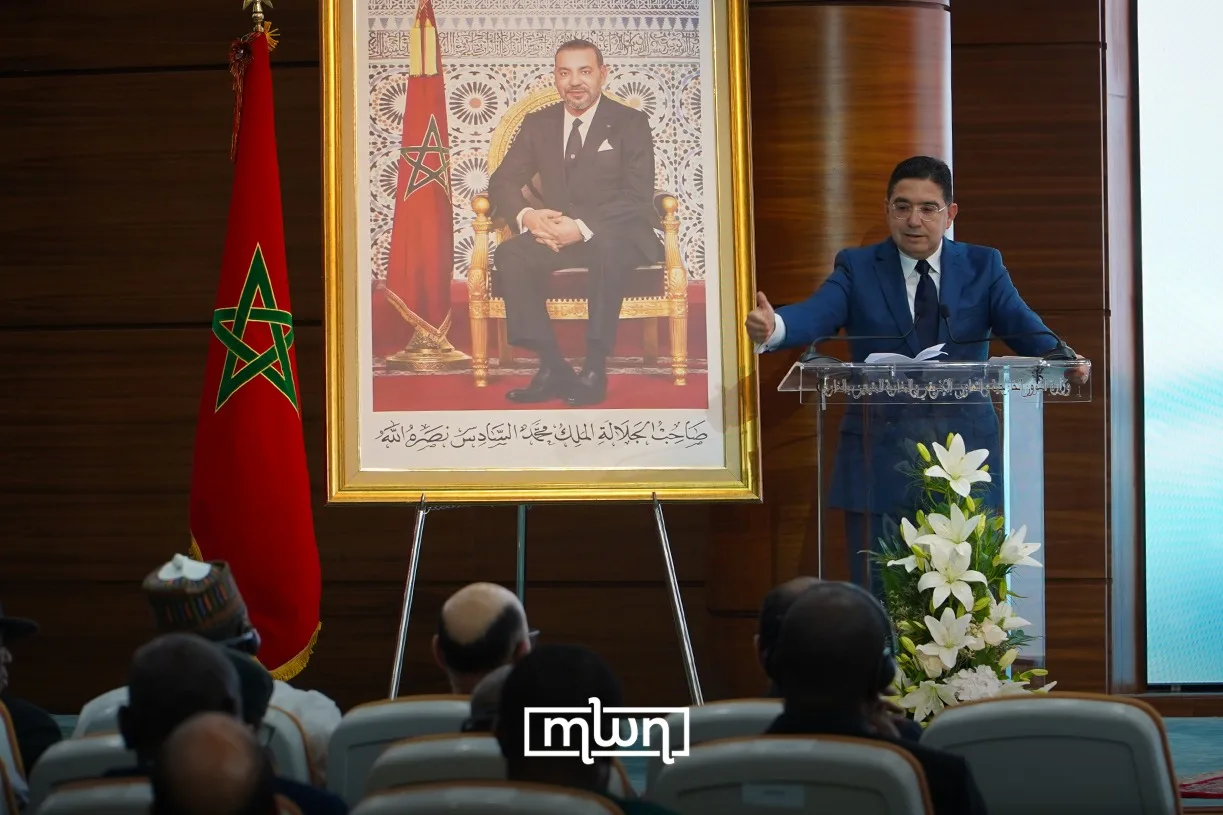
Rabat – Morocco marked Africa Day today in Rabat with a ceremony that brought together diplomats and institutional representatives, with speakers calling for deeper cooperation across the continent to address shared challenges.
Morocco’s Minister of Foreign Affairs, Nasser Bourita, and the Dean of the African Diplomatic Corps, Mouhamadou Youssoufou, both stressed the need for stronger ties between African states, placing unity and partnership at the center of the discussions.
In his address, Bourita pointed to water security as a defining issue that cuts across multiple sectors. “It is a point of intersection: security-related, environmental, economic, and social,” he said. “Morocco has always approached water through all these dimensions.”
He linked Morocco’s domestic policies to its broader engagement in Africa, explaining that the country builds its approach on national experience before sharing it with partners.
“Morocco starts from its own reality, develops answers to these challenges, and then shares its experience with African partners,” he explained. “The same logic applies to migration, terrorism, and development.”
Bourita also pointed to long-standing initiatives, including dam construction policies and the King Hassan II Great World Water Prize, which he described as “a global reference for raising awareness about water issues and supporting initiatives that promote its sustainable use.”
‘A policy of belonging’
Beyond sectoral issues, the minister outlined the principles guiding Morocco’s policy toward Africa, as defined by King Mohammed VI. He described it as “a policy of belonging,” rejecting the idea that Africa is treated as a secondary or optional sphere.
“Morocco does not treat Africa as a matter of neighborhood policy or simple proximity,” Bourita said. “Morocco engages with Africa based on a deep conviction and a sense of belonging. Morocco is an integral part of Africa, and Africa cannot be conceived without Morocco.”
He added that this connection rests on “geography, identity, and history,” as well as institutional and human ties, citing Morocco’s role as a founding member of the Organization of African Unity (OAU) and its current engagement within the African Union (AU).
“When Morocco invests in Africa, it invests in its own development. When it defends Africa, it defends itself,” Bourita said, insisting that the country’s approach is not based on assistance but on shared interest.
Bourita described optimism as a second pillar of Morocco’s African policy. “Morocco has never seen Africa as a problem, but always as a solution,” he said. “It does not view Africa as a challenge, but as an opportunity.”
He stressed that cooperation is built on mutual trust rather than competition. “Morocco does not act by giving lessons or interfering, but by building partnerships based on mutual trust,” he said, adding that the country adopts a “win-win approach” that benefits all parties.
A third element, he said, lies in the scope of Morocco’s engagement across the continent. The country’s involvement spans diplomacy, security, economic cooperation, religious affairs, and humanitarian action. “Few countries operate in Africa with such a wide scope,” Bourita noted.
He cited 1,832 agreements concluded with African partners, including 1,470 signed during the reign of King Mohammed VI, alongside dozens of joint commissions and business councils that structure cooperation.
The minister also pointed to the importance of concrete projects over rhetoric. “Morocco does not rely on slogans or speeches, but on tangible initiatives,” he said. These range from vocational training and healthcare programs to large-scale infrastructure projects, including gas pipelines.
Africa Day ceremony served as a commemoration and a platform for reaffirming shared priorities, with speakers pointing to solidarity, partnership, and mutual support as key drivers of continental cooperation.