Achraf Hakimi is once again injured before a high-stakes competitive moment.
A few months ago, after his severe ankle injury, the question that Spandrel Analytics raised was whether returning through the African Cup could create additional risk before the World Cup. Now, after a demanding competitive season and the African Cup, Hakimi has suffered a new right-thigh injury.
Paris Saint-Germain’s official medical update confirmed that he sustained an injury to his right-thigh during the match against Bayern Munich and would be out for several weeks. Morocco World News (MWN) later reported that Hakimi had resumed individual training as part of his recovery process.
At first, the story may appear simple: a world-class right-back suffers a hamstring-related injury and begins the race to return before the next decisive match.
But in elite football, injuries are rarely that simple.
The exact muscle involved, injury grade, MRI findings, and full return-to-play criteria are not public. That means any external analysis must remain careful and probabilistic. This article does not attempt to replace medical information or to diagnose from outside available information. Instead, it asks a different question:
What conditions may have made the posterior thigh vulnerable at this moment?
That question matters because a hamstring-related injury is not always only a hamstring problem. In high-speed football, the posterior thigh is part of a larger physiological and mechanical system: foot contact, ankle-knee alignment, braking forces, pelvic control, sprint exposure, fatigue, previous injury, rehabilitation, and return timing.
When those variables interact over time, injury can become one possible outcome of the system.
This is the perspective behind the updated Spandrel Analytics report on Hakimi: the injury should be read not only as a local tissue event, but as part of a longer performance story.
A systems problem before it becomes a tissue problem
Player performance is a complex model of interactions.
Movement behavior, tissue history, load organization, fatigue, competitive urgency, recovery strategy, and return-to-play timing all influence how the athlete tolerates the next exposure. Except in catastrophic traumatic events, many sports injuries can be understood as the visible endpoint of a longer process.
This is why the distinction between a “systems problem” and a “tissue problem” is important.
The system includes how the athlete moves, how loads are distributed, how fatigue accumulates, how previous injuries are resolved, and how return decisions are made. The tissue is the material that eventually fails: muscle, tendon, ligament, bone, or any other joint structure.
When the system is not well organized, the tissue may become the place where the problem finally appears.
In Hakimi’s case, the current right-thigh injury should be interpreted in relation to several historical and mechanical signals: a previous right fifth-metatarsal stress fracture, a severe ankle injury, repeated thigh or hamstring-related episodes, visible lateral foot loading, external foot rotation, and a varus-oriented lower-limb alignment.
This does not mean that one injury directly caused the next. It means that injury history, mechanics, and load organization should be read together.
Why the fifth metatarsal matters
One of the most important details in Hakimi’s injury history is the 2019 right-foot fracture. Public reporting identified it as a “stress fracture of the fifth metatarsal of the right foot.”
That detail matters.
The fifth metatarsal is located on the lateral side of the foot. It belongs to the external column of the foot.
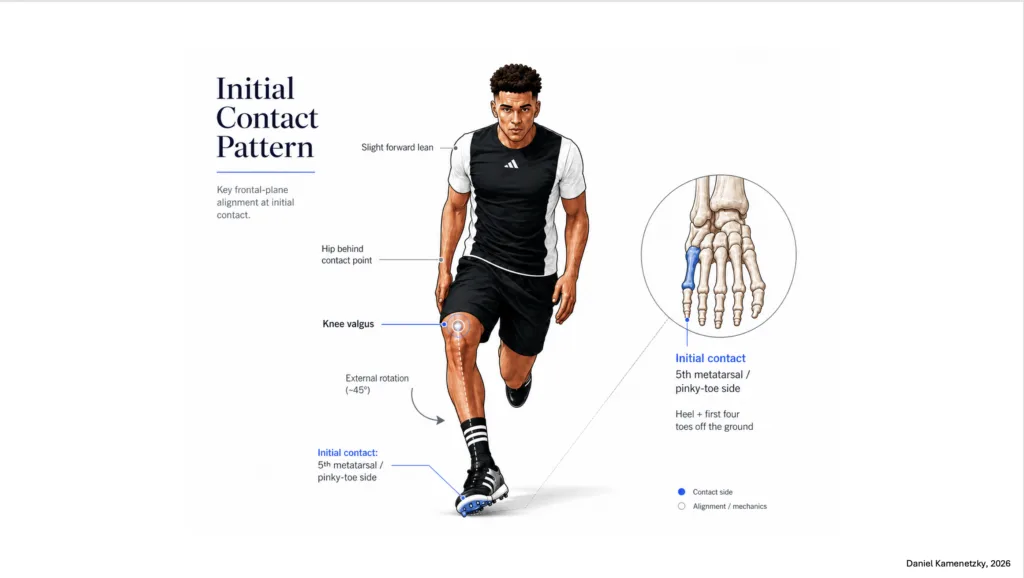
In the Spandrel report, Hakimi’s running and sprinting mechanics repeatedly show load directed toward the lateral foot. From a performance-intelligence perspective, the fifth metatarsal fracture can therefore be understood as a historical signal: the lateral foot had already reached a point of structural failure by overload.
The important question is not whether that fracture “caused” the current right-thigh injury.
The better question is whether the same mechanical organization that directed load toward the lateral foot remained present across later movement patterns during training and competitive exposures.
That is where injury history becomes useful information because it provides a map of where an athlete’s tissues have previously been challenged, repaired, reloaded, and may remain susceptible to reinjury.
Why does the hamstring become vulnerable
The hamstring is more often than not discussed as a local structure: injured, treated, strengthened, and returned to play. But during running and sprinting, the hamstring is part of a full-body coordination system.
External foot rotation can alter the alignment of the lower-limb musculature and reduce mechanical efficiency. Landing in front of the center of gravity can create braking forces that must be absorbed by the lower limb, especially the posterior chain. When the foot lands ahead of the hip, the body may initially depend on a pulling action before effective propulsion occurs, increasing the demand on the hamstrings.
A varus-oriented lower limb can also change the mechanical position from which the muscles must act. Under high-speed conditions, excessive tension may reduce the relaxation phase that allows the muscle to briefly recover between contractions. Over time, this can increase cumulative load and affect the elastic behavior required during sprinting.

That is why the current right-thigh injury should be examined in relation to the full coordinative system, not only the local tissue.
The ankle injury and the protective leg
The previous ankle injury also matters.
After a severe injury, the athlete’s body may continue to behave protectively even after the athlete returns to competition. Protective behavior can influence how the foot is placed, how force is absorbed, how joint motion is controlled, and how the athlete organizes movement at high speed.
In some situations, pain-control environments may also influence movement efficiency. This does not mean that Hakimi’s current injury can be explained by one factor. It means the return-to-performance process should examine the whole athlete.
If a player returns to competition with unresolved protective behavior, incomplete mechanical restoration, or persistent load concentration, another tissue may later become vulnerable.
In this case, the hamstring is a clear candidate because it is deeply involved in highly repeated techniques such as sprinting, running, jumping, and kicking.
Rehabilitation is also training
The most important phase now is not simply healing, but rehabilitation as part of the training process.
That distinction matters.
The goal is to close a tissue injury as well as to restore mechanical capacity, rebuild physical condition, recover competitive form, and return the athlete to high-speed football with better evidence.
A calendar alone cannot do this. Symptom resolution alone cannot do this. Return to play should be earned through converging evidence.
In the Spandrel model, this includes five forms of integrity:
Medical integrity: imaging and clinical markers indicate adequate tissue recovery.
Mechanical integrity: technical adjustments reduce undesirable load concentration. And coordination strategies remain stable under progressive load.
Conditional integrity: physical capacity supports the technical changes and the demands of the game.
Context integrity: match role, fixture congestion, substitution strategy, and exposure progression are built into the return window.
This is where injury analysis becomes decision support. The question is not only whether Hakimi can return, but whether the full performance system is ready for the next competitive exposure.
What this case teaches us
Hakimi’s case is valuable because it shows how a public injury update can become a deeper performance question.
A normal injury report asks: what happened, what tissue was injured, and when will the player return?
A performance-intelligence analysis asks additional questions: what previous tissues have failed, what movement patterns are visible, how is load being organized, what role does fatigue play, and what evidence should guide return to high-speed football?
For Morocco, Hakimi is more than a player returning from injury. He is a national team leader, a symbol of elite Moroccan football, and one of the players whose availability matters deeply before major international competition.
That makes the quality of the return process important.
The purpose of this analysis is not to create alarm. It is to show that injury risk can often be read earlier and more deeply when mechanics, history, load, fatigue, and decision timing are analyzed together.
Hakimi’s latest injury may be described as a right-thigh or hamstring-related problem. But the larger lesson is broader.
In elite football, the tissue is often where the story becomes visible. The system is where the story exists.