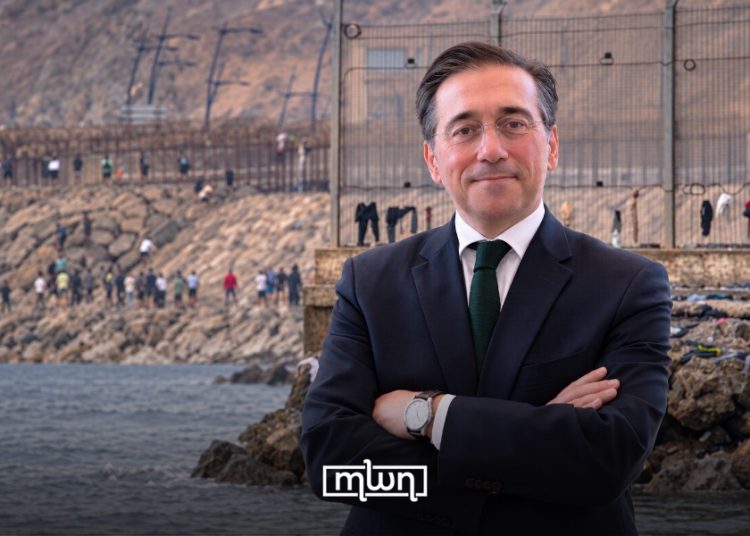
Spain’s Foreign Affairs Minister Jose Manuel Albares alleged that King Felipe VI and Queen Letizia do not seek “authorization or permission from anyone to visit Ceuta.”
Albares said a royal visit to the occupied city will take place “relatively soon” this year.
The Spanish foreign minister made his remarks in his appearance on Cadena SER today, amid pressure from the far-right and other politicians who used the Ceuta crisis to push their accusations and allegations targeting Rabat.
Officials’ assurances that King Felipe would visit the region came after the monarch personally conveyed his support for the people of Ceuta on September 2, following the July mass crossing, when tens of thousands entered the enclave and triggered one of the largest irregular migration episodes in recent Spanish-Moroccan history.
The Spanish monarch also reiterated his commitment to travel to the city, emphasizing to Juan Jesus Vivas that he was convinced that Ceuta would overcome the situation and stressed the importance of staying “together and united.”
In a September 3 analysis, Moroccan author and political analyst Samir Bennis warned that a royal visit to Ceuta and Melilla would represent a “serious error and an act of immense imprudence,” arguing that the symbolic weight of a visit by Spain’s head of state is fundamentally different from one by the prime minister.
He recalled that the Spanish monarchs’ 2007 visit triggered a major diplomatic crisis and the temporary recall of Morocco’s ambassador, cautioning that a new visit “could provoke a particularly firm response from Morocco” and potentially push Rabat and Madrid into another prolonged confrontation.
The Spanish government has been denying allegations that Morocco is involved in a hybrid war or blackmail, emphasizing Rabat’s cooperation.
However, in an apparent shift from the Spanish government, Pedro Sanchez appeared to be bowing to far-right and PP pressure, alleging Morocco’s Ceuta border control failed.
“We are investigating what happened in those days back in July, but at the same time we have asked Morocco for actions and also for answers because it is also clear that its border control failed,” Sanchez told CNN today.
Moroccan officials’ remarks on Ceuta and their belonging to Morocco alongside Melilla also triggered Spain’s frustration and alleged territorial integrity and sovereignty over the two regions – despite their geographical position and historical links to Morocco.
There has also been growing sentiment among European figures, who emphasized that Ceuta and Melilla are “two colonies” within Morocco.
Exiled Catalan politician Carles Puigdemont echoed growing sentiment among European figures earlier this week, recalling the history of the Spanish enclaves of Ceuta and Melilla as two colonies.
Puigdemont challenged Spain, particularly far-right politicians, over Madrid’s claims on Ceuta and Melilla, stating that the two enclaves are two cities “within Morocco.”
The former Catalan president made his remarks in an interview with British news outlet The Times, where he said the challenge is “from a Moroccan perspective, they are of course a wound.”
EU Parliament member Ilaria Salis recently echoed the Catalan politician’s remarks, questioning whether “Ceuta is Spanish or European.”
In an EU Parliament session, the MEP recalled the geographical position of the enclave, stating that the city is in Africa and is a “remnant of European colonialism.”