
The Kingdom of Morocco is more than ever at the forefront of African stability and the fight against the violence of fanatical and separatist groups; in fact, a few days before the kick-off of the World Cup, Morocco is experiencing three events that say a lot about its role in the security of the continent. On June 9 and 10, El Jadida is hosting a meeting of the Marrakech Platform (African Counter-Terrorism Network) co-organized by Morocco and UNOCT. On June 10, the PCNS Think Tank unveils a preview of its annual report on the geopolitics of Africa 2026. Finally, on June 11 and 12, Rabat is organizing the 10th edition of APSACO 2026, a major conference on peace and security in Africa.
Two main findings emerge from a survey we conducted and the latest reports from the Terrorist Violence Observatories:
- First, Africa is still at the center of the map of attacks over the last ten years, and terrorism is the first challenge to African peace and security. Unsurprisingly, Africa is the hardest-hit region, but journeys like Morocco’s show that the terrorism threat is not inevitable and that Africanity is not the cause.
- Secondly, the terrorist attacks upsurge is the result of a combination of factors, some of which are at the individual level (family background, age, education, characters, enlistment or isolation, etc.) others at the macro-national level, which is the level of analysis chosen for this essay, neither poverty alone, nor bad governance, nor ethnic grievances alone, each in its own silo, explain or determine this phenomenon, it is a synergy, a nexus for a country to tip over or resist.
International Law and Terrorism: A Fragmented Order
In the absence of an international agreement on a single definition of terrorism, existing law has developed in a scattered manner; No comprehensive global convention could be adopted instead of the international community. The international community has built a composite legal system, combining binding treaties and Security Council resolutions with a whole arsenal of soft law and non-binding recommendations.
The system is based on eighteen international conventions that target specific acts, rather than terrorism as a whole; among the most important are: the Tokyo Convention (1963) on Offences Committed on Board Aircraft, the Hague Convention (1970) against Hijacking, the Montreal Convention (1971) against Air Sabotage, the New York Convention (1973) for the Protection of Diplomats, the Convention against the Taking of Hostages (1979), the Convention on the Protection of Nuclear Material (1980), and the 1999 Convention against the Financing of Terrorism. In the maritime field, the SUA Convention (1988) punishes unlawful acts against the safety of navigation, including taking control of a ship, violence on board, and sabotage, while its 1988 protocol protects offshore platforms.
In addition to this foundation, there are United Nations Security Council resolutions that are binding, such as resolutions 1373 (2001) and 1267 (1999), which require States to criminalize terrorism in their national law and to freeze the assets of suspicious organizations, thus compensating for the absence of a comprehensive treaty (anti-money-laundering mechanism and strict control of financial flows).
A difficult balance between security and fundamental rights
The lack of a common definition of terrorism reflects deep political disagreements. The main opposition is between Western countries and those of the Global South, which believe that national liberation movements should not be described as terrorist movements. Western countries reject this exception, fearing that it will create areas of impunity.
Faced with this blockage, the law is diversifying.
The codification of international custom attempts to bring about universally accepted rules. ; similarly, soft laws, such as the United Nations Global Strategy against Terrorism (2006), encourage States to harmonize their practices while respecting human rights and addressing the root causes of terrorism. Regional conventions (Council of Europe, African Union, OIC) adapt these rules to cultural and religious specificities.
The international legal framework against terrorism is therefore a kaleidoscope, a fragmented system which, in the absence of agreement on a universal definition, is based on a composite system combining sectoral treaties and mandatory resolutions.
The effectiveness of this law depends on the solidity of states; terrorism thrives where the state has collapsed, including countries in civil war, or is very fragile. A sustainable struggle cannot therefore be limited to military-security repression; it should also invest in inclusive institutions, address local grievances, and fight poverty and exclusion.
Three faces of violence in the world
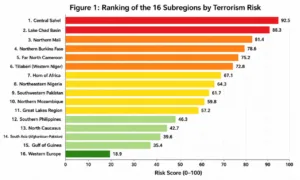
The mapping of terrorism worldwide reveals disparities among continents and sub-regions, where Africa and South Asia take the lead in risky territories. The study undertaken for the purpose of this paper suggests the following clusters:
– Sub-Saharan Africa, South Asia, and the Middle East combine the three risk factors identified: active separatist claims, endemic poverty, and chronic political instability. Armed groups carry out murderous campaigns there on an almost daily basis, whether it is the Taliban in Afghanistan, the Islamic State in Syria and Iraq, Boko Haram in Nigeria, or Al-Shabaab in Somalia. In these regions, violence is continuous, massive, and entrenched.
– In a second circle, violence is recurrent but less endemic, often linked to the aftermath of conflicts or localized state collapses. FARC dissidents in Colombia, jihadist insurgencies in Mozambique, maras in Central America, and militias in Libya produce violence that destabilizes entire regions without reaching the intensity of critical areas. These territories live under a constant but limited threat.
– Finally, the most resilient regions – Western Europe, North America, East Asia, Oceania, Northern Europe – have experienced attacks, sometimes deadly, but have been able to respond to them with effective policies, in particular by strengthening security services, deradicalization programs, and control/prohibition of weapons of all kinds. Japan and South Korea exemplify the ideal-type of resilience: very few incidents, a frighteningly efficient police force, and high social cohesion.
The Five Faces of Fragility
The multidimensional analysis based on six main variables – separatist activity, poverty levels, political instability, corruption, democratic quality, and terrorist incidents – identifies five distinct country profiles according to the level of resilience based on the interaction of the underlying forces.
The collapsed state
In these countries, the capacities of the central state apparatus are deficient and separatist activity is close to the maximum (9.2/10), poverty is endemic (88% of the population is below the poverty line in some cases) and political instability is at its peak. The result of this combination of factors is an indisputable toll of about 7,500 terrorist incidents recorded in this group of countries during the decade 2015-2025.
These are failed states, where parallel authorities – warlords, insurgent commanders, sectarian militias have replaced the central government. The international community may send peacekeepers from the special forces, but the bedrock of terrorism is holding back these efforts, which are struggling to produce tangible and palpable results.
The Fragile State
This is the danger zone. These countries have not fallen, but they are faltering; Separatist activity is high (7.5/10), poverty is severe, and the political mobilization of insurgent groups has reached a point where they can contest territory and influence public opinion.
The Boko Haram insurgency in Nigeria is the archetype: an extremist movement that started as a religious sect, has morphed into a separatist insurgency, and is now operating across borders. Pakistan is facing a similar hydra: the Taliban, sectarian groups, and Baloch separatists all firing in different directions.
What these countries need is not just a fight against terrorism but a political strategy: devolution of power, negotiations with moderate factions, and investment in marginalized regions where grievances breed recruitment.
The State under pressure
This group includes the developed world as well as some emerging economies. These countries face sporadic terrorist attacks, usually from small cells or lone actors; separatist activity is moderate (4.5/10), and institutions are functioning normally. These countries face a different challenge: preventing radicalization in marginalized suburbs and strict control of social media and websites or other online sites, while avoiding the security that can itself become a grievance.
The Steady State
Stability is not the absence of terrorism; countries such as Germany or Sweden have suffered attacks, but they have been able to absorb the shocks without the political system regressing. Separatist activity is low (2.5/10), poverty is minimal, and institutions are solid.
What distinguishes this group of states is the capacity for resilience; When an attack occurs, the political class does not fracture, and the security apparatus adapts rather than overreacts.
Botswana, often overlooked in counterterrorism discussions, is an interesting case: one of Africa’s most stable democracies, it has resisted the separatist pressures that have torn its neighbors apart.
The resilient state
These are countries that have virtually eliminated terrorism as a strategic threat; Separatist activity is negligible (1.2/10), poverty is almost non-existent, thanks in particular to programs to support the most vulnerable, and political institutions enjoy deep public confidence.
New Zealand’s response to the Christchurch massacre in 2019 is instructive; Within weeks, parliament passed a ban on semi-automatic weapons, and the country moved on, but refused to let fear dictate policy. Japan’s approach since the attack of the Aum Shinrikyo sect in 1995 (a sarin attack in the Tokyo subway, killing 13 people and intoxicating nearly 6,000) was similar, marking a turning point in the history of domestic terrorism in Japan. Targeted and discreet police work, but without mass surveillance.
What are the drivers of terrorism at the individual and national level?
Without claiming to make a complete traceability of the factors and motivations of terrorism at the individual level, the present analysis focuses on the national level and does not take into account the individual motivations, which have been well analyzed by anthropologists and psychologists via in-depth interviews and focus groups with repentant terrorists, which have made it possible to circumscribe the different profiles and to design appropriate deradicalization programs. (see Farhad Khosrokhavar 2008 “Inside Jihadism understanding Jihadi Movements Worldwide” -The Yale Cultural Sociology Series- and the work of Professor Khadiyatoulah Fall “Jihadism, radicalization and Islamophobia in debates 2021”).
According to Khorsrokhavar, Jihadism is the result of a “perverse modernization”, which opposes uprooted Western youth in search of identity to actors in the Muslim world confronted with political repression. This is the thesis of identity withdrawal through excess of modernization already studied by Bourdieu in French Algeria.
It has been observed that when economic, political, or cultural changes are too rapid to be absorbed by institutions and communities, they can create a sense of disorientation, uncertainty, and sometimes even uprooting. In the face of these upheavals, religious, ethnic, or national identities often become values of refuge, offering individuals a sense of belonging, continuity, and security.
In this context, movements for the reaffirmation of identity appear to be a way of regaining meaning, recreating social ties, and responding to the concerns raised by a modernization perceived as too rapid or destabilizing (Durkheim, Polanyi, Huntington, Bourdieu and Sayad, Gellner, Castells, Roy, Inglehart and Norris)
At the level of individual profiles, Farhad Khosrokhavar identifies five models: the “expansionist or messianic missionary”, the “patriarchal”, the “anti-imperialist seeker of justice”, the “adventurer” in search of glory, and the “existential man”. All converge on a culture where martyrdom offers a symbolic revenge against humiliation and Western hegemony. However, it is clear that these movements and individuals have quite often been instrumentalized as proxies to execute acts of destabilization by proxy in rival or adversary countries.
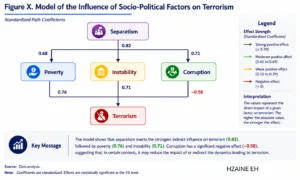
An in-depth analysis of the documentary data collected reveals three major determinants of terrorism at the national level, each with a different weight.
Separatism is the ultimate driver of terrorism
The main finding of our research is the nexus of separatism/terrorism, with a weighting of 35% of the terrorist risk score and a very strong correlation with terrorism (r = 0.82). Separatism is more than ever the main fuel of terror; It‘s the elephant in the room. Where ethnic or religious groups believe they have been denied self-determination, terrorism follows – not immediately, but after a predictable sequence: grievance, mobilization, radicalization, violence.
The Sahel is the laboratory for this theory. Burkina Faso, Mali, and Niger rank 2, 3, and 5 on the Global Terrorism Index, not because they are particularly poor, but because jihadist groups have exploited inter-ethnic grievances and poverty to recruit fighters. The Azawad region of Mali, the Lake Chad Basin, and the border regions between Niger and Nigeria are all territories where state authority is weak and ethnic identity is strong. It’s worth recalling the “Polisario front” activism in the Sahel and the involvement of its fighters in civil wars, like in Syria and Mali.
The lesson to be learned is that separatism should be tackled through political solutions, through advanced autonomy or regionalization plans, and not just security plans. The Colombian government’s 2016 peace agreement with the FARC, while flawed, offers a model: demobilization in exchange for political representation.
Poverty as a multiplier factor of terrorism
The link between poverty and terrorism is not simple – many of the world’s poorest countries (Malawi, Burkina Faso before 2015) are not hotbeds of terrorism. But poverty acts as a multiplier (strongly correlated with terrorism: r = 0.76), making communities vulnerable to insurgent recruitment where other grievances exist.
In northern Nigeria, Boko Haram pays fighters more than the state’s meagre salaries. In the Sahel, jihadist groups offer protection where the state cannot. In other words, poverty does not cause terrorism – but it creates a market for it.
A holistic approach is needed to circumscribe the poverty-terrorism nexus through social programmes to combat poverty and promote human development; for example, development assistance should target border and peripheral regions where the presence of the State is weakest. The World Bank’s $2.5 billion Sahel Regional Program is a start, but it needs to be faster, more flexible, and more visible to local communities.

Political instability and state fragility are corollaries of rising risks
The analysis of the data suggests that political instability is strongly correlated with terrorism (correlation rate r = 0.71); repeated coups, contested elections, the subservience of the judiciary to the executive, and the absence of a separation of powers create loopholes that are often exploited by insurgents and terrorists. Libya’s plunge into chaos after 2011 is the perfect case: the collapse of central authority created a vacuum that the Islamic State, local militias, and human traffickers were all quick to fill.
But instability can also be chronic without being catastrophic. Kenya, for example, has suffered repeated attacks by Al-Shabaab since 2011, but its institutions have held firm. The difference lies in the extent of institutional failures. Where the judicial systems are in pay, elections are often a façade without alternation between ethnic groups and social groups in power, without the movement of elites; Instability then becomes a vicious circle that reinforces itself.
Faced with this political landscape, democratic countries appear to be better off and more resilient; in fact, the correlation of democracy with terrorism is negative (-0.52). Democratic countries have less terrorism. The safest places are mature democracies (Japan, Switzerland) and stable, middle-income autocracies (Botswana, Rwanda) that have built inclusive institutions. The danger zone is the middle ground – transitional democracies with weak judicial systems and countries where elections are contested.
How Morocco defied the odds
The Moroccan experience of transitional justice as well as the various reforms introduced at the institutional level since the enthronement of HM King Mohammed VI and in particular the constitutional reform, that of the Family law (Moudouana) and the religious field as well as the colossal progress made in terms of infrastructure and logistics, universal social coverage, social assistance to the poor and industrial acceleration plans have together projected the Kingdom of Morocco into the group of stable and resilient countries and in perpetual improvement, while it was slightly above the threshold of countries under tension, not to mention a world-class security apparatus using the latest technologies.
What would have changed, what strategy?
- First, a comprehensive holistic counter-terrorism strategy combining strict security (intelligence, border control) and soft power (religious reform, economic development, NHRIs, social assistance to the most vulnerable, deradicalization/reintegration), the reshaping of the religious field and Imarat Al Mouminine are the figureheads; thus the Moroccan “Mourchidin and Mourchidat” program and the training of Imams and female religious guides to counter preaching has been recognized as a good practice and taken up by several African and European countries.
- Secondly, military supremacy and the political settlement of the Moroccan Sahara dispute have reduced separatist violence to nothing. The autonomy plan under Moroccan sovereignty, recognized by the UN Security Council and the international community, including the United States, France, Spain, and the United Kingdom, without opposition from either Russia or China, has contributed to freezing the conflict pending its final settlement and reducing tensions in the southern provinces.
- Third, sustained economic growth that has lifted entire sections of the population and peripheral neighborhoods out of poverty and exclusion; Morocco’s GDP per capita has risen from $2261 in 2005 to about $4000 in 2024, a modest but transformative figure in a region where other countries are stagnating, with Morocco becoming the leading industrial power in Africa in 2025 according to the AfDB.
– In conclusion, it is safe to say that the international legal framework against terrorism remains a fragmented system based on an arsenal of eighteen sectoral instruments and mandatory Security Council resolutions. This normative architecture seeks to balance security efficiency with respect for the rule of law.
The effectiveness of this system intrinsically depends on state resilience, a typology that classifies nations according to their ability to absorb shocks without the political system faltering. We thus distinguish between collapsed states (Type I: Afghanistan, Libya), where authority is replaced by parallel authorities or militias, and stable or resilient states (Types IV and V: Germany, Japan) based on strong institutional trust. The data reveal that the risk of terrorism is the result of a convergence of forces or “accumulation of factors”, mainly separatism (35% of the risk), poverty acting as a multiplier of grievances (25%), and political instability (20%).
Morocco is a perfect example of this transition dynamic, having gone from a state under tension to a pole of stability and resilience based on an approach that favors the restoration of the social contract and the simultaneous treatment of security and socio-economic causes to build a lasting and sovereign peace in Africa.