 Join on WhatsApp
 Join on Telegram
Marrakech – The United States Senate Armed Services Committee has advanced a defense bill that would direct the Pentagon to develop a comprehensive plan to position Morocco as Washington’s leading military partner in Africa over the next decade.
Section 1268 of S. 4784, the Fiscal Year 2027 National Defense Authorization Act, instructs the Secretary of Defense to submit to congressional defense committees, within 180 days of enactment, a detailed plan to enhance defense cooperation with Morocco.
The plan must align with the United States-Morocco Roadmap for Defense Cooperation covering 2026 through 2036. The bill also requires the Secretary to submit the full text of that roadmap to the Senate and House Armed Services committees within 30 days of enactment.
The provision was introduced on June 15 by Senator Roger Wicker (R-MS), who chairs the Senate Armed Services Committee. The committee voted 18-9 to advance the broader NDAA, which now awaits a floor vote in the Senate. A parallel House version is moving on a similar track.
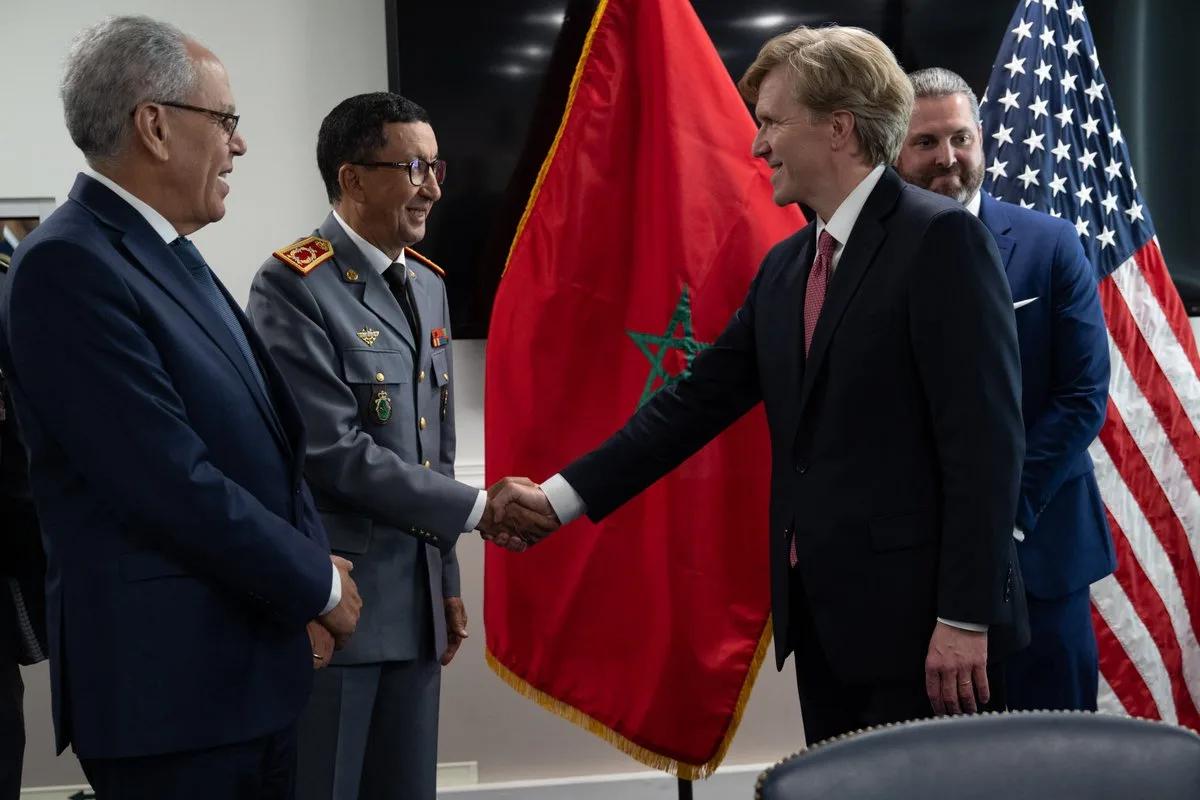
The legislative directive follows the formal signing of the 2026-2036 roadmap in Washington on April 15. A high-level Moroccan delegation, led by Delegate Minister for National Defense Abdellatif Loudiyi and Inspector General of the Royal Armed Forces (FAR) Lieutenant General Mohamed Berrid, visited the Pentagon from April 14 to 16 for the 14th session of the bilateral Defense Consultative Committee.
They were received by US Secretary of Defense Pete Hegseth. Morocco’s Ambassador to Washington, Youssef Amrani, and US Ambassador to Rabat, Duke Buchan III, were also present. Under Secretary of Defense Elbridge Colby co-signed the roadmap.
Section 1268 lays out several concrete elements the Pentagon must address. These include options for establishing cooperative security locations on Moroccan soil to promote regional stability and joint crisis readiness.
The bill uses the term “cooperative security locations” rather than bases, and does not explicitly call for the establishment of permanent US military installations. The plan must also contain a roadmap for deepening counterterrorism cooperation to address threats to the US homeland, Morocco, and the broader region.
On joint readiness, the bill asks the Pentagon to assess the feasibility of a cost-sharing arrangement to refurbish strategic air command runways formerly operated by the United States in Morocco. It also calls for advancing Moroccan force modernization through the procurement of American defense articles and the establishment of an all-domain range complex.
A separate element directs the creation of a drone center of excellence in Morocco for joint all-domain operations. The bill describes this center as a model for technology-driven defense partnerships.
The provision further calls for expanding the scope and scale of bilateral and multilateral exercises, specifically naming African Lion. It directs the Pentagon to ensure that such exercises incorporate cybersecurity, drone and counter-drone operations, undersea technologies, hybrid warfare, critical infrastructure protection, logistics, and the countering of adversarial artificial intelligence and autonomous systems.
The reference to African Lion is timely. The 2026 edition of the exercise, AFRICOM’s largest annual joint drill, concluded on May 8 after running for nearly three weeks across Morocco, Ghana, Senegal, and Tunisia. It brought together over 5,600 military personnel from more than 40 countries and included more than 30 US-based defense industry partners testing emerging technologies in live conditions.
Speaking via remote address at the closing ceremony in Agadir, Hegseth said “there is no better partner than Morocco” to host the exercise. He described Morocco’s commitment to the drills, now in their 22nd year, as “exceptional and sustained.”
Hegseth also noted that Morocco was the first country to formally recognize the United States in 1777. “As we prepare to mark the 250th anniversary of our independence, we also recognize that this unique friendship will celebrate its own 250th anniversary in the coming months,” he said. The ceremony also saw the awarding of the US Legion of Merit to Gen. Berrid.
Morocco has held Major Non-NATO Ally status since 2004 and sits at the western edge of North Africa, controlling the southern shore of the Strait of Gibraltar. As Western influence has receded across the Sahel following a series of military coups, Washington increasingly views Rabat as its most reliable security anchor on the continent.
The United States currently supplies approximately 60% of Morocco’s arms imports, according to the Stockholm International Peace Research Institute (SIPRI). Morocco ranked 28th globally in arms imports between 2021 and 2025.
If enacted, Section 1268 would codify the bilateral defense roadmap signed in April into American law, anchoring the partnership across future administrations and budget cycles. The NDAA is expected to receive a presidential signature by December.
Read also: Morocco-US Relations: A Strategic Partnership Forged by Vision and Continuity