
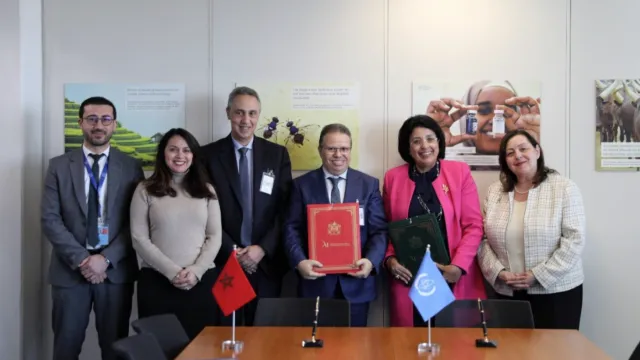
Agadir – Morocco’s Mohammed VI Foundation of Health Sciences (FM6SS) and the International Atomic Energy Agency (IAEA) have signed a new Practical Arrangement aimed at expanding cooperation in cancer care, radiation medicine, medical training, and scientific research.
The agreement, signed in Vienna on June 24, strengthens an existing partnership between the two institutions and establishes a framework for broader collaboration that could benefit not only Morocco but also countries across Africa.
According to the IAEA, the arrangement combines the agency’s technical expertise in nuclear applications for health with FM6SS’s growing network of healthcare facilities, universities, and research centers.
“This partnership with the IAEA aligns with our institutional mandate to expand medical education and research capabilities,” said Professor Youns Bjijou, Deputy Director of the Mohammed VI Foundation of Health Sciences.
“By combining our clinical infrastructure with the support of technical expertise from IAEA, we aim to accelerate innovation and enhance the regional capacity in radiation medicine, particularly in low- and middle-income countries,” he added.
The agreement comes as African countries continue to face significant challenges in cancer care, including shortages of trained specialists, limited access to treatment, and gaps in medical infrastructure.
Under the new arrangement, the IAEA and FM6SS will cooperate on training programs, research initiatives, quality management, and the development of educational materials.
The Moroccan foundation will also host fellowships and internships at its facilities and contribute to the IAEA’s Rays of Hope initiative, which seeks to improve cancer care capacities in low- and middle-income countries.
“We are very pleased with this partnership with the Mohammed VI Foundation for Sciences and Health,” said Najat Mokhtar, IAEA Deputy Director General and Head of the Department of Nuclear Sciences and Applications.
“The role of FM6SS is central to advancing cancer care in the region, and we look forward to collaborating with the foundation to strengthen medical training, quality management, research, and innovation,” she stated.
A key focus of the partnership is addressing the shortage of professionals in nuclear medicine, radiotherapy, diagnostic imaging, and medical physics across Africa.
“This arrangement reflects our commitment to enhance access to care and to support the patients,” said May Abdel-Wahab, Director of the IAEA Division of Human Health.
“Training the next generation of medical physicists, nuclear medicine specialists and radiation oncologists in Africa is not just a technical priority, it is a health equity priority,” she noted.
The signing ceremony concluded with a visit by FM6SS representatives to IAEA laboratories, where they explored technologies and research programs supporting the use of nuclear science in medicine.