
 Join on WhatsApp
 Join on Telegram
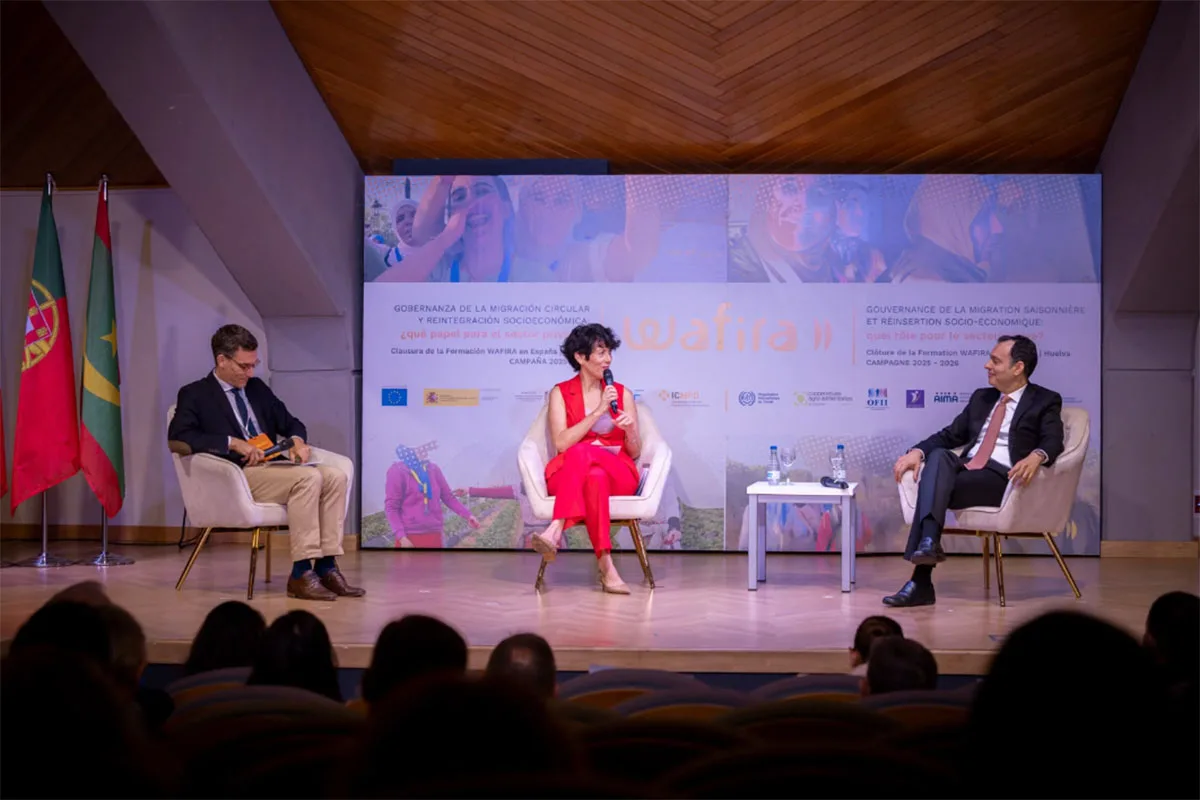
Marrakech – Morocco and Spain convened in Huelva on Thursday for a joint forum on migration governance, with both governments framing their 25-year circular migration partnership as a working model for the Euro-Mediterranean region.
Moroccan Minister of Economic Inclusion, Small Enterprise, Employment and Skills, Younes Sekkouri, presented Morocco’s migration policy at the event, describing it as rooted in solidarity, shared responsibility, and respect for human dignity.
The approach, implemented under the directives of King Mohammed VI, places human capital at the center of public policy and treats labor mobility as a driver of economic growth and skills transfer, Sekkouri noted.
“The excellent cooperation between our countries confirms that circular migration can be a true engine of shared development when it is based on close coordination between institutions, businesses, and social actors,” Sekkouri told the forum.
Spanish Minister of Inclusion, Social Security, and Migrations Elma Saiz called the Morocco-Spain migration cooperation “a particularly valuable reference.” She pointed to institutional and public-private collaboration as key formulas behind the model’s durability.
The bilateral framework rests on several structural instruments, including a 2001 bilateral agreement, memoranda signed in 2009 and 2023, and a 2025 declaration of intent. Permanent mechanisms such as the Joint Permanent Group on Migration and the High Joint Commission underpin the partnership’s operational continuity.
Record numbers in 2025
Spain’s Collective Management of Hiring at Origin program, known as GECCO, posted record figures in 2025. A total of 25,767 workers from 17 countries were employed across 21 Spanish provinces – a 25% increase over the previous year.
Morocco accounted for 81% of all GECCO hires, with a predominantly female workforce. The Huelva region concentrated the bulk of activity, driven by demand in the berry agriculture sector.
“The GECCO system demonstrates that it is possible to build stable, effective, and mutually beneficial mobility mechanisms for workers, employers, and the territories involved,” Saiz told attendees.

The forum also served as the closing ceremony for the Spanish training phase of WAFIRA II, held at the Ibero-American Forum of La Rábida. Both ministers presented diplomas to the first cohort of 225 Moroccan seasonal workers who completed an integrated training program during the 2025-2026 agricultural campaign.
The training combined personal skills development, entrepreneurial competencies, basic financial literacy, and intercultural mediation, following the International Labour Organization (ILO)’s GET Ahead methodology. Participants also drafted individual business plans.
“With WAFIRA II, we commit to providing greater support to women workers throughout their entire migration process – before departure, during their stay, and upon return – to transform a professional experience into a sustainable opportunity for economic empowerment,” Sekkouri stated.
WAFIRA II, the second phase of an international circular migration project backed by Spain, France, Morocco, and the European Union, aims to support 3,000 Moroccan seasonal workers across Europe over the 2025-2028 period. The program includes an entrepreneurial accelerator targeting 300 direct beneficiaries in income-generating activities.
The initiative’s second phase expands its geographic scope to six countries: Morocco, Spain, France, Portugal, Mauritania, and Cape Verde.
Cooperativas Agro-alimentarias de Huelva coordinated the training logistics on the ground, managing classrooms, schedules, transport, materials, and follow-up activities in direct partnership with local agricultural cooperatives.
The closing event included a technical visit to an agricultural operation in Huelva province, allowing institutional representatives from both governments, the EU, the ILO, and Morocco’s ANAPEC employment agency to observe the cooperative and productive context in which WAFIRA II’s Spanish phase unfolded.
Representatives from the International Centre for Migration Policy Development (ICMPD) also attended, alongside the project’s teaching and intercultural mediation teams.