
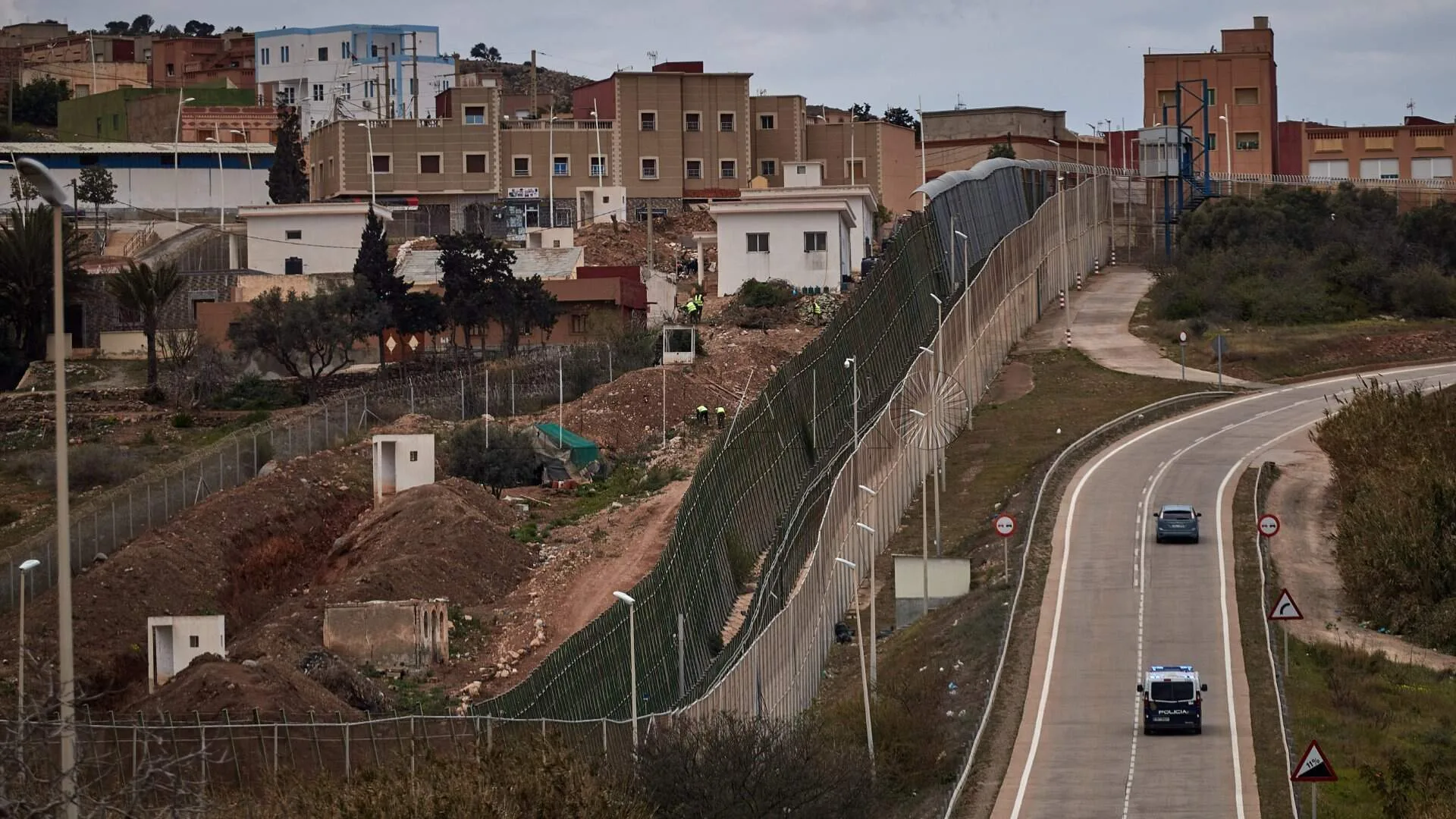
Marrakech – The removal of the Gibraltar border fence has reignited debate over Spain’s frontier with Morocco at Melilla. Local political and civic groups in the Spanish enclave are now calling for the dismantling of the physical barrier separating the territory from its Moroccan surroundings, drawing direct inspiration from the Gibraltar model.
The Nueva Melilla party and the city’s Muslim Community issued separate statements this week urging authorities to replicate the approach applied in Gibraltar. Both groups argued that the fence dividing Melilla from the Moroccan city of Nador should give way to a framework built on cooperation and shared development.
Their calls came hours after Spain and Gibraltar celebrated the fall of what Spanish Prime Minister Pedro Sánchez described as “the last wall in continental Europe.” The border fence, in place since 1908, was physically dismantled early Wednesday after a post-Brexit treaty between the UK, Spain, Gibraltar, and the EU took effect at midnight.
The deal, signed Tuesday in Brussels, eliminates border controls and customs checks on the land frontier. It brings Gibraltar into the EU’s Schengen free-movement area and grants Spain responsibility for Schengen controls at the territory’s airport and port.
The territory, home to roughly 40,000 residents, depends on some 15,500 Spanish cross-border workers who commute daily. Crowds crossed freely between Spain’s La Línea de la Concepción and Gibraltar shortly after midnight.
Gibraltar Chief Minister Fabian Picardo declared that “the frontier that has so often divided and constrained our region will now become a place of cooperation and shared opportunity.” He added that the agreement was reached “without surrendering who we are, without compromising our British sovereignty.”
That development resonated directly in Melilla. Nueva Melilla expressed its desire to one day witness “the tearing down of the fence that separates Melilla from its immediate surroundings.” The party envisioned a joint appearance by the president of Melilla and the mayor of Nador to announce common projects, shared investments, and a new phase of institutional cooperation.
The formation maintained that pursuing deeper collaboration with Morocco does not require surrendering sovereignty or political positions. It framed the issue as one of geographic permanence, noting that Melilla and Nador will remain neighbors and must build relations grounded in mutual respect.
Nueva Melilla pointed to the enclave’s potential as a logistic, commercial, university, and cultural platform between Europe and North Africa. It also noted the economic transformation underway in Nador, driven by infrastructure investments and the Nador West Med port complex.
Both cities, the party argued, could serve as complementary development engines under a stable cooperation framework.
The Muslim Community, meanwhile, drew attention to daily difficulties at the Melilla and Ceuta border crossings. Long waits routinely affect workers, students, and business owners, generating economic and human costs that limit development on both sides.
The group noted that existing Spain-Morocco cooperation on counterterrorism, irregular migration, and trade demonstrates a political climate favorable to new border management models.
Among its proposals, the community called for a joint working group of Spanish, Moroccan, and EU specialists to study more efficient frontier alternatives. It also suggested concentrating controls at maritime and air access points, supported by advanced technology and police cooperation.
Any new arrangement, the group maintained, should preserve security competencies without questioning the legal or political status of Melilla or Ceuta.
“The borders of tomorrow should not be measured solely by their capacity to control, but also by their capacity to generate prosperity, trust, and coexistence,” the community declared.
Gibraltar was ceded to Britain under the 1713 Treaty of Utrecht. Its land border was completely shut in 1969 under dictator Francisco Franco and did not reopen until 1982. More than 96% of Gibraltar residents voted to remain in the EU during the 2016 Brexit referendum.