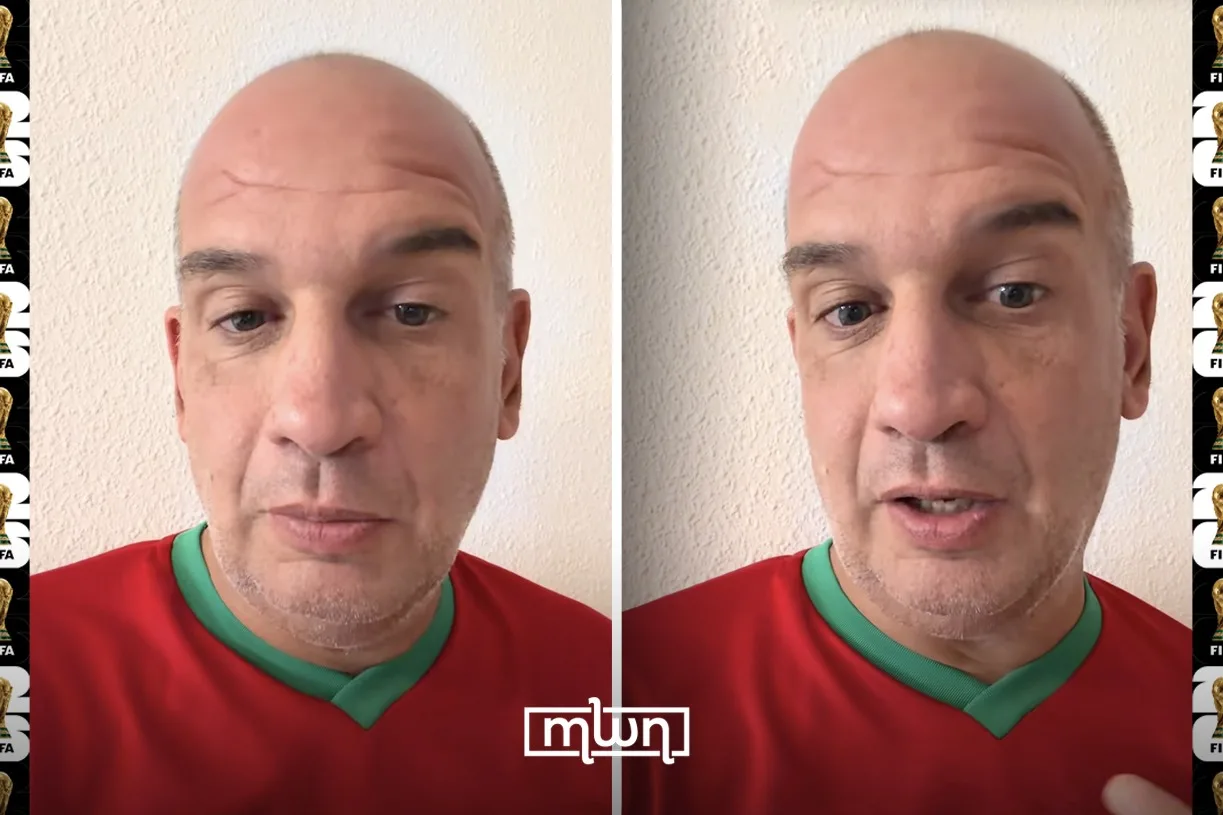
Marrakech – The leader of a Melilla-based political party has publicly challenged what he described as entrenched anti-Moroccan sentiment in the Spanish enclave, arguing that supporting Morocco’s national football team does not diminish anyone’s Spanish identity.
Isaac Fernández Atencia, the spokesperson of Nueva Melilla, made the remarks after Morocco’s 3-0 victory over Canada secured the Atlas Lions a place in the World Cup quarterfinals. Wearing a Moroccan national team jersey, Fernández Atencia offered his congratulations to the Moroccan squad and rejected the notion that such a gesture conflicts with Spanish patriotism.
Fernández Atencia defied the nativist orthodoxy in Melilla, where hostility toward Morocco has long served as an informal marker of national allegiance. “I am Spanish, I am from Melilla, and I am Andalusian,” he declared. “By wearing the jersey of a country I have a sentimental bond with, I am not less Spanish, nor do I stop defending Melilla and its Spanishness.”
View this post on Instagram
He pointed to what he called lingering “complexes” within Melilla’s society, where displays of support for Morocco often trigger backlash – a reaction he attributed to deep-seated prejudice rather than genuine patriotic concern.
The unease around Moroccan identity in Melilla was not born overnight. It reflects a broader undercurrent in Spanish collective memory, shaped by nearly eight centuries of Moorish rule over the Iberian Peninsula.
The fall of Granada in 1492 ended Muslim governance in Al-Andalus, but the trauma and residue of that prolonged coexistence – and the perceived threat of a Moorish return – left a lasting imprint on Spanish political and cultural consciousness.
That historical anxiety continues to surface in modern political discourse, particularly within far-right circles that frame Moroccan immigration as a civilizational threat.
Even the Spanish language preserves the sentiment. The idiom “No hay moros en la costa” – literally “there are no Moors on the coast” – originated during the Middle Ages, when coastal villages in Spain faced frequent raids from Morocco.
Watchmen would shout the phrase to indicate safety and signal that the horizon was empty and danger had passed. Today, Spaniards use it to mean everything is fine and there is nothing to worry about – though the ethnic roots of the expression remain intact.
Fernández Atencia addressed the far right directly. “Now the Vox people and Melilla’s extreme right can go see a psychologist,” he stated. “You can call me whatever you want. This is also what it means to be Spanish and to be from Melilla.”
He argued that fans across Spain routinely wear the jerseys of Argentina, Italy, or England without controversy. The same standard, he contended, should apply to Morocco – given the geographic proximity, familial ties, and social bonds that connect a significant portion of Melilla’s population to its neighbor.
“You can wear the Argentine jersey, you can wear the Italian jersey,” Fernández Atencia noted, “but I can’t wear the Moroccan jersey – a country right next to me, one I love and care about?”
The spokesperson, whose party currently holds no parliamentary seats, reiterated that Nueva Melilla does not adopt adversarial positions toward any country. “We are not anti-anything,” he affirmed. “And I am certainly not anti-Moroccan, because to be Spanish you do not have to be anti-Moroccan.”
He had already defended the legitimacy of Melilla businesses and residents openly supporting Morocco earlier in the tournament. At the time, he confirmed his primary allegiance to the Spanish national team but added that when Spain is not competing, he backs Morocco as “a close nation” with which he maintains personal and emotional ties.
Fernández Atencia closed with a line that captured the duality of his position. “May Spain win the World Cup,” he declared. “And if Spain doesn’t win – Dima Maghreb.”