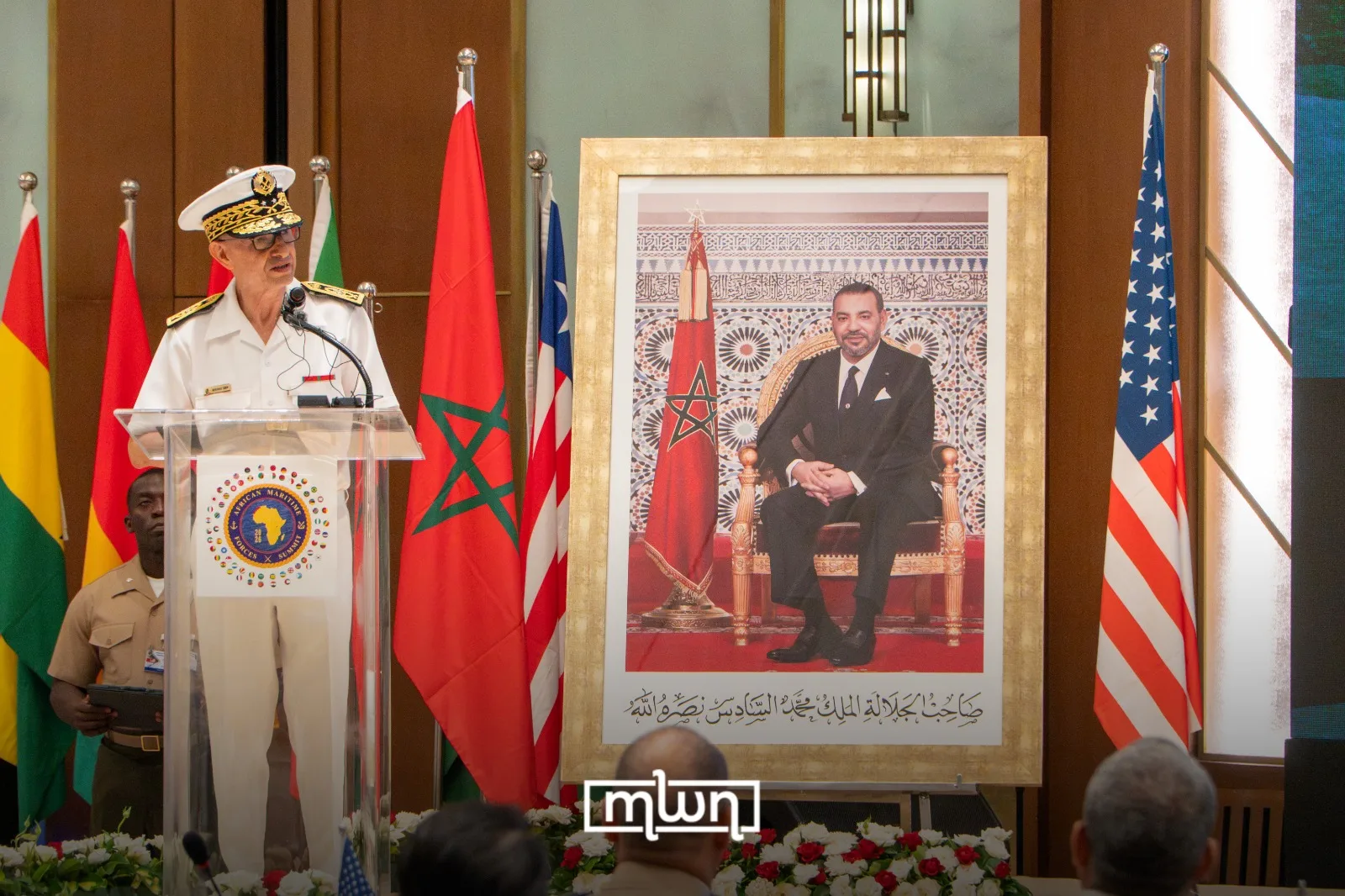
Marrakech – Rabat hosted the opening of the fourth annual Africa Maritime Forces Summit on Tuesday, where American and Moroccan officials laid out a shared approach to securing the continent’s waters. The United States framed its role in plain terms. “We plan to work with Africa, not for Africa,” Ben Ziff, Chargé d’Affaires at the US Embassy in Rabat, told the gathering.
The summit, known as AMFS 2026, runs July 20-24 in the Moroccan capital. It is co-hosted by the Royal Moroccan Armed Forces, US Naval Forces Europe and Africa, and US Marine Corps Forces Europe and Africa.
Organizers convened leaders from more than 40 African nations and nearly 20 partner nations under the theme “Innovation and Partnership to Strengthen Maritime Security.”
View this post on Instagram
Ziff cast the meeting as a turning point for regional cooperation. He called it “a pivotal moment for fostering collaboration, enhancing capacity building, and addressing the growing challenges facing African waterways.”
African partners are “capable, willing, and able to take on the security challenges that we all face today,” he said. The threats, he argued, do not respect borders. “No country can do this alone,” Ziff continued. “Our threats to Africa are regional and transnational, and our response must be regional and transnational.”
Morocco opened the summit under the authority of the throne. Rear Admiral Mohamed Tahin, Inspector of the Royal Moroccan Navy, noted that the event proceeds “under the high instructions of His Majesty King Mohammed VI, Supreme Commander and Chief of General Staff of the Royal Armed Forces.”
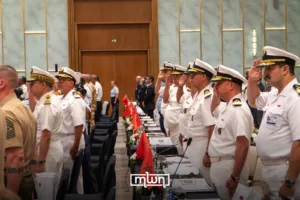
He described the gathering as a reflection of “Morocco’s steadfast commitment to promoting African cooperation, strengthening regional stability and fostering collective efforts in support of maritime peace and security.”
Tahin welcomed naval chiefs, senior military leaders, and maritime experts from African and partner nations. He pointed to a long agenda of shared threats, among them maritime domain awareness, illegal, unreported, and unregulated fishing, trafficking, terrorism, irregular migration, and protection of the marine environment.
For the Royal Moroccan Navy, he added, maritime security is “a shared responsibility and a strategic priority” that depends on “sustained dialogue, mutual trust, coordinated action and effective partnership among all stakeholders.”
African-led solutions
The American co-hosts returned repeatedly to the idea of African-led solutions. Major General Daniel L. Shipley, commander of US Marine Corps Forces Europe and Africa, said that the stakes reach well beyond the military.
“Maritime security affects legal commerce, food security, regional stability, and the daily lives of communities that depend on the safe and secure African waterways,” he remarked. The dangers, in his telling, span piracy, illegal fishing, trafficking, smuggling, terrorism, and transnational crime.
Shipley placed African states at the center of any durable response. “African nations understand these challenges directly and are best positioned to shape solutions that endure,” he continued.
He framed the American contribution as support rather than substitution, describing a mission to “build capable professional partners” who can secure their own approaches and act when threats cross borders.
Trust has to be built in advance, he argued, stressing, “You cannot surge trust in crisis. You build it over time through training, education, exercises, key leader engagements, and sustained presence.”
In an announcement before the opening, Admiral George M. Wikoff, commander of US Naval Forces Europe and Africa, described the forum as a chance for African leaders and partners to “exchange perspectives, strengthen professional relationships and identify practical approaches to shared maritime challenges.”
Shipley, in the same announcement, reduced the aim to a phrase. “AMFS is about turning dialogue into action,” he noted, casting the meeting as a way to help African leaders “build capacity and strengthen the partnerships needed to counter shared threats.”
A 250-year partnership
The Rabat meeting builds on the previous edition, held last year in Mauritius. Its choice of venue carries weight for Washington. According to organizers, the event recognizes the nearly 250-year relationship between Morocco and the United States.
Shipley returned to that history, calling the bilateral tie “one of our oldest” and casting this year’s summit as another instance of it “continuing through practical cooperation and shared commitment to regional security.”
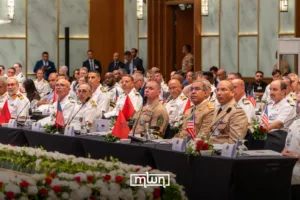
That history opened at sea. Morocco was the first country to recognize American independence, and it did so through its ports. In December 1777, Sultan Mohammed III opened Moroccan harbors to American ships while the Revolutionary War was still underway. The recognition, in other words, was a maritime act, and the waters have been part of the relationship ever since.
That thread reappeared during the anniversary itself. On July 4, the Royal Moroccan Navy frigate RMNS Mohammed VI sailed the Hudson River alongside more than 35 warships from 15 nations in International Naval Review 250, part of the celebrations marking 250 years of American independence.
The Moroccan vessel and the Senegalese patrol ship Niani were the only two African warships in the multinational formation. US Naval Forces Europe-Africa cited the crossing as a demonstration of the Royal Moroccan Navy’s capacity for long-range projection and endurance in distant theaters.
The summit also follows a run of defense agreements. On July 13, Morocco’s Royal Armed Forces (FAR) and US Africa Command (AFRICOM) signed a memorandum of understanding to establish the Africa Multidomain Training and Experimentation Center (AMTEC) in Tan-Tan by 2030.
The facility is planned around three components, a multidomain training area, a drone academy, and an innovation and experimentation center. It is meant to position the kingdom as a regional hub for training and defense technology serving African partners.
Days earlier, on July 8, the two governments held in Washington a counterterrorism dialogue co-chaired by US Acting Principal Deputy Coordinator for Counterterrorism Monica Jacobsen and Ismail Chekkori, Director of Global Affairs Issues at Morocco’s Ministry of Foreign Affairs.
Both sides agreed to build on efforts to defeat groups including AQIM and ISIS, and to coordinate on terrorism designations, terrorism financing, and stemming terrorist violence in the Sahel.
A reworked program
This year’s program adds new features. Organizers introduced interactive breakout sessions built around a real-world scenario, a coordinated illegal, unreported, and unregulated fishing incident that evolves across each session.
Participants are not wargaming in teams, according to the program, but working through their own response postures as the threat shifts.
The summit also hosts the Africa Senior Enlisted Leaders (SEL) Conference, a dedicated track meant to develop a professional enlisted corps across African navies. It brings senior non-commissioned officers from partner nations together to share experience and, in the organizers’ words, “promote mutual professionalization.”
Sessions are grouped by language, with interpretation in Arabic, English, French, Portuguese, and Spanish. Each is organized around one of three themes: policy innovation at the national level, cooperation with neighbors and partners, and technological innovation in maritime security.
Navies as ‘instruments of statecraft’
To frame the plenary discussions, organizers circulated a set of scene-setter papers, a mix of original articles written for the summit and condensed versions of published scholarship. Two of them lay out the intellectual terrain the delegates are meant to work through.
The first, by José Guerreiro, treats the sea as a development question rather than a defense one. Africa’s maritime future, he argues, will be determined not only by the ability to secure its waters but to “govern them strategically” as part of a broader economic transformation.
He points to the blue economy, from fisheries and shipping to offshore energy, tourism, and port infrastructure, as evidence that maritime spaces have become “productive economic spaces” rather than zones of sovereignty alone.
In his account, the obstacle is fragmentation. Governance is split across ministries and agencies that “operate independently from one another,” a division integrated maritime policy is meant to replace with a single strategy.
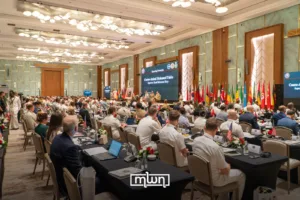
The second paper, by Michelle Nel and Mark Blaine, supplies the summit’s guiding idea. Navies, they write, are not only “instruments of warfare”; they are also “instruments of statecraft” suited to operate across the range between cooperation and deterrence.
Maritime diplomacy, in their reading, has become “a strategic necessity rather than a political option,” since piracy, trafficking, and illegal fishing “cannot be effectively addressed by individual states acting alone.”
They tie the argument to the African Union’s 2050 Africa’s Integrated Maritime Strategy and to regional mechanisms such as the Gulf of Guinea’s Yaoundé Architecture and the SADC mission in Mozambique.
Their paper also carries a caveat that cuts against the week’s optimism. Diplomacy “unsupported by operational capacity,” they warn, “risks becoming symbolic rather than strategic.” It is a reminder that the partnerships on display in Rabat still rest on the naval capability each state can bring to them.