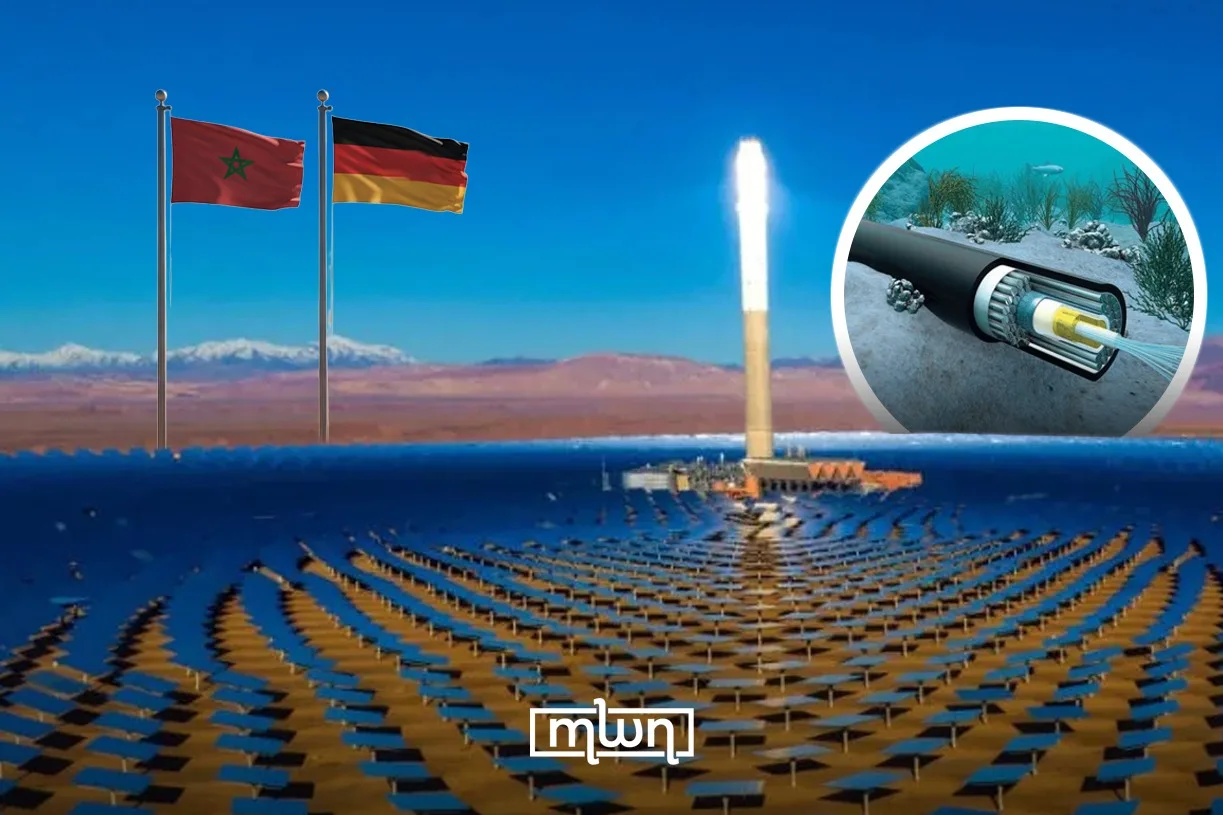
Marrakech – A $30 billion plan to carry Moroccan renewable electricity to Germany through what would be the world’s longest intercontinental undersea power link has stalled over disagreements about the project’s structure and the guarantees behind it, four sources familiar with the talks told Reuters.
The venture, known as Sila Atlantik, would connect the two countries through two high-voltage subsea cables capable of delivering up to 5% of Germany’s annual electricity demand.
The cables would run about 4,800 kilometers and draw on as much as 15 gigawatts of solar and wind capacity installed in Morocco, with total infrastructure costs reaching roughly $30 billion, according to the developers.
Political and technical divergences
The sticking points are political as much as technical. The chief roadblock is Moroccan authorities’ insistence on an intergovernmental agreement formally endorsed by Berlin to secure long-term state backing, two Moroccan and two German sources told Reuters.
Rabat also wants the link to carry electricity in both directions rather than as an export-only line, a shift that raises the price. “Technically, it is feasible, but economically it would be more costly,” one German source noted of a two-way connection.
Land allocation remains unresolved. Moroccan authorities had promised around 150,000 hectares in the southern Guelmim-Oued Noun region to Xlinks, the collapsed £25 billion Morocco-UK project, but have not approved the same for Sila Atlantik, a senior regional official told Reuters.
Sila Atlantik, the German company created for the project, declined to answer specific questions but described itself as “progressing in line with its technical, commercial, regulatory and financial roadmap.”
The company continues to weigh “the technical and regulatory options that will best support its long-term development.” Morocco’s Energy Ministry did not respond, though it wrote by email that “regional integration is a key pillar of Morocco’s energy transition strategy.”
The project emerged after Xlinks collapsed a year ago, and its German developers moved to build on an energy partnership between the two countries that dates to 2012.
In February, Economic State Secretary Frank Wetzel wrote to Moroccan Investment Minister Karim Zidane to welcome the initiative and note its “ambitions and potential.”
At the time, Roman Dudenhausen, a project initiator and managing director of Conenergy, pointed to “growing interest in Sila Atlantik” and described “very constructive negotiations with the Moroccan government.”
Developers plan to export up to 26 terawatt hours a year, enough to replace the output of three large thermal plants. The cable would run along the coasts of Portugal, France, Belgium, and the Netherlands before reaching Germany, and Deutsche Bahn has emerged as a potential major customer.
Morocco spreads its bets across Europe
Morocco is not confining its ambitions to Germany. It already runs the only electricity interconnection between Africa and Europe, through Spain, a link that proved critical when Madrid faced a major power outage last year.
A second Spanish connection of 700 megawatts is planned, a Morocco-Portugal line under study could cost up to €735 million ($838 million), and a French connection is also in preparation.
That French link came up last week during the 15th High-Level Meeting in Rabat, where Prime Minister Sébastien Lecornu touched on the cross-Mediterranean interconnection and announced the launch of an expression of interest.
The Portuguese track has also gained fresh momentum. On Monday, Morocco’s Minister of Energy Transition, Leïla Benali, and Portugal’s Minister of Environment and Energy, Maria da Graça Carvalho, agreed in Lisbon to revive their interconnection, stalled since 2022, and to pursue EU financing alongside private investors.
Carvalho, who called the link important “for Europe and also for Africa,” is pressing Brussels to recognize it as a project of European interest and to unlock funding reserved for strategic infrastructure.
The push follows the April 2025 blackout that exposed the Iberian Peninsula’s weak ties to the wider European grid, and Rabat and Lisbon intend to submit the cable to the European Union’s T-MED programme, which aims to mobilize as much as €25 billion for cross-border renewable-energy infrastructure.
Read also: Morocco to Launch Massive 4,800km Power Cable to Supply Germany with Saharan Energy