
 Join on WhatsApp
 Join on Telegram
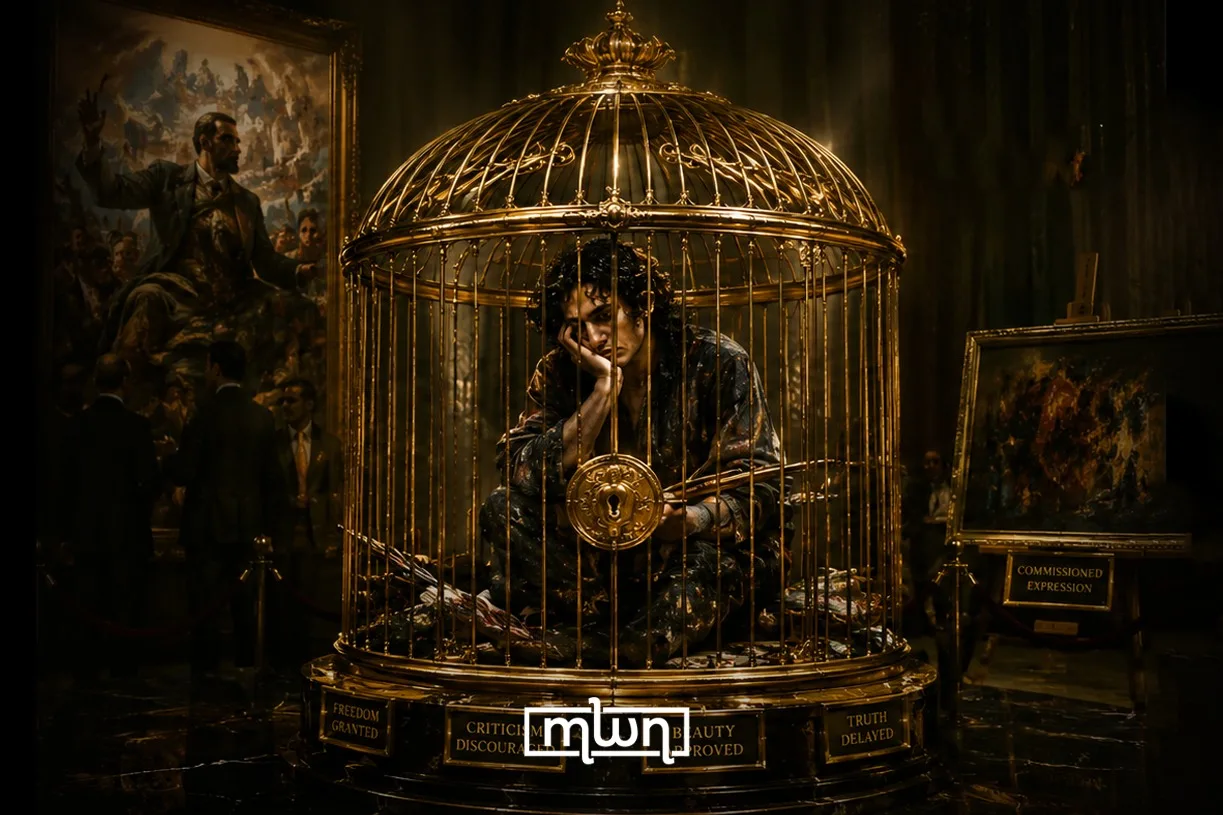
Luxury prisoners do exist in all social groups. One may watch them walking in downtown capital cities, in the most remote corners of the countryside, and on the zigzagging paths connecting rural to urban centers. They are infesting the political, economic, social, artistic, and academic arenas. They are there, barely aware of their loud disarray and crumpled desolation, no matter how difficult they may try to laboriously turn the dark side of their daily routine into white.
This portrait sounds probably unfair and wrong. Maybe yes, maybe no. It stems from a heated debate among friends amid a unique moment of despairing lucidity. Everyone, deliberately or inadvertently, succumbs to the categorization dilemma no matter how right or wrong they might be. A compass that derails from constant makeshift switching. This kind of behavior drives them toward collecting business cards, pins, and fancy gadgets to show off.
The luxury prisoners live at the mercy of shifting colors that adorn their daily lives and the illuminations that get into their understanding to shake their dormant consciences. The ordeal begins early in the morning when they stand in front of their mirrors to adjust the collars of their shirts, properly tie their ties, and brush their hair. Naturally, I spare women from the term “Russian “roulette,” a description that would undoubtedly lack relevance, elegance, and gentlemanly behavior.
The ordeal continues through a frantic race to get to work, be on time for appointments, and meet commitments. These are the people who have a job and receive a salary at the end of each month. This description does not spare people who do not work. Colors have no real significance in their views. They see the black color everywhere, unless they belong to the category of those who live off their families or are dependent on their wives.
Avatar, icon, and smoke
The most ill-fated luxury prisoners are those who bring about people’s gossip. Artists, writers, businessmen (and women), and political actors. They hover in an orbit that brings about unjustified jealousy. Often due to their fault. They laboriously manage the distance that separates and brings them closer to the public.
Politicians top the list of luxury prisoners. Forget the narrative about the duty and need to participate in building the nation’s glory! The move can certainly be a significant motivation. However, when they enter the political arena, these actors express that they only show ambition to achieve a status on the social mobility scale.
In this regard, three groups of politicians can be mentioned. The first category involves professional politicians. They enter politics and refrain from leaving the stage no matter what. Politics is meant as their most valuable shot and their reason for being. They neither believe in the circulation of elites nor in the virtues of alternation of power.
The second group involves politicians who get on the political chessboard as a result of a request made imperative for the purpose of political division of labor among elites. Politics is not their favorite flavor. However, to their credit, they agree to leave the political chessboard upon accomplishing the mission entrusted to them.
The third group involves outsiders who embrace politics on a whim and for the sake of having fun. Politicians belonging to this group are the most versatile and the most dangerous for the political cohesion of the parties to which they have been attached. Because they start thinking they are to be irreplaceable and indispensable and that without them the system cannot withstand socio-political troubles, they easily fall into denial or even megalomania.
Curiously, the three groups of politicians endure an ordeal that grants them the status of prisoners of excellence. People take them as some sort of business cards, even if they fade away or leave the political stage willingly or by force. Society calls on them, solicits them, and challenges them to resume their lives as normally as possible. Some of them agree to play along with such a hilarious game. In doing so, they add to their ordeal, as luxury prisoners, the curse of living miserably.
A few retired friends are gathering unexpectedly on the occasion of the 2026 World Cup. Everyone enjoys analyzing the performance of the Moroccan national team. Some commend an overall honorable performance, except for the match against France. The others seize this opportunity to revisit the conspiracy theory they apply at every turn.
A friend keeps silent for a moment. He is known for his balanced views. He comments, “When you can’t fund dreams…” Then, he stops sharp. When urged to make his view crystal clear, he stresses, “Since the beginning of our unexpected meeting, we have only been wandering like rebellious gypsies, unable to agree on anything whatsoever. Our image might be described as being an avatar at best and a bleeding icon at worst. Not so long ago, we were, unbeknownst to us, business cards. We still are, except for the fact that our cards are shredded. We are aware of that, but people don’t want to believe it or give us a break.”
“Solicited, if not harassed, by relatives and friends, we thought the sun only rose to flirt with our teeth, that it only set to caress our heads and wish us good night.” Look at us now! Even the ultraviolet rays can’t spare us from piercing the walls of our dilettantism.
Our colleague sums it all up. Curiously, the bitterness transforms into an unexpected relief. It is the fate of all the elderly who converge toward the same destination: bitter solitude in a surreal setting of the end of time. Luxury prisoners for whom only the pension helps nurture the hope of living in the dignity they deserve. The merit of quietly walking toward their destiny, which Jacques Brel masterfully conveyed in his favorite song “Les Vieux,” The Old, released in 1963.
Brel chants without trying to promote the illusion: “The old people don’t talk anymore/ Or only sometimes with the corner of their eyes/” Even rich, they are poor/ They no longer have illusions and have only one heart for two. At their place, it smells of thyme, cleanliness, lavender, and the old-fashioned verb (…). Is it from laughing too much that their voices crack when they talk about yesterday (…)? And if they tremble a little, is it from seeing the silver clock age/that purrs in the living room, that says yes, that says no, that says I am waiting for you (…)?”
People who love to self-flagellate are fond of the songs of Nass El Guiwane, Jil Jilala, Lamchaheb, etc., which describe the bitterness, misery, and helplessness of the 1960s-1990s. This era also witnesses a massive return to myths and false values that drain illusions.
Fans of Nass El Guiwane sometimes share an iconic song, السيف البتار (1980), drawn from the repertoire of protest, Sufi, and often unflavored songs: “A rich man passed away, oh my dears; folks of all walks of life followed him—some read at his head, some held the rosary by his side — the poor man passed away, oh my dears; no one convoyed him where he belonged —A Quran reciter recited at his head, his head was too loaded for what he read — here you go, advise him, my brother in Allah.’’
A scream that cracks like Brel would have described. Or a wake-up call that resonates like Bob Dylan’s meditation (1970) in “The Man in Me”: “The man in me will hide sometimes to keep from bein’ seen / But that’s because he doesn’t want to turn into some machine.”
Henceforth, a surreal situation is created. Other groups of luxury prisoners might be listed: on one hand, artists and music lovers who identify with an image that extracts them from the reality they can’t get rid of or reject. On the other hand, an audience that envies the status of the first group of prisoners and ends up framed.
No sarcasm, a snare, and a delusion
In 1994, a respected Moroccan personality visits an Asian country. He is renowned for his talent as a discreet and good-mannered mediator. His interlocutors introduced him as being part of the inner circle at the top of the decision-making system. He steps in immediately to dismiss such a false claim. He emphasizes that he does his job just like the other high-ranking colleagues and that he does not enjoy any special privilege or treatment.
During this visit, the Moroccan personality makes commitments and honors them in the weeks that follow. When he is asked to explain why he is offended that he is introduced at his true worth, he replies: “Always meditate on the story of the hen that laid golden eggs, the goose that laid golden eggs, and the woman and the hen!” Otherwise, I suggest you read Homer, unless you have done so. You see, the mermaid—” No one in the audience understands the point at the time. Yet, the link is obvious and reminiscent of a snare and a delusion.
Another group of luxury prisoners can be listed: the activists of the latest trend. It applies to people who, following an incident or a professional issue that they can’t handle, become the ultimate protesters.
These makeshift activists step up because they are victims of an aberration or a professional injustice. Instead of dealing with the person or the structure to which they belong to defend their rights, accordingly, they choose the public space and target institutions, politicians, and all people who might disagree with them.
The luxury prisoners can be those gamophobes who barricade themselves behind a boastful freedom. They don’t care that society labels them as “confirmed bachelors,” “unmarried girls,” or worse, “spinsters.” They don’t care that people finger-point them for not having descendants to perpetuate their legacies. The truth is that they experience unbearable sequences of life where the emptiness suffocates them to the point they, sometimes, prefer to vanish.
Nevertheless, gamophobes are less dangerous than fraudulent fiancés. These are the people who choose to chase after recognition through marital relationships. I remember the story of that luxury fiancé who takes advantage of the most naive and desperate brides.
His stroke of genius is mind-blowing: he proposes to a potential victim, behaves in the pure tradition of the Puritans, and waits for the right moment to rob her and run away. The poor bride is smeared and blamed for being unwise and even stupid. Hypocrisy takes over the stage, and nobody acknowledges their share of responsibility and guilt about what happens.
Luxury prisoners can also be those people who hang copies of their diplomas on the walls of their living rooms next to photos taken with celebrities. Being proud of one’s achievements is a legitimate right; however, diplomas and photos displayed in an inappropriate location reflect inappropriate behavior on the part of these individuals.
As a matter of fact, every image is flayed if it is scrutinized with narcissism. This can apply to people who are framed in social media and trapped in the show-off ritual. They post everything they do daily to the point of forgetting to behave themselves for the sake of being respected.
Long-distance marriage can be a form of luxury prison. Two examples can be mentioned. The first one is that of a writer relatively well-known in his country. He is thrown out of the family home by his younger wife. He is driven out of a house he co-owns because his wife realizes she has never been the muse she thinks she is. He lives in a nursing home.
The second example is that of a mixed couple belonging to distant geographical areas. What could be more normal? This situation happens all the time. However, over time it appears for partners that adapting without losing something in the process isn’t worth it. The sacrifice they can make might be a futile luxury. At the first opportunity, imprints of their childhood and youth take over their memories. The victims may be children who pay the highest price of the failure of their parents once the romance is gone.
The most evident example in this regard is the luxury of religious conversion. It is, with a few exceptions, just a facelift imposed by emotion and high expectations that has nothing to do with faith. Once the emotion is no longer funded, the illusion takes residence. Some converts find no promises of paradise anywhere.
A muse, an alibi to survive
The fate of child artists who become prisoners of luxury is even worse. This is a story that attracts people’s attention for its cinematic side of the spectrum. Child artists filed lawsuits against their own parents. The latter are accused of exploiting them and are on the front page. These artists are deprived of living their childhood as normally as possible.
As a matter of fact, the debate is about image. The image serves an agenda that goes beyond the search for prestige or a highly sought social rank. It draws attention to the issue of power and domination. The image? The luxury prison that scratches walls of illusion to falsely make them look like a reality. It plunges luxurious prisoners into suspense instead of providing them with a tangible answer.
An anecdote to conclude. It relates to a friend who lost his father. The loss hit him deeply. A few years ago, he had convinced his father to sign a general power of attorney to allow him to temporarily manage the family’s business. His father was very old and was constantly pressured by his son to give him more powers.
However, while the people around the table showed compassion, our friend lit a cigarette and said, with a surprising tone, “Things didn’t go as I planned.” My only consolation is that, thanks to my connections at the Wilaya, I managed to secure a grave in the Martyrs’ Cemetery for my father. He may rest along with the dignitaries of the city and laugh at them, now that they share the same void and bitterness.
Faced with our incredulity, he took a puff of his cigarette and pouted. His behavior reminded us of Meursault, the main character in Albert Camus’ novel “The Stranger,” published in 1942. A neighbor of the family later told us that our friend was deeply hurt because his father had revoked the general power of attorney a week before he died. He would have suspected his son of plotting to seize all his assets by making him sign dubious debt acknowledgments.
Indeed, dreams and illusions, images and sketches, can be a matter of money and assets. When the sources dry up, the value of objects and the aura of people fall under the verdict of Léo Ferré (1971): “With time going, everything goes away/ You forget the face, and you forget the voice/ The heart, when it no longer beats/ It’s not worth going/ You have to let it go, and it’s alright (…). With time goes, everything goes away/ And one feels bleached like an exhausted horse/ And you feel frozen in a bed of hazard/ And you feel all alone maybe, but at peace/ And you feel cheated by the lost years/ So really/ With time, you no longer love.’’
Luxury prisoners? Indeed, they do exist. They try hard to break free. They can’t help it. They then share a room with stress. In front of others, they display a fake serenity as if to take a futile revenge against their powerlessness, their wandering in deceptive luxury, or even against the erosion of a dignity that slips through their fingers from toasting with emptiness.
The luxury prisoners… They live to the rhythm of the embers that turn them into slices of barbecue. They live in solitude even though they hear sounds all around. So, they would better hum along with Willie Nelson: “Heaven is closed and hell’s overcrowded/ So I think I’ll just stay where I am/ So many people, well, it sure is lonely/ Who even gives a damn? / I hear someone calling: “Come in from craziness” / But there ain’t nobody around.’’
The void! This fresh breath of air puts what is thought of as prime truth into perspective. It sends the lavish and shallow people to take a sunbath under the parasol of dreams and illusions.