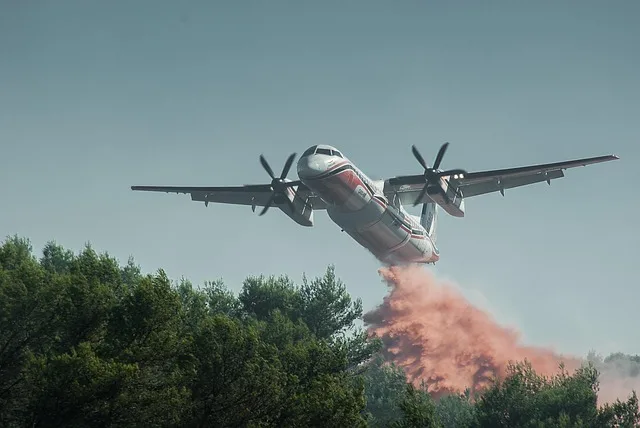
Agadir – The Royal Armed Forces (FAR) have intensified its plan to combat forest fires, mobilizing a wide range of aerial resources, including Canadair CL-415 firefighting aircraft, Turbo Thrush planes, and EC225 Super Puma helicopters.
The Royal Air Force (FRA) operates a fleet of eight Canadair CL-415 aircraft, while the Royal Gendarmerie contributes 15 Turbo Thrush aircraft and two EC225 Super Puma firefighting helicopters to support aerial intervention efforts.
These capabilities form part of a broader national coordination mechanism involving several institutions, including FAR specialized units, the Royal Gendarmerie, Auxiliary Forces, Civil Protection, local authorities, the National Center for Forest Climate Risk Management, the National Agency for Water and Forests (ANEF), and the General Directorate of Meteorology.
A Four-level response system
Based at the 3rd Air Base in Kenitra, the Canadair fleet represents a central component of Morocco’s aerial firefighting operations, which are organized according to a four-level intervention system.
At the first level, ground teams are deployed to contain and control fires. When fires reach a higher level of intensity, aerial resources, particularly Canadair water bombers, are mobilized. The third level involves the deployment of Royal Gendarmerie aviation units, while the fourth level allows Morocco to seek international assistance when necessary to protect lives, property, and forest ecosystems.
The unit’s mission is to ensure rapid intervention and coordinate with different stakeholders at both central and local levels whenever a fire breaks out.
The Canadair Aircraft use is designed specifically for forest fire intervention, allowing it to collect water directly from seas, dams, and lakes without returning to an airport.
The water-scooping operation takes around 12 seconds, enabling the aircraft to collect more than 6,000 liters of water before heading directly toward the fire zone.
The aircraft’s technical capabilities allow it to operate in challenging environments, including mountainous areas and forests that are difficult to access through traditional firefighting methods.
Outside the fire season, aircraft undergo extensive inspections and overhauls covering key systems, including engines, landing gear, water tanks, avionics equipment, and electrical networks.