
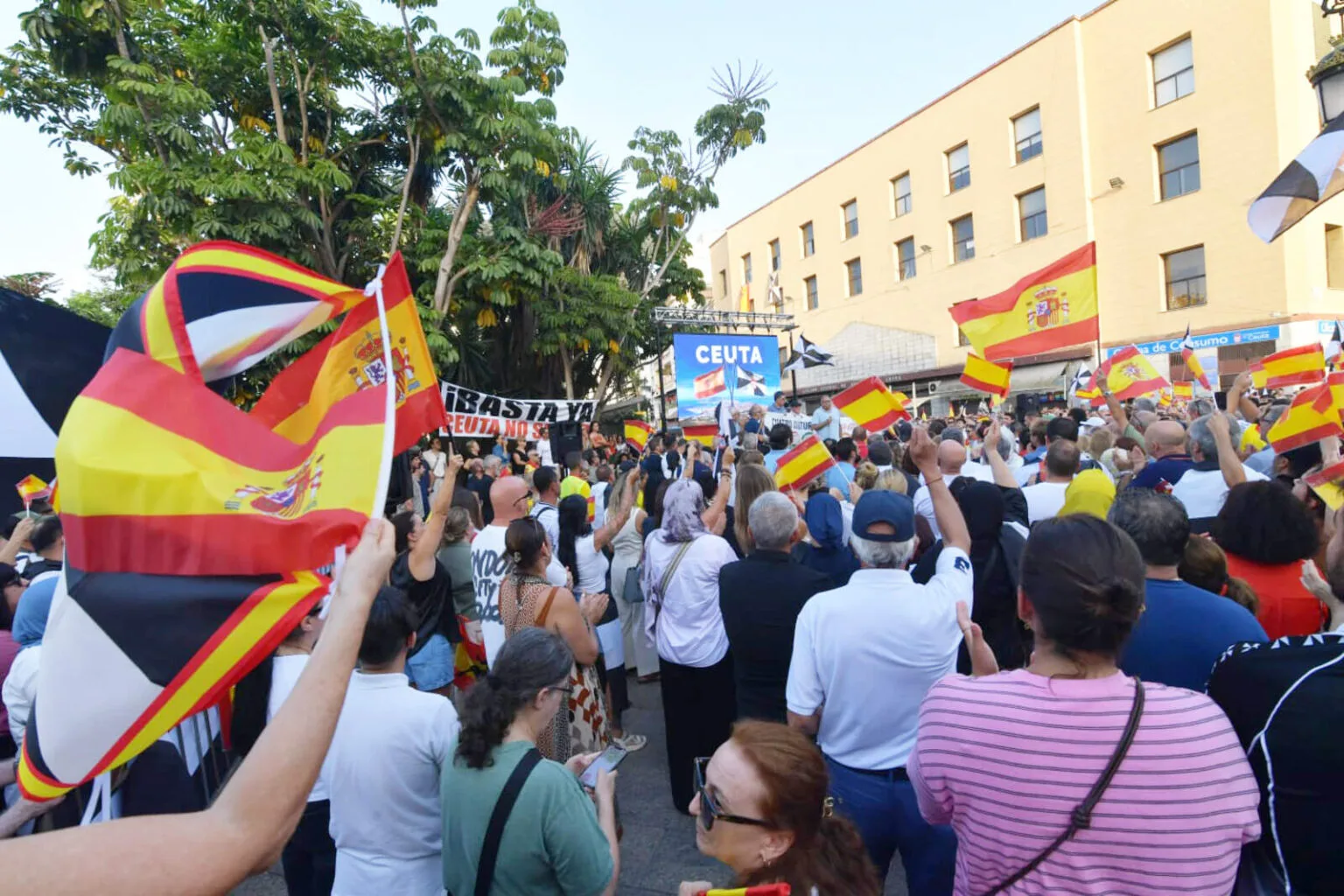
Rabat – Thousands of people gathered in Ceuta on Sunday to protest the mass arrival of migrants from Morocco last month, calling for stronger border security and greater support from the Spanish government.
The demonstration, held in Ceuta’s Plaza de la Constitución, brought together residents from different cultural and religious communities, El Faro De Ceuta reported. Organizers said the protest aimed to express concern about the impact of the migration surge on the city and to demand an urgent response from Madrid. Local authorities estimated that between 10,000 and 12,000 people attended.
The gathering came less than two weeks after tens of thousands of migrants entered Ceuta from Morocco in one of the largest migration surges the Spanish territory has experienced.
Mass crossing overwhelms Ceuta
The crisis began in late July, when large groups of migrants crossed from Morocco into Ceuta, with many attempting to reach the territory by swimming around the Tarajal breakwater. Others crossed by land.
Spanish authorities initially estimated that around 50,000 people had entered Ceuta, while Ceuta’s regional president Juan Jesús Vivas put the figure at about 60,000. Moroccan authorities later estimated that around 40,000 people had entered the territory. By August 3, Spain said about 69,500 migrants had returned to Morocco. Spanish reports estimate the crossings at over 80,000.
The sudden influx overwhelmed reception facilities in the city, which has a population of around 84,000. Many migrants, including unaccompanied minors, were left without adequate accommodation as authorities struggled to manage the arrivals.
In addition, many of the migrants who entered Ceuta were subjected to attacks and left without adequate access to food or water for several days.
The crossing also had a high human cost. Spain reported 72 deaths on its side of the border, while Morocco reported 14 deaths on the Moroccan side, bringing the officially reported toll from the two sides to at least 83 at that stage.
The death toll has varied as authorities continued to recover bodies and identify victims. El Faro de Ceuta referred to 82 deaths.
Some migrants drowned while trying to cross by sea, while others died amid the large crowds attempting to pass the breakwater, according to Spanish reports.
Residents demand stronger security
During Sunday’s protest, demonstrators called for more police and civil guards, stronger intelligence measures and changes to the infrastructure around the Tarajal breakwater. They also demanded greater support for public services and called for reforms concerning the return of Moroccan minors who remain in Ceuta.
At the end of the demonstration, many participants moved to the headquarters of Spain’s Government Delegation, where they called for the resignation of the government’s representative in Ceuta.
The protest also featured calls for greater security and for Ceuta to receive the same protection and resources as other parts of Spain.
The organizers said the city remained far from normal after the mass crossing, with public services under pressure and concerns remaining over security, migration and social cohesion.
The crisis has also had wider consequences. Spain increased security measures across its territory, while France and Italy announced tighter controls on travelers arriving from Spain amid concerns over the unprecedented influx.
Read also: Ceuta: A Crisis of Loss, Discrepancy, and Accountability
Spanish Prime Minister Pedro Sánchez described the mass crossing as a violation of Spain’s territorial integrity and blamed human-smuggling networks for encouraging migrants to attempt the journey.
Spanish authorities also linked the surge to a July 8 Supreme Court ruling that limited the immediate return of migrants who reached Ceuta and Melilla by sea. Sánchez said traffickers had spread a misleading interpretation of the ruling through social media, encouraging people to believe they could enter Ceuta and remain there.
Morocco rejected suggestions that it had relaxed its border controls or deliberately allowed the mass crossing.
Morocco’s Ministry of the Interior also cited the impact of the court ruling, explaining that trafficking networks had quickly exploited the ruling and that Morocco had maintained its security deployment along the northern coast.
Morocco also said the crisis occurred despite continued border controls and stressed its long-standing cooperation with Spain on migration. Moroccan Ambassador to Spain Karima Benyaich said the events had unfolded against Morocco’s wishes and that Rabat had always supported legal, orderly, and safe migration.