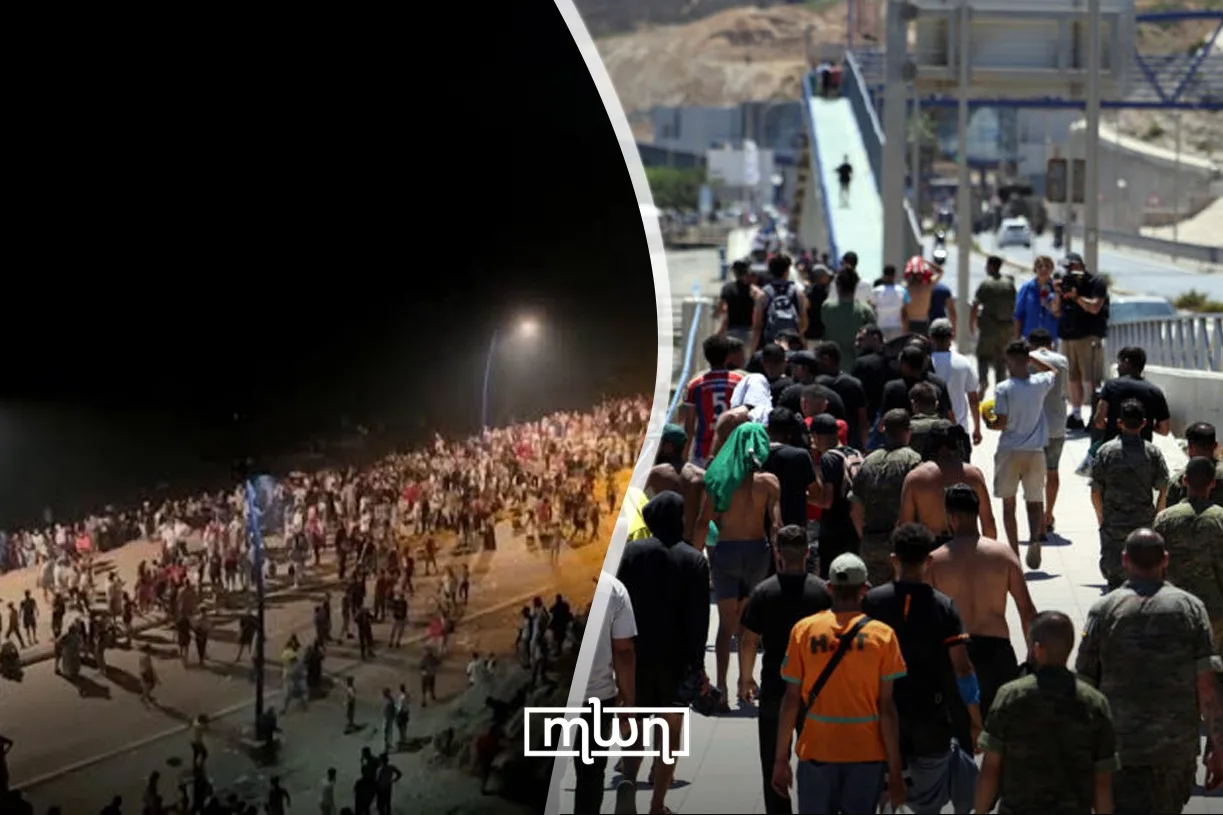
Days after the largest single crossing wave in the history of the Fnideq-Ceuta route, the questions have shifted. It is no longer only about why so many young Moroccans took to the water. It is about what happened once the swimming stopped: the count of the dead, the silence from Rabat, and a wave of disinformation that briefly turned a border crisis into a geopolitical conspiracy.
A death toll that depends on which side of the border you ask
In the aftermath of the mass migration attempt that made headlines worldwide, the border reasserted itself almost as quickly as it had been breached. Of the more than 50,000 people who crossed into Ceuta, most did not stay. Within days, thousands were making the same crossing in reverse. pushed back by Spanish army units, worn down by hostility from Ceutans as the enclave’s capacity buckled, or simply left with no shelter, food, or welcome.
A handful found family already living in Ceuta or a place in makeshift reception centers; for most, the crossing meant to be final turned out to be temporary, proof that a border, even breached by tens of thousands at once, does not stop being a border. It was in this crisscrossing of a frontier that never truly vanished that the human cost became clear. Staggering was how the authorities of the two bordering countries kept track of the numbers of the falling lives of this tragedy. Spanish authorities regularly provided figures as to the death toll, which steadily climbed through the crisis, from an initial count in the teens to over 70 and finally 100 victims confirmed dead. By contrast, Moroccan authorities have provided a different account, confirming 11 deaths on their side of the border while noting that efforts to recover and identify the bodies at sea remain ongoing. Moroccan officials have thus contested the higher figures reported elsewhere.
The difference in reported casualty numbers points to the challenge of establishing a unified count in the aftermath of such a complex event. No joint figures have been issued by the two sides. For families still searching for missing relatives, the absence of a single confirmed toll continues to leave uncertainty during an already difficult time.
Some reports suggest that some of the recovered bodies were in advanced stages of decomposition, suggesting that not all victims died during the most recent wave of crossings. The condition of the remains indicates that some individuals may have died during earlier attempts, potentially weeks before the latest surge, and were only discovered afterward. This further complicates efforts to establish an accurate timeline of the events and contributes to the difficulty authorities are facing in determining a precise death toll.
Silence where an accounting/accountability was expected
Perhaps more striking than the numbers is the absence of an official Moroccan response to match the resounding scale of the event. Days after the crisis, no Moroccan government body had issued a formal statement acknowledging the deaths, offered condolences to affected families, or explained what would change in how the border is managed. Figures from the opposition, including former head of the government and current PJD leader Abdelilah Benkirane, have publicly lashed out against the government’s silence, arguing that the lack of any visible acknowledgment has become a story of equal significance to the crisis itself.
The vacuum left by the government was soon followed by an incident Moroccans have considered to be a total disregard: reports that Morocco’s head of government Aziz Akhannouch left for a short private holiday in Mallorca shortly after attending Throne Day ceremonies, as the crisis was still unfolding and families in the north were searching for missing relatives. He returned within 48 hours amid mounting criticism, but has not to date offered a public explanation of the trip’s timing or addressed the crisis directly. Whatever one makes of a head of government’s right to a holiday, the timing was deafening: a private jet to a Spanish island while Moroccan bodies washed up on a Spanish beach a few hundred kilometers away was always going to be difficult to defend.
Allegations that go beyond neglect
Silence and bad timing are one set of criticisms. A more serious allegation emerged, though it remains difficult to verify. Some reports have suggested that security forces may not only have struggled to contain the crossings but, in certain instances, appeared to allow movement toward the border. Foreign reporting, including by the New York Times, cited testimonies from migrants who said police had directed or encouraged them toward the border rather than turning them back.
Morocco’s Interior Ministry has instead pointed to factors such as social media misinformation, trafficking networks, and confusion surrounding a recent Spanish Supreme Court ruling limiting summary returns as key drivers of the surge, rejecting suggestions of any official encouragement.
These two accounts are not easily reconciled, and neither has been independently and conclusively established. What can be said is that the allegation of encouragement, rather than mere failure to prevent, is now part of the public record and deserves a direct government response, not silence.
What the crisis was not: a manufactured plot
One more thread deserves to be addressed plainly, precisely because it spread so fast. Within 72 hours of the crossings, a theory began circulating on social media that the crisis had been orchestrated by Morocco on behalf of Israel and the United States, as retaliation against Spain’s vocal criticism of the war in Gaza. Different versions of the claim were reposted by public figures on both the far left and far right and, according to one monitoring group’s analysis, reached over 100 million views on a single platform within three days.
It is worth being direct about this: no evidence has surfaced to support it, and journalists who examined the claim, including at Al Jazeera and Euronews, found nothing beyond coincidence of timing and pre-existing political grievances. That does not mean Morocco’s strategic rivals have no interest in shaping the narrative around this crisis. That kind of interest is a permanent feature of regional politics. Yet, there is a real difference between noting that interest and endorsing a baseless plot theory. The Ceuta crisis has enough real, documented failures of governance and accountability without needing an invented one.
If we put the factually proven disinformation campaign aside, what remains is a simple, answerable set of questions: How many Moroccans actually died attempting this crossing? Why has that number not been reconciled with Spain’s count? And why, more than a week on, has no government official offered families a public accounting?
The views and opinions expressed in this article are those of the authors and do not necessarily reflect the official policy or position of Morocco World News.