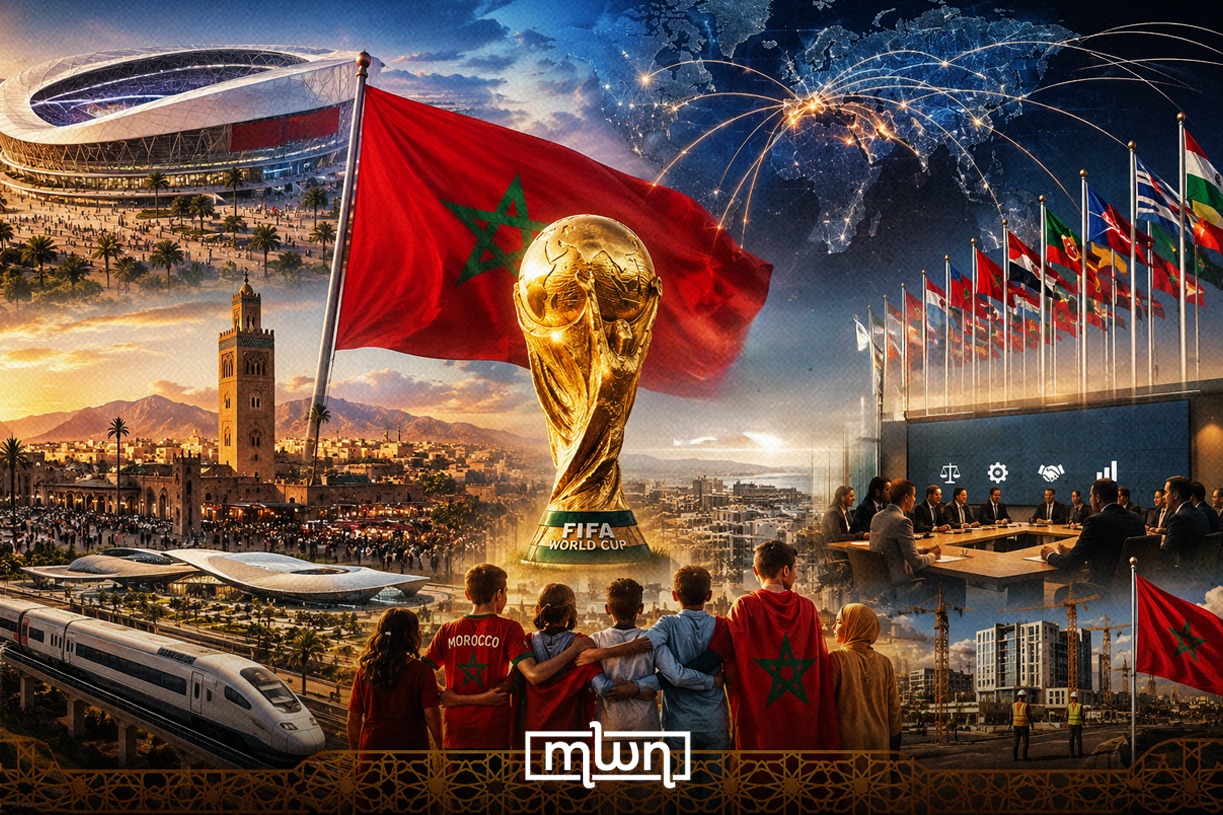
The 2030 FIFA World Cup represents far more for Morocco than a major sporting event. The designation of Morocco, Spain, and Portugal as hosts creates an exceptional opportunity for the Kingdom to accelerate infrastructure development, strengthen human capital, stimulate investment, improve territorial cohesion, and reinforce its international standing. The tournament should therefore be understood not simply as a sporting competition but as a potential catalyst for a new phase of Moroccan national development.
The expression “World Cup Government” is a political and analytical formulation rather than a constitutional category. It refers to the government that will assume responsibility for the decisive phase of Morocco’s preparations between 2026 and 2030. Morocco’s parliamentary elections are scheduled for September 23, 2026, but the future parliamentary configuration, coalition, and Head of Government cannot yet be known. The central argument is that Morocco’s success in 2030 should not be measured merely by the quality of its stadiums or the efficiency of tournament organization. The real test will be the legacy left after the final whistle: stronger infrastructure, productive employment, enhanced human capital, competitive Moroccan enterprises, better-integrated territories, sustainable water and energy policies, and greater public confidence. As the original working document emphasizes, the crucial question is whether the investments made for 2030 will remain useful to Morocco after the tournament.
From mega-event to national development project
FIFA’s hosting requirements extend well beyond stadiums. They encompass transport, accommodation, training facilities, security, telecommunications, public services, and governmental guarantees. Morocco must therefore modernize rapidly while ensuring that the infrastructure created for the tournament remains economically and socially useful afterward.
The principle of legacy should govern investment decisions. Transport infrastructure should improve everyday mobility; airports and railways should serve citizens and businesses; digital infrastructure should enhance productivity; and stadiums should have viable post-2030 uses. The working document rightly stresses that priority should be given to projects that reduce territorial inequalities, strengthen the productive economy, benefit Moroccan SMEs, and possess credible maintenance and operating models.
This approach is particularly important given the scale of Morocco’s current public investment. The World Bank reported strong economic growth in 2025, driven partly by public investment associated with the 2030 preparations, while emphasizing that significant labor underutilization remains a structural challenge.
Development must therefore be understood as multidimensional, involving politics, society, culture, institutions, and the economy . The World Cup should accelerate a transformation that Morocco already needs rather than become a justification for projects with uncertain long-term social returns.
Governance: The central challenge
The principal difficulty may ultimately be coordination rather than construction. A successful World Cup requires cooperation among the ministries responsible for the Interior, Finance, Transport, Tourism, Energy, Water, Health, Education, Justice, and Foreign Affairs, as well as local authorities, public enterprises, private companies, and the Royal Moroccan Football Federation (FRMF).
The working document identifies several risks: competition among ministries and agencies, overlapping responsibilities, excessive committees without clear accountability, opacity in public procurement, and excessive centralization.
The future government therefore needs a clear governance architecture based on four principles: defined responsibilities, transparent timetables, measurable performance indicators, and independent oversight. The essential question should always be: who decides, who implements, who monitors, and who reports?
This challenge also connects with Morocco’s broader trajectory of institutional reform. The Moroccan political system has evolved through gradual reform and incremental democratization. The World Cup could become a practical test of whether administrative effectiveness can coexist with transparency and accountability.
Host cities should therefore be genuine partners rather than merely implementing agencies. Regions, municipalities, universities, businesses, professional organizations, and civil society should all participate. Multilevel governance should become one of the defining principles of the Moroccan 2030 project.
Financing the World Cup and protecting the social contract
The financial challenge is equally significant. Morocco must finance necessary infrastructure while maintaining fiscal sustainability and continuing to address education, healthcare, purchasing power, and employment.
The fundamental question is therefore not simply how much Morocco will invest, but who will pay, who will benefit, and who will bear the costs after 2030. Public investment can stimulate economic growth, but its quality and long-term productivity are decisive. The future government should distinguish between projects required specifically for the tournament, infrastructure already justified by national needs, low-return investments, and temporary expenditures that could become permanent burdens.
Public procurement should be particularly transparent. Major contracts should have clear criteria, appropriate oversight, and measurable outcomes. At the same time, World Cup expenditure should strengthen Moroccan SMEs, helping them upgrade their technological and managerial capacities and integrate international value chains.
The issue is ultimately one of the social contract. Citizens must perceive 2030 not as a project primarily designed for foreign visitors and investors, but as an accelerator of improvements in their own lives.
Employment and human capital
Employment should be one of the principal indicators of the World Cup’s success. Construction, transport, tourism, hospitality, security, healthcare, engineering, logistics, digital services, cybersecurity, and event management will all generate opportunities. Yet many construction-related jobs will inevitably be temporary.
The objective should therefore be a national “Skills 2030” strategy, linking vocational training, universities, and businesses. Young Moroccans should be prepared for emerging occupations through training in languages, hospitality, digital technologies, cybersecurity, infrastructure maintenance, logistics, event management, emergency medicine, and international communications.
The original document rightly insists that the World Cup should not merely produce stadiums but lasting human capital. The most valuable legacy may ultimately be the skills acquired by a generation of Moroccan professionals.
This is especially important because Morocco’s challenge is not simply economic growth but the creation of sufficient productive employment. The World Bank has identified structural reforms, private investment, productivity, and job creation as essential to Morocco’s next development phase.
Water, climate, and sustainability
Water scarcity constitutes one of Morocco’s most serious structural challenges. A major international event will temporarily increase pressure on urban water systems through hotels, restaurants, stadiums, landscaping, sanitation, and increased populations.
The government should therefore make 2030 a laboratory for water efficiency and climate resilience. Wastewater reuse, desalination, reduction of distribution losses, efficient irrigation, and less water-intensive sporting facilities should form part of an integrated strategy.
The same principle applies to energy. Morocco’s investment in renewable energy and electricity storage provides an opportunity to associate the World Cup with the country’s broader transition toward a more resilient and sustainable energy system. The World Bank’s support for pumped-storage hydropower illustrates this strategic direction. The World Cup could consequently become a showcase for a climate-resilient Morocco, strengthening both domestic sustainability and the Kingdom’s international climate diplomacy.
Territorial cohesion and cultural inclusion
A major risk is that the benefits of 2030 will remain concentrated in the principal metropolitan areas. The tournament should instead contribute to reducing territorial disparities through improved transport, digital connectivity, tourism, education, healthcare, and business infrastructure.
This objective is closely connected with Morocco’s cultural diversity. The country’s Amazigh heritage, for example, should form part of a comprehensive national narrative rather than being treated merely as cultural decoration. The relationship between identity, territory, language, and solidarity is central to contemporary Moroccan cohesion.
The World Cup should also provide opportunities for youth participation, entrepreneurship, mobility, and civic engagement. National pride will have lasting value only when it is accompanied by genuine opportunities for social and economic advancement.
Political trust and public participation
The World Cup can strengthen national pride, but it cannot substitute for effective healthcare, education, employment, or social protection. The original document rightly warns that citizens could perceive the project as a policy conducted “from above” if major investments fail to produce tangible improvements in everyday life.
Transparency will therefore be indispensable. The future government should explain the costs and expected benefits of major projects, publish procurement criteria, prevent conflicts of interest, and establish mechanisms through which citizens and local stakeholders can evaluate progress.
The persistence of clientelistic and neo-tribal mechanisms in Moroccan political life also makes institutional trust particularly important. The World Cup should strengthen confidence in institutions rather than reinforce perceptions of privilege, exclusion, or political distance.
International projection and sports diplomacy
The 2030 World Cup offers Morocco an extraordinary opportunity for international projection and soft power. Hosting the tournament with Spain and Portugal places the Kingdom at the intersection of Africa, Europe, the Mediterranean, and the Arab world.
The event can promote Moroccan tourism, heritage, hospitality, infrastructure, and investment opportunities while reinforcing Morocco’s image as a bridge between Europe and Africa. Yet international visibility will also bring heightened scrutiny concerning workers’ rights, accessibility, security, media access, non-discrimination, cybersecurity, and transparency.
This reflects a broader challenge in Moroccan international policy: balancing sovereignty and national interests with international responsibilities. Morocco’s experience in migration governance illustrates this balancing act between sovereignty, security, and human rights. The same principle should guide the World Cup.
Making 2030 a national legacy
The future “World Cup Government” will ultimately be judged not simply by whether Morocco stages an efficient and memorable tournament, but by what remains after the final whistle.
The true legacy should consist of better infrastructure, stronger Moroccan enterprises, productive employment, enhanced human capital, greater territorial integration, sustainable water and energy policies, more effective institutions, and renewed public confidence.
The September 2026 elections will determine the political configuration responsible for this decisive phase. Whatever coalition emerges, the government will face a compressed timetable and an exceptionally demanding agenda.
Its central task will be to reconcile international ambition with social justice, modernization with inclusion, administrative efficiency with transparency, and economic growth with sustainability.
The World Cup must therefore not become an end in itself. It should be an accelerator of Morocco’s broader transformation. Its ultimate value will not be measured by the grandeur of stadiums or ceremonies, but by the quality of the Moroccan state, economy, society, and territory that remain when the tournament is over.
The decisive question is consequently not simply whether Morocco will be able to welcome the world in 2030, but what kind of Morocco will welcome the world—and what kind of Morocco will remain after the world has departed.