
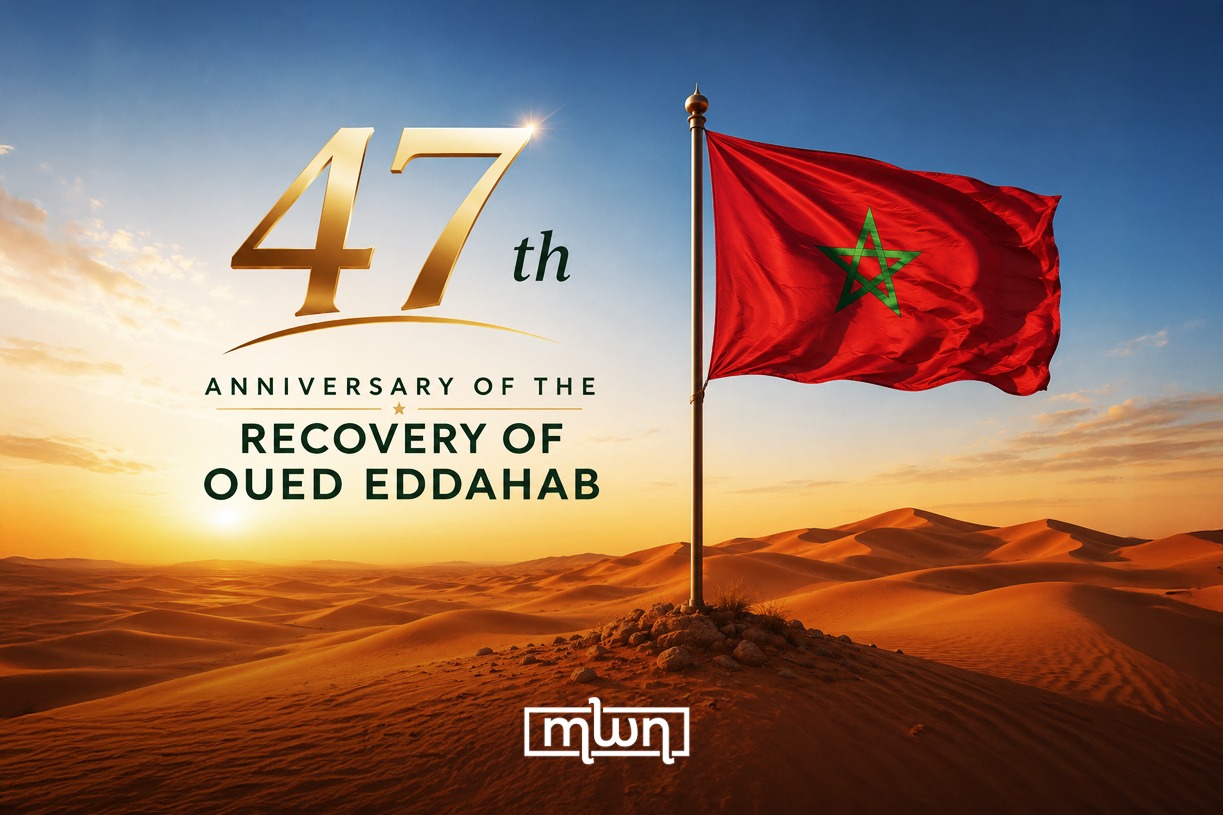
Rabat – Morocco marks today the 47th anniversary of the recovery of Oued Ed-Dahab, a date commemorating the return of the southern region to Moroccan rule in 1979.
The Anniversary of the Recovery of Oued Ed-Dahab commemorates August 14, 1979, when Morocco recovered the southern part of Western Sahara following Mauritania’s withdrawal from the territory.
The occasion is observed annually as part of Morocco’s national commemorations and is closely linked to the country’s efforts to consolidate its territorial integrity.
From Spanish rule to the recovery of Oued Ed-Dahab
Western Sahara remained under Spanish colonial rule until 1975. Following Spain’s withdrawal, Morocco and Mauritania reached an agreement with Madrid on the administration of the territory, with Morocco administering its northern part and Mauritania the southern area, including Oued Ed-Dahab and Dakhla.
The separatist Polisario Front opposed Morocco’s presence in the territory and launched an armed campaign, leading to years of conflict in the region.
Mauritania later withdrew from the conflict. On August 5, 1979, it signed the Algiers Agreement with the Polisario Front and renounced its claims to the southern part of Western Sahara. Morocco subsequently recovered Oued Ed-Dahab.
On August 14, 1979, representatives and tribal leaders from Oued Ed-Dahab traveled to Rabat, where they pledged allegiance to the late King Hassan II. The ceremony reaffirmed their allegiance to the Alaouite Throne and their identification with Morocco.
In his address to the delegation, Hassan II welcomed them back to what he described as their homeland and pledged to safeguard the region’s security while supporting its development. In Morocco, the ceremony has since been commemorated as a defining moment in the recovery of Oued Ed-Dahab and the consolidation of the North African country’s territorial integrity.
A milestone in Morocco’s territorial integrity
For Morocco, the recovery of Oued Ed-Dahab marked an important step in the country’s efforts to complete its territorial integrity following the end of Spanish colonial rule.
The anniversary is observed as part of Morocco’s national commemorations and reflects the country’s longstanding position that Western Sahara is an integral part of its national territory. The date is also linked to the broader regional conflict surrounding the Sahara, which has remained unresolved since the 1970s.
Morocco has since advanced its Autonomy Plan as the most realistic and viable political solution to the regional dispute. Under the proposal, the Sahara would remain under Moroccan sovereignty while enjoying broad self-government.
The anniversary comes as Morocco’s position on the Western Sahara conflict has gained growing international support. More than 130 countries now support Morocco’s Autonomy Plan as a serious, credible, and realistic basis for a political solution under Moroccan sovereignty.
The momentum has been particularly visible among major international powers. The US and France have expressed strong support for Morocco’s Autonomy Plan, while Spain and the UK have also backed the initiative as the most realistic and credible basis for resolving the Sahara issue.
Recent diplomatic developments have also weakened support for the Polisario Front’s self-styled Sahrawi Arab Democratic Republic (SADR). In April, Mali withdrew its recognition of the entity and endorsed Morocco’s Autonomy Plan as the only serious and credible basis for a settlement, following the steps of several other countries.
Honduras followed later that month by suspending its recognition of the self-styled SADR, with Colombia being the latest country to do so. Earlier this month, the Latin American country said there will be “no political or diplomatic contacts, exchange of missions, or support for the SADR in multilateral forums, including the United Nations and the Security Council, where Colombia currently serves as a non-permanent member.”
These developments have added to growing international momentum behind Morocco’s position on the Sahara and its Autonomy Plan, first presented in 2007.
A growing investment hub
Nearly five decades after the recovery, Oued Ed-Dahab has undergone major economic and infrastructure development. Dakhla, the region’s main city, has become a growing center for tourism, fisheries, agriculture, and renewable energy. The city is also known internationally for water sports, particularly kitesurfing.
Morocco is also developing major infrastructure projects in the region as part of its broader development strategy for the southern provinces.
One of the most significant projects is the Dakhla Atlantic Port, which is intended to strengthen trade and transport links between Morocco and African markets.
The government has also promoted investment in agriculture, fisheries, tourism, and green energy across the region.
The region has attracted growing interest from foreign investors and business leaders. In July, a US congressional delegation visited Dakhla to explore investment opportunities and learn about major projects in renewable energy, agriculture, tourism, and fisheries. The delegation also visited the construction site of the Dakhla Atlantic Port.
A US delegation had also visited Dakhla in February to discuss potential cooperation and investment, particularly in healthcare and tourism. In December 2025, a business delegation from Spain’s Canary Islands traveled to Dakhla to explore investment and trade opportunities in the fisheries and other sectors.
French economic and institutional interest has also increased. In 2025, a Morocco-France Economic Forum brought more than 300 business leaders to Dakhla, while the French Development Agency announced plans for €150 million in investments in Morocco’s southern provinces.