
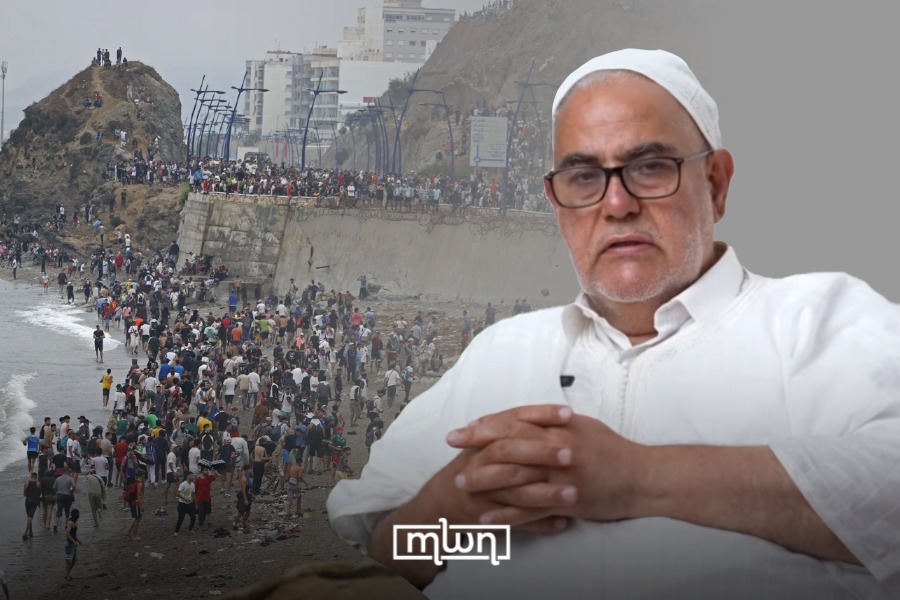
Rabat – Former head of government and Secretary-General of the Justice and Development Party (PJD) Abdelilah Benkirane has called for answers over the circumstances behind the recent mass movement of Moroccans toward Ceuta, while using the episode to renew his criticism of the government.
In a video posted on PJD’s official YouTube channel, Benkirane questioned how such a large movement could have taken place on the same day as Throne Day, when Morocco was celebrating King Mohammed VI’s annual address.
“We must know what happened,” Benkirane said, asking who had organized the movement and whether those behind it were from inside or outside the country.
He said he had raised the matter with King Mohammed VI and stressed that doing so was a matter of respect for the monarchy as an institution.
“Until now, there has been no answer, and we are waiting,” he said.
Benkirane also turned to what he described as a striking willingness among some Moroccans, particularly young people, to leave the country.
He acknowledged that poverty and limited prospects are often cited as reasons for irregular migration but argued that these conditions are not new.
“This has always existed in Morocco,” he said, while pointing to Europe’s stronger level of economic and material development as part of the attraction.
Benkirane blames government for youth frustration
The PJD leader placed much of the responsibility for the frustration among young Moroccans on the government, pointing to what he said was a growing perception of corruption in essential sectors such as education and healthcare.
He also referred to allegations of interference in public-sector recruitment competitions, saying such perceptions can further erode young people’s confidence in their prospects at home.
Benkirane also questioned whether government initiatives designed to support young people and entrepreneurs have delivered the promised results.
He singled out the Forsa program, arguing that some participants failed to achieve the success they had expected. He further claimed that some beneficiaries now face legal difficulties and could even risk imprisonment.
His remarks reflect a broader political criticism of government programs that seek to address unemployment and economic vulnerability but, according to Benkirane, have not always translated into tangible improvements in the lives of their intended beneficiaries.
Attack on Akhannouch’s political record
Benkirane then shifted his criticism directly toward Head of Government Aziz Akhannouch, whom he accused of a political failure to address several of the country’s longstanding challenges.
He argued that Akhannouch had fallen short of resolving key problems and criticized what he described as a weak connection between the government and citizens.
For Benkirane, the issue goes beyond individual government policies. He presented the migration episode as a symptom of a deeper frustration among parts of Moroccan society, particularly young people who see limited opportunities at home while Europe remains a powerful symbol of greater economic security and prosperity.
Benkirane ended his intervention with a political appeal ahead of Morocco’s next legislative elections, urging voters to reject both the RNI and the Authenticity and Modernity Party (PAM).